Stress and success

Stress and SuccessI met Jonathan Brown at the last Boyd Conference in Quantico, back in October, and we spent quite a lot of time discussing the role of stress in Boyd’s framework.

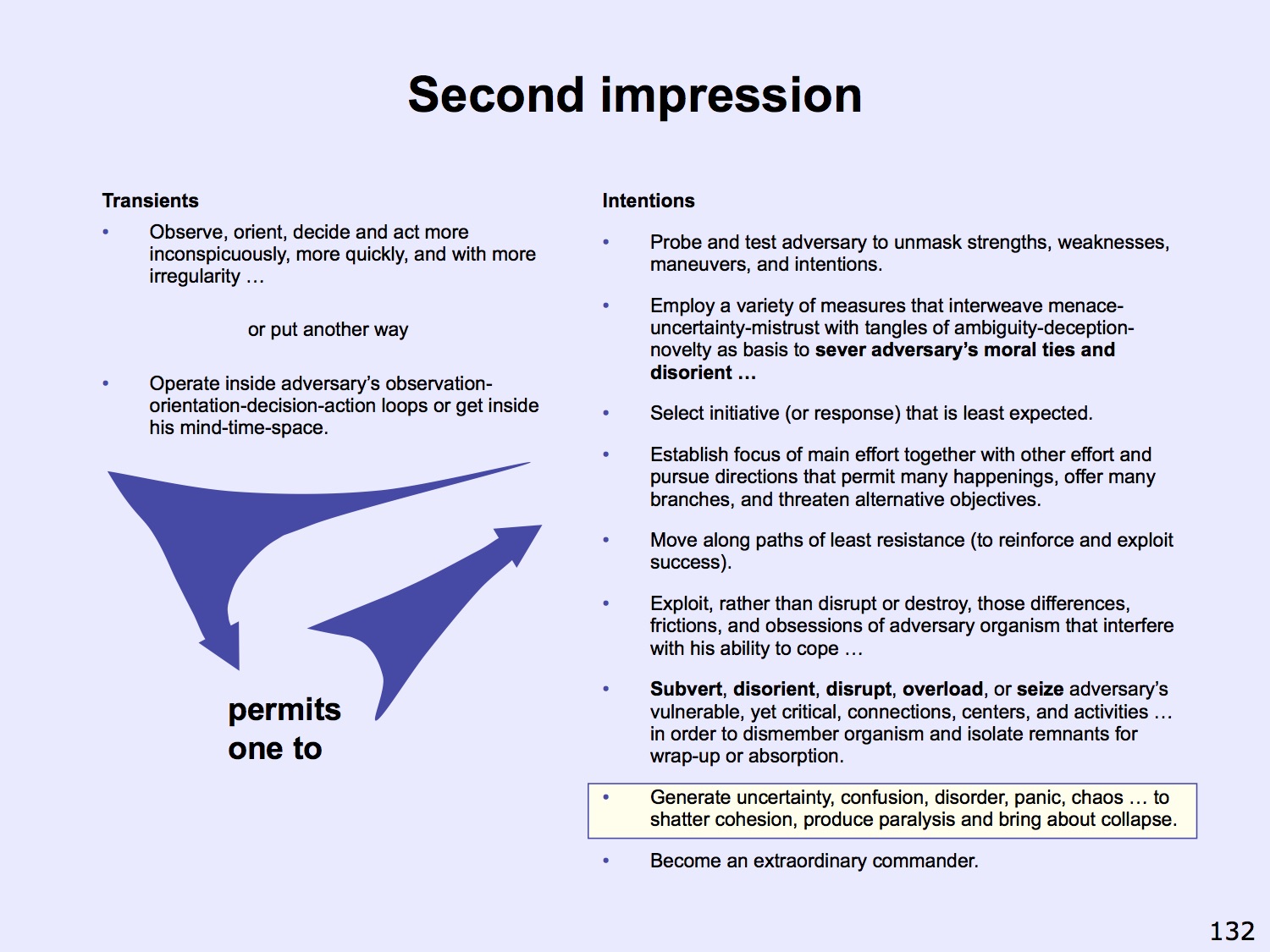
Boyd thought of stress as an offensive weapon. On chart 132 of Patterns of Conflict, for example, he lists one of the intentions of operating inside opponents’ OODA loops as:

Generate uncertainty, confusion, disorder, panic, chaos … to shatter cohesion, produce paralysis and bring about collapse.

Which seems like a reasonably good definition of “stress” to me. He also used to say that it was OK to be confused, so long as your opponent is more confused. Probably the same thing is true of stress.

In this new book, now available on Amazon, Brown takes Boyd’s famous definition of the goal of human activity — to survive on our own terms — and melds it with the latest research on the causes of stress.

I think you’ll find it most interesting, not to mention practical, and it might even provide new insights into Boyd’s work.

By the way, the publisher is listed as “A.L.P. Limited (Publishing), The Old Bakery, Tunbridge Wells, Kent.” The Brits still have a way about these things, don’t they?

Is 4GW dead?

I’m sorry, Mrs. Lind, there’s nothing more we can do.

Has the concept of fourth generation warfare outlived its usefulness? The term was coined by Bill Lind and his colleagues in a paper they published in the Marine Corps Gazette in October 1989, “The Changing Face of War: Into the Fourth Generation.”  If you haven’t read this paper, you might want to take the time now.

Here is their primary prediction:

Fourth is a goal of collapsing the enemy internally rather than physically destroying him. Targets will include such things as the population’s support for the war and the enemy’s culture. Correct identification of enemy strategic centers of gravity will be highly important.

In broad terms, fourth generation warfare seems likely to be widely dispersed and largely undefined; the distinction between war and peace will be blurred to the vanishing point. It will be nonlinear, possibly to the point of having no definable battlefields or fronts. The distinction between “civilian” and “military” may disappear. Actions will occur concurrently throughout all participants’ depth, including their society as a cultural, not just a physical, entity. Major military facilities, such as airfields, fixed communications sites, and large headquarters will become rarities because of their vulnerability; the same may be true of civilian equivalents, such as seats of government, power plants, and industrial sites (including knowledge as well as manufacturing industries). Success will depend heavily on effectiveness in joint operations as lines between responsibility and mission become very blurred. Again, all these elements are present in third generation warfare; fourth generation will merely accentuate them.

Continue reading

Paying for Einheit

Somewhere in the middle of new employee orientation, more years ago than I shall admit, I suddenly jerked awake when the briefer very slowly enunciated that “It is a fireable offense for employees to discuss their salaries.”

Tom Peters once insisted that in a capitalistic society, where we reward according to performance, why not post the scores? The answer, quite obviously, is that we often don’t reward according to performance, despite what we say. What companies get from such a policy is mistrust, with rumor replacing fact.  As the WSJ reported in an article today (paywall), even ostensibly well-run companies like Apple would sometimes rather play games than build a more powerful organization.

The article makes an important point: Don’t kid yourself — people will find out the truth. And some of the better performers will feel betrayed.

Like many readers of this blog, I come from a military background, where you can look at people’s uniforms and know to within a few dollars a year how much they make. And not coincidentally, the best military organizations make a fetish out of building Einheit.

In Boyd’s framework, Einheit is what defines the organization: We strive to improve it within our organization, and one of your primary goals is to destroy Einheit in your opponents. If you build an environment where internal politics flourishes, you’re doing your opponents’ jobs for them.

As the Journal article observes: “So one way for employers to head off internal politics: Be even more transparent.”  It would seem logical. Showing that you have nothing to hide is a step towards building trust.

Deming was right, again

Surprise.

You may recall that he did not like programs like “employee of the month” for a couple of reasons. If they truly recognized superior performance, then your small group of superior performers would win every month. And if you ensured that “everybody had a fair chance” at winning, then you’re rewarding poor performance.

New research at Washington University in St. Louis confirms this, and adds another point: employees will game the system to give themselves the best chances of winning. So you end up rewarding those who are good at winning contests, not necessarily those who contribute to achieving the organization’s objectives:

  • “The researchers show that two types of unintended consequences limit gains from the reward program. First, employees game the program, improving timeliness only when eligible for the award, and strategically calling in sick to retain eligibility.
  • “Second, employees with perfect pre-program attendance or high productivity suffered a 6 percent to 8 percent productivity decrease after program introduction, suggesting that awards for good behavior they already exhibited de-motivated them.”

Note that “timeliness” is a performance metric and like all such metrics is susceptible to gaming.

What the second bullet indicates is that programs like this destroy Einheit.

First Violet of Spring

African VioletWe bought this little guy for a Christmas get-together in 2011, and about this time last year it quit blooming.

Still, it provided a touch of green in an otherwise drab corner, so we’d water it every now and then.

When we were leaving for Chicago nearly two weeks ago, I notice a bud. When we got back on Monday, here’s what greeted us.

I take this as a good omen. I don’t know of what, but that’s the nature of omens.

Any OODA is better than no OODA

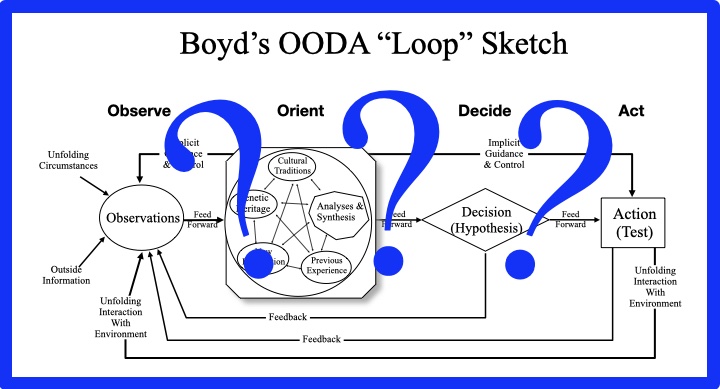
John Boyd coined the term “OODA loop” some 25 years ago, but it’s always fun to watch a pundit, particularly a business guru, breathlessly discovering this amazing new strategy.

Here’s the latest one I’ve found, “What a Fighter Pilot Knows About Business: The OODA Loop,” on Forbes.com.

Don’t get me wrong. I’m a firm believer that anyone who writes about the OODA “loop” and credits Boyd (as this article did) is doing good work. Once people start down the path, a few will look deeply enough to make Boyd’s framework a powerful strategic tool.

Having said that, how much trouble would it be for authors such as this one, to Google “John Boyd” and learn a little about what he actually wrote?

For example, the article insists that:

4. Action refers to business process management (BPM). The right actions may require workflow or process orchestration, whether manual or via software, to control the flow of work and to trigger the execution of human (or automated activities) at the right time.

Does this, perhaps, give you a top-down flavor? People are “triggered” and presumably sit around with their thumbs up their you-know-whats in the interim. Boyd, by contrast, is all about creativity and initiative.  For example, on chart 74 of Patterns of Conflict, he wrote:

A common outlook possessed by “a body of officers” represents a unifying theme that can be used to simultaneously encourage subordinate initiative yet realize superior intent.

Nobody in an organization run according to Boyd sits around waiting to be “triggered.”

Oh well. As I said, anybody who spells Boyd’s name right is doing good.

[If you'd like to know what Boyd actually wrote about the OODA "loop," I modestly recommend my paper, "Boyd's real OODA loop," available on our Articles page.]


Transportation update

Scott McCartney has a nice piece over at the Wall St. J. (subscription required). The title pretty much says it all: “Passenger Rights? What Passenger Rights?”

Got me to thinking. You have a lot of rights.

  1. You have the right not to fly. A previous post talked about the advantages of being there, physically, when you’re trying to build Einheit. Once you have it, though, you may be able to dial back the travel. Now, options like FaceTime, Google+, Go-to-Meeting and even Skype start making a lot of sense. Especially when the alternative is a $4,200 business class ticket plus hotel and M&IE, and likely for more than one person.
  2. I’ve also mentioned alternatives like the bus for shorter trips. Greyhound, for example, is rolling out what might be called business-class busses. For trips of 4 hours or less, the time difference with air travel is negligible, and the cost difference can be enormous. I assume that if rail is an alternative, you’ve already looked into it.
  3. If you must go by air, look at options like Delta’s Economy Comfort or United’s Economy Plus. They’re better than steerage, survivable for trans-atlantic runs, and MUCH less expensive than business class. Put the savings into a nicer hotel or Business Premier on the EuroStar. You can make a whole lot of EuroStar and TGV trips for the difference between Economy Comfort and Business Class across the pond.
  4. If you don’t want to get stranded and stuck with hotel and meal costs, buy travel insurance. Delta won’t let you complete an on-line ticket without making an explicit choice about trip insurance. And there are good third party policies — I use Travel Guard, but there are many others. Plus many premium credit cards include such services, and if you’re a member of the Marine Corps Association, they have an emergency assistance program that includes such things as medical evacuation, vehicle and dependent children return, and interpreter services. They don’t, unfortunately, send in the Marines to get you out.
  5. I’ve left out mileage/coupon upgrades. With current airline load factors running above 80% across the board, I can’t conceive of flying enough to get high enough in a loyalty program to actually get a seat. If you are Diamond, though, they’re certainly worth a try. In three years of Platinum level on Delta, I had a grand total of one international client who would spring for a full-fare coach ticket, instead of a much cheaper “lowest price,” and then a grand total of once was able to find a suitable flight that had an upgrade available. Once.
  6. Take the QM2 across the pond, esp. if there’s more than a couple of you going. The cost will be less than business class, you won’t arrive with jet lag, and you can get a lot of work done in route.

It seems that the airline industry has bifurcated into a typical pattern, perhaps reflecting our economic situation, of “price is no object” on the one hand, and “buy the lowest priced option” on the other. Assuming that you’re not a one-percenter (I seem to have few readers in this category), this bifurcation is something of an illusion — you do have options that can get you out of eight hours of fetal position.