
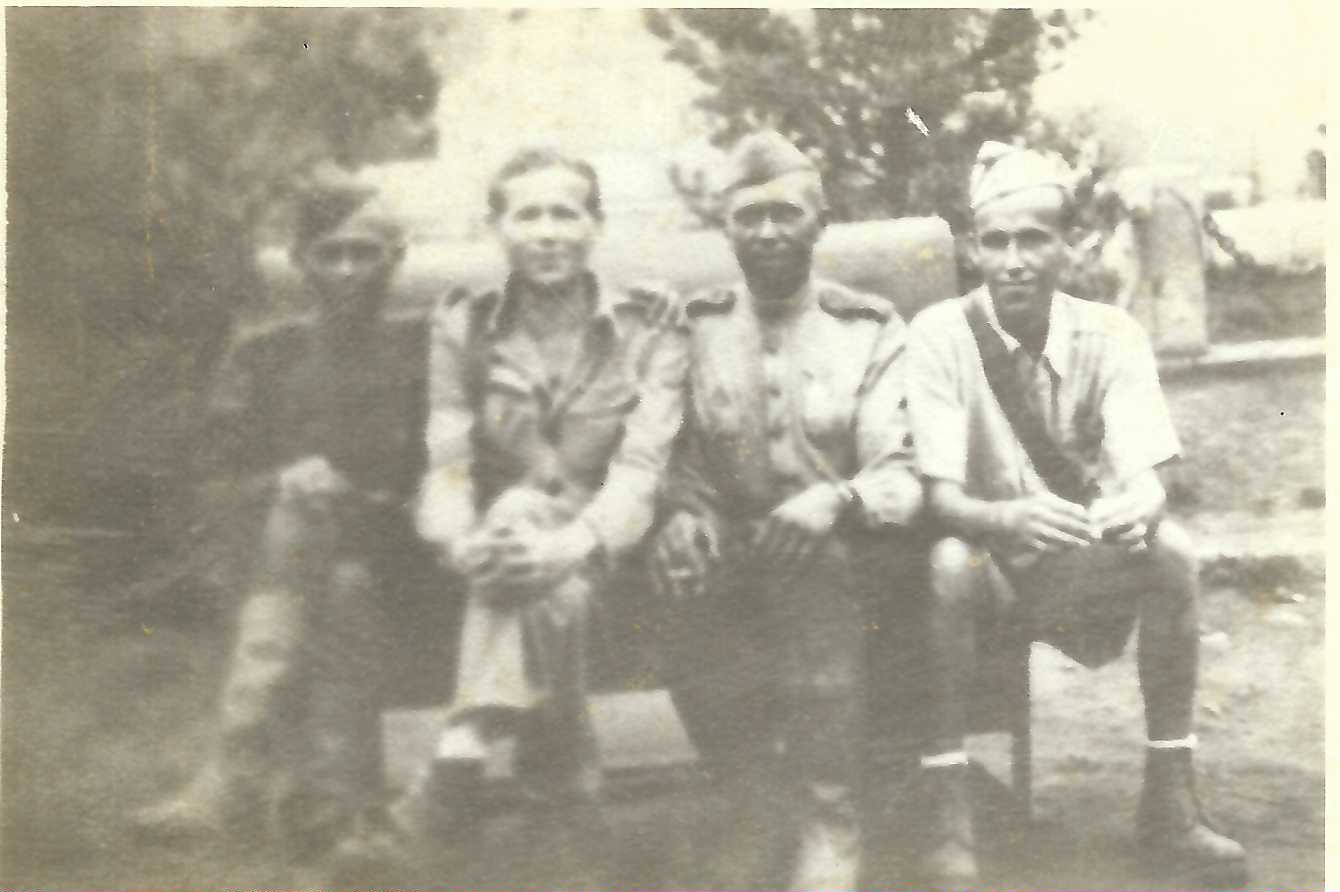
The person on the far right is my late father, then-Captain Grover C. Richards, Jr. He and a fellow POW posed for this photo with two Red Army soldiers who had just liberated Camp Hoten in Mukden, Manchuria, (now Shenyang, Liaoning province) in mid-August 1945.
The Soviets invaded Manchuria on August 9, 1945, exactly 80 years ago as I write this. Boyd considered that operation as one of the two examples of a blitzkrieg that was superbly executed, highly successful, and overlooked outside a small group of students of military history and strategy. The other was the Battle of the Kerch Peninsula (December 1941 – May 1942).*
It was an enormous operation, involving over 2 million troops from both sides. The Red Army alone employed over 5,000 tanks, many of them them modern T-34s, nearly 30,000 artillery tubes and Katyusha rocket launchers — the famous “Stalin’s Organs” — and nearly 4,000 aircraft. Although the action took place in an arena of war the size of western Europe, the battle was over in 11 days.
If you are familiar with Boyd’s terminology, we can describe the Soviet strategy simply as: They operated inside the Japanese OODA loops. Although outmanned, outgunned, and often surrounded, many Japanese units fought tenaciously to the last. But if your opponent is inside your OODA loops, it is ultimately to no avail.**
One of the factors that made this campaign so interesting was that the bulk of the Soviet forces had to move from western Europe, where they had participated in the defeat of Nazi Germany, to far eastern Siberia, a distance of roughly 6,000 miles. This was accomplished in the space of three months. As described by Wikipedia:
They (the Japanese) had estimated that an attack was not likely before the spring of 1946, but the Stavka (Soviet high command) had in fact been planning for a mid-August offensive, successfully concealing the buildup of a force of 90 divisions. Many Soviet units had crossed Siberia in their vehicles to avoid straining the rail link.
The Japanese were caught completely by surprise upon receiving the Soviet declaration of war an hour before midnight on 8 August, now facing a simultaneous invasion on three fronts that began just after midnight on 9 August.
Here is a YouTube video that gives an overview of the campaign (only the first half is on Manchuria). Although the quality is uneven, you should be able to pick out many of the elements of blitzkrieg strategy: Deception and surprise; high tempo of operations; bypassing and isolation of strong points; and advance via multiple thrusts to probe and test the opponent and generate ambiguity:
* On Boyd’s chart of “Blitzkrieg Results,” Patterns 89, under “Successful,” Kerch is “Summer 1942.” The Manchurian operation is also listed.
**As described in glorious detail on slide 132 of Patterns of Conflict.
My father retired from the Army as a LTC on June 30, 1961, became a college professor, and retired the second time as Chair of Psychology of what is now Georgia Southern University in 1981. He died in Jacksonville, FL, on September 29, 1996, and is buried in Arlington. His military awards included the Silver Star for actions on Bataan.
 Slightly East of New