
By Chet Richards and Brian “Ponch” Rivera
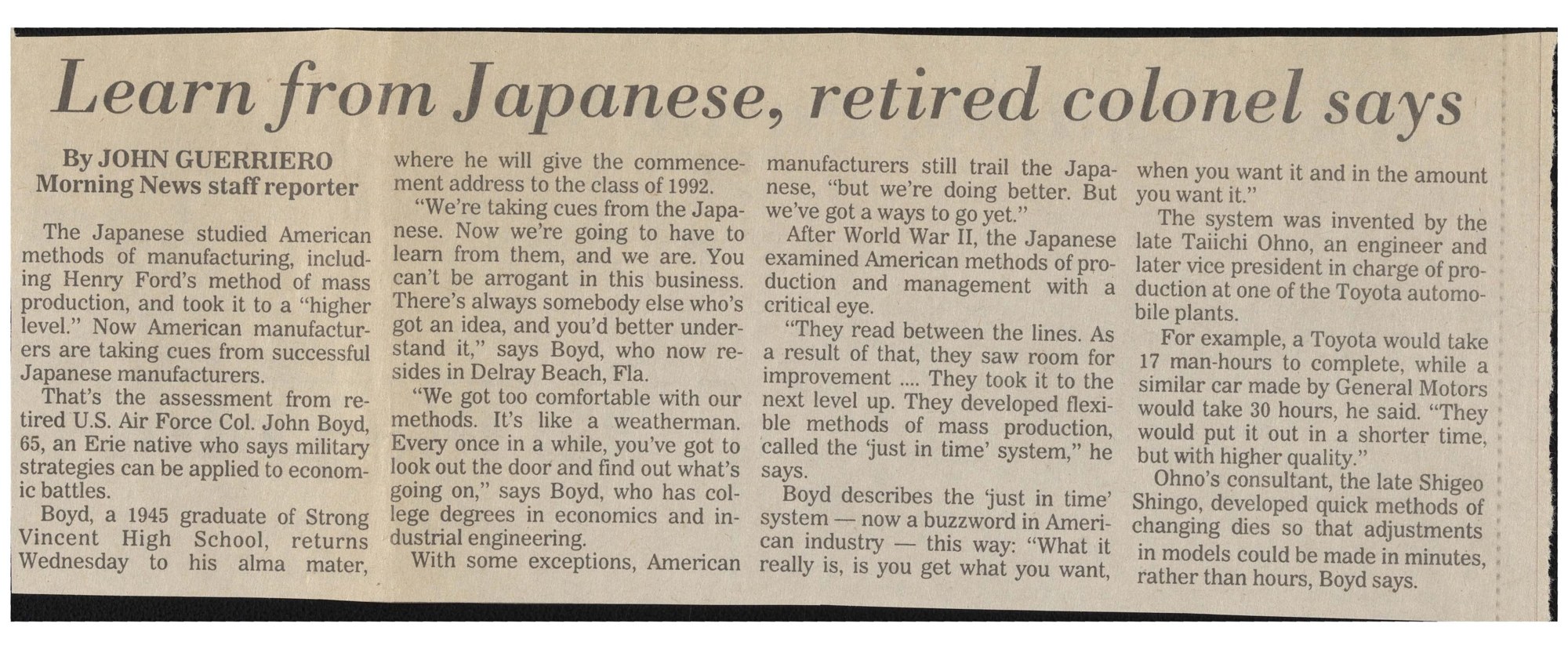
In 1992, John Boyd went home to Erie, Pennsylvania, to give the commencement address at Strong Vincent High School, where he had graduated in 1945. Before the ceremony, he told a Morning News reporter what American manufacturers needed to learn from the Japanese.
“We’re taking cues from the Japanese. Now we’re going to have to learn from them, and we are. You can’t be arrogant in this business. There’s always somebody else who’s got an idea, and you’d better understand it.””We got too comfortable with our methods. It’s like a weatherman. Every once in a while, you’ve got to look out the door and find out what’s going on.”
To people who know Boyd only as a fighter pilot, a tactician of air-to-air combat or a philosopher of conflict, it may seem strange to hear him talk about manufacturing. His interest in business and manufacturing, however, went back many years. His first college degree was in economics, and in the early 1960s the Air Force sent him to Georgia Tech for a second degree, in industrial engineering.
By 1992, Boyd had studied the Toyota Production System in depth. Material in his papers, now held by the Marine Corps History Division at Quantico, Virginia, shows that this interest grew out of his earlier work on the theory of conflict and competition. In Patterns of Conflict, Boyd’s advice was to “operate inside adversary’s observation-orientation-decision-action loops.” He wanted to understand how the Toyota Production System let Toyota do that to American competitors that were much larger and better financed.
Chet laid out a business example in his June 1989 briefing for Lockheed, “War, Chaos, and Business,” using what George Stalk called the H-Y War. In 1981, Yamaha announced that it would become the world’s largest motorcycle maker, a position Honda held. Honda counterattacked. Over the next eighteen months it introduced 113 new models against Yamaha’s 37, and Yamaha gave up: “We want to end the H-Y War. It was our fault.” In Boyd’s terms, Honda was operating inside Yamaha’s OODA loop.
The same briefing listed how to tell the approach is working against a business competitor: “His new products are consistently late,” “Turnover is high throughout his organization,” “He constantly blames his customers,” and “He launches witchhunts and other ever-intensifying internal searches for The Cause of His Problem.” These are the business cousins of what Boyd described in war, where the aim is to “generate uncertainty, confusion, disorder, panic, chaos.” As we read it, Boyd saw the same symptoms in American industry, and that is the warning behind his Erie remark about the weatherman.
Then, as books on the Toyota Production System (TPS) appeared in English during the 1980s, he got a close look at how the Japanese actually did it.
He explained one of the primary elements of the TPS, just-in-time, in one line: “What it really is, is you get what you want, when you want it and in the amount you want it.” The Japanese, he said, studied American mass production after the war and “took it to the next level up.” A Toyota took 17 man-hours to build, Boyd said, against 30 hours for a similar General Motors car. The article says the system “was invented by the late Taiichi Ohno, an engineer and later vice president in charge of production at one of the Toyota automobile plants.” Ohno’s consultant, Shigeo Shingo, developed quick ways of changing dies, so model changes took minutes instead of hours.
As Ohno himself explains, he did not “invent” the Toyota Production System. It evolved over many years, starting with the invention of the auto-activated loom, which would stop “should any one of the many warp threads break or the weft threads run out.” As Chet recalls, the TPS material Toyota gave prospective suppliers in the early 1990s credited three people as its primary creators: Sakichi Toyoda, Kiichiro Toyoda and Taiichi Ohno. Ohno gives them generous credit in his own book.
That distinction matters, because what interested Boyd most about the TPS was how it evolved. It struck a personal note. In the early 1960s, Boyd and the mathematician Thomas Christie had built energy-maneuverability theory, a way to compare the performance of two air-to-air fighters across their entire ranges of speed, altitude, acceleration and turn rate. Fighter pilots still learn it. It changed the design of modern fighters, away from higher, farther and faster and toward maneuverability and agility.
Why, Boyd wondered, was he able to build it when many people with far more knowledge of aerodynamics, propulsion and even basic physics could not? According to Franklin “Chuck” Spinney, as he told it to Chet, Boyd thought about that question for years. His answer became his first paper after retiring, “Destruction and Creation” (1976). As Chet reads Boyd’s later work, Boyd applied that answer to everything he did for the rest of his career.
The OODA loop and PDCA do different jobs
Boyd, in his usual voracious manner, did not stop with the TPS. He read Shewhart and Deming closely, and there he met the plan-do-check-act (PDCA) cycle. At that point the OODA loop had not yet been sketched. It was described as a cycle of observation, orientation, decision and action. Chet’s 1989 Lockheed briefing drew it that way, as four words in a cycle, credited to Boyd’s “Patterns.” Lockheed was doing a lot with Deming and PDCA at the time, so later in the same briefing Chet set the Shewhart/Deming cycle under the heading “THIS SHOULD LOOK FAMILIAR.” In that early form, the two did look alike. Chet’s manuscript from the late 1980s called the Shewhart/Deming cycle “a final example of the O-O-D-A loop in business” and gave it its job: “The purpose of this cycle is to get your act together internally so that you can compete externally.”
The sketch Boyd produced on 28 June 1995, in “The Essence of Winning and Losing,” looks very different from PDCA. Orientation sits at the center, shaped by genetic heritage, cultural traditions, previous experiences and new information. Feed-forward and feedback paths run through it, and implicit guidance and control runs from orientation straight to observation and action.
We see PDCA and the OODA loop doing different jobs. PDCA is a method a team uses to test and improve a process. The OODA loop represents how a living system, whether a person, a team or a company, interacts with a changing environment full of other adaptive agents. Run well, PDCA improves OODA loops.
Boyd saw the limit of any cycle that runs only inside a process. On a legal pad dated 5 May 1992, under the heading “Unstated Message derived from Shewhart & Deming,” he wrote:
“We can neither maintain nor reduce statistical variation of a physical process/system unless we reach out beyond that process/system. … or put another way … We can neither maintain nor reduce statistical variation of a physical process/system from within that process/system.”
As we read it, improvement needs information from outside the process, and the OODA loop is how that information gets in.
What Boyd was reading
On another page of the same legal pad, dated 15 July 1992, Boyd wrote out a reading list. It includes Rafael Aguayo’s book on Deming, Deming’s Out of the Crisis, Masaaki Imai’s Kaizen, Ichiro Majima’s The Shift to JIT, three books by Ohno, two by Shingo, Stalk and Hout’s Competing Against Time, and The Machine That Changed the World by Womack, Jones and Roos. The source list for his briefing cycle, A Discourse on Winning and Losing, carries the same three Ohno books and the same two Shingo books.
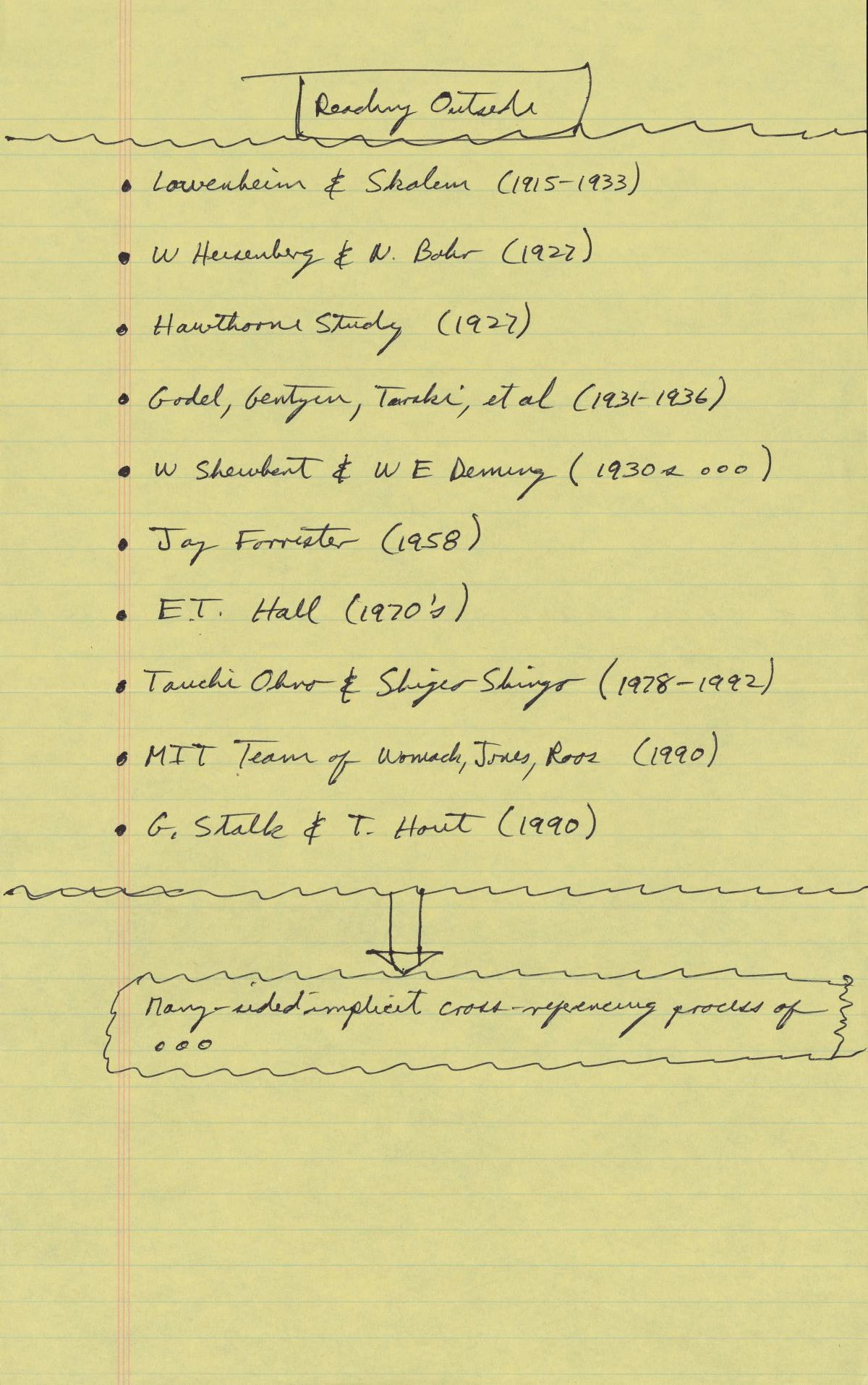
Another page shows where Toyota sat in his thinking. Under the heading “Reading Outside,” Boyd listed the people he drew from: Löwenheim and Skolem, Heisenberg and Bohr, the Hawthorne Study, Gödel, Gentzen and Tarski, Shewhart and Deming, Jay Forrester and E.T. Hall. Then come “Taiichi Ohno & Shigeo Shingo (1978-1992),” the MIT team, and Stalk and Hout, on the same list as the mathematicians and the physicists. An arrow runs from the list down to a box: “Many-sided implicit cross-referencing process of …”
That reading came before the 1995 sketch, and we believe the Toyota system influenced it, through Toyota’s continuous interaction with its environment and its emphasis on orientation. In the margin of Imai’s Kaizen, next to a figure that sets “Innovation” against “Kaizen,” Boyd wrote: “They’re not necessarily true. Both Taiichi Ohno’s & my own work blow these juxtapositions apart.”
Beside one of his OODA loop sketches, on a page from a telephone conversation in the 1990s, Boyd wrote that the loop “can be used to represent how we deal with this world around us, regardless of our profession.”
Ponch has done Lean work for many years, Toyota included, and this is the thread he kept pulling in Boyd’s papers and in Boyd’s personal library at the Marine Corps History Division. Here is what he found in the margins.
Boyd thought the MIT team missed Ohno
The Machine That Changed the World (1990) made the word “lean” famous. John Krafcik coined it two years earlier, in a 1988 article in the Sloan Management Review. Krafcik also served as the MIT team’s assembly plant survey leader. Boyd’s copy of the book is full of his notes. On the blank page that closes chapter 3, facing the Part Two title, “The Elements of Lean Production,” he wrote:
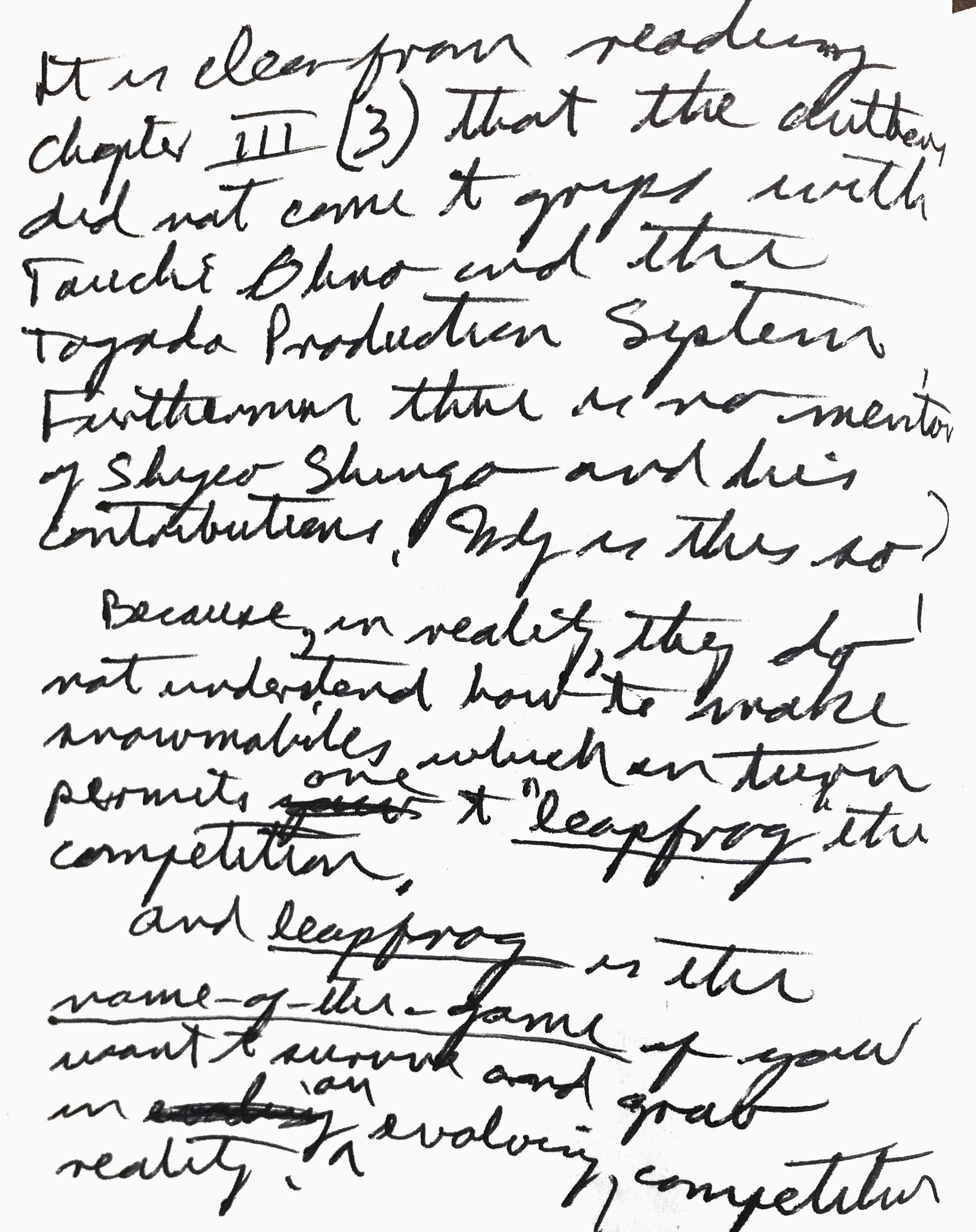
Boyd’s note on the blank page before Part Two of his copy of The Machine That Changed the World. Handwriting only. Photo by Brian “Ponch” Rivera of Boyd’s personal library, Marine Corps History Division. Register ID BL-0101.
“It is clear from reading chapter III (3) that the authors did not come to grips with Taiichi Ohno and the Toyota Production System. Furthermore there is no mention of Shigeo Shingo and his contributions. (Why is this so) Because, in reality, they do not understand how to make snowmobiles which in turn permits one to ‘leapfrog’ the competition. And leapfrog is the name-of-the-game if you want to survive and grab in an evolving, competitive reality.”
Snowmobiles are Boyd’s image for creation, from “Destruction and Creation.” You take skis, an outboard motor, bicycle handlebars and tank treads, pull them apart from the things they belong to, and recombine them into something new. His complaint, as we read it, is that the MIT team described the parts Toyota had built and skipped the creative process Ohno used to build them. Inside that same chapter, on page 62, Boyd says kanban “is only part of the JIT system,” and the authors “have not captured Ohno’s reverse ‘thinking.'”
In other words, unlike Boyd, the MIT team did not dig into the thinking behind how the creators of the TPS evolved the system. Ohno covers this in detail in his book, and we think it struck a chord with Boyd as he reflected on how he had evolved energy-maneuverability and then the rest of his work. To be fair to Womack, Jones and Roos, that does not appear to have been their aim.
He was just as hard on the managers the book describes. Early in Part Two, the authors recount their first interview with the senior managers at General Motors’ Framingham plant, who had just returned from a tour of NUMMI, the Toyota-GM joint venture. Boyd wrote above the passage: “Folded back inside themselves, possessed mental images that could neither appreciate nor cope with what’s really going on.”
GM had a front-row seat. NUMMI opened in 1984, and yet, as Frank Langfitt reported for This American Life, “It was 15 years before GM took the lessons of NUMMI seriously.”
Boyd saw Toyota inside Detroit’s OODA loop
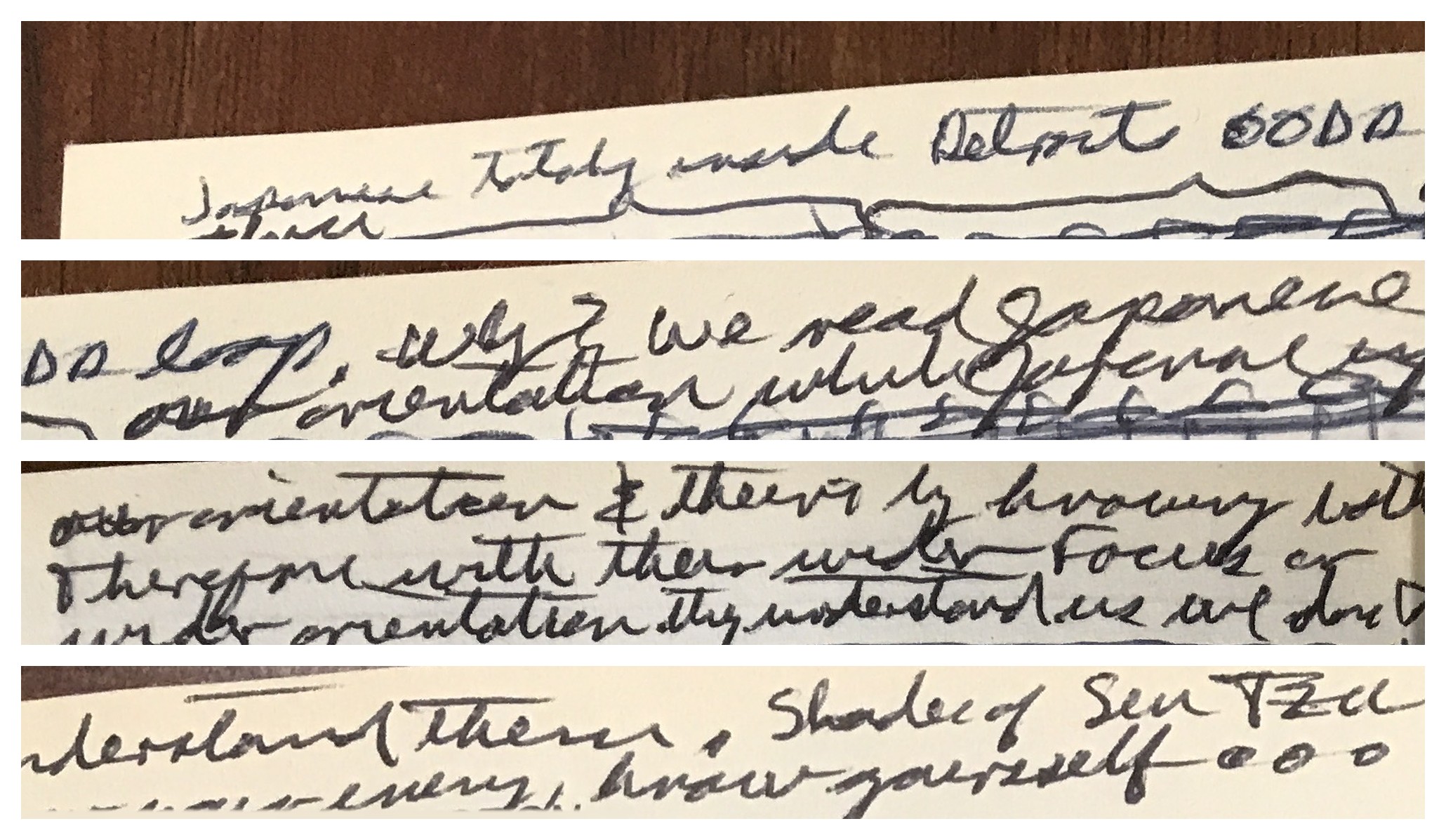
Where the book explains how the West misread Japanese success, Boyd wrote across the top of page 65:
“Japanese totally inside Detroit OODA loop; why? We read Japanese thru our orientation while Japanese exploit our orientation & theirs by knowing both. Therefore with their wider focus or wider orientation they understand us we don’t understand them. Shades of Sun Tzu: Know your enemy, know yourself.”
What Boyd credits is a wider orientation, and as we read it, speed follows from orientation. Boyd said as much at a 1988 Defense Department conference on agility, where he defined agility as “the ability to shift from one unfolding OODA loop pattern to another by being able to transition from one orientation to another.” Chet quoted that definition in his 1989 briefing, and his manuscript makes the same point: “your ability to cycle rapidly through O-O-D-A loops (old definition of agility) depends on your ability to change your orientations (new definition).”
Boyd read pull as control from the outside in
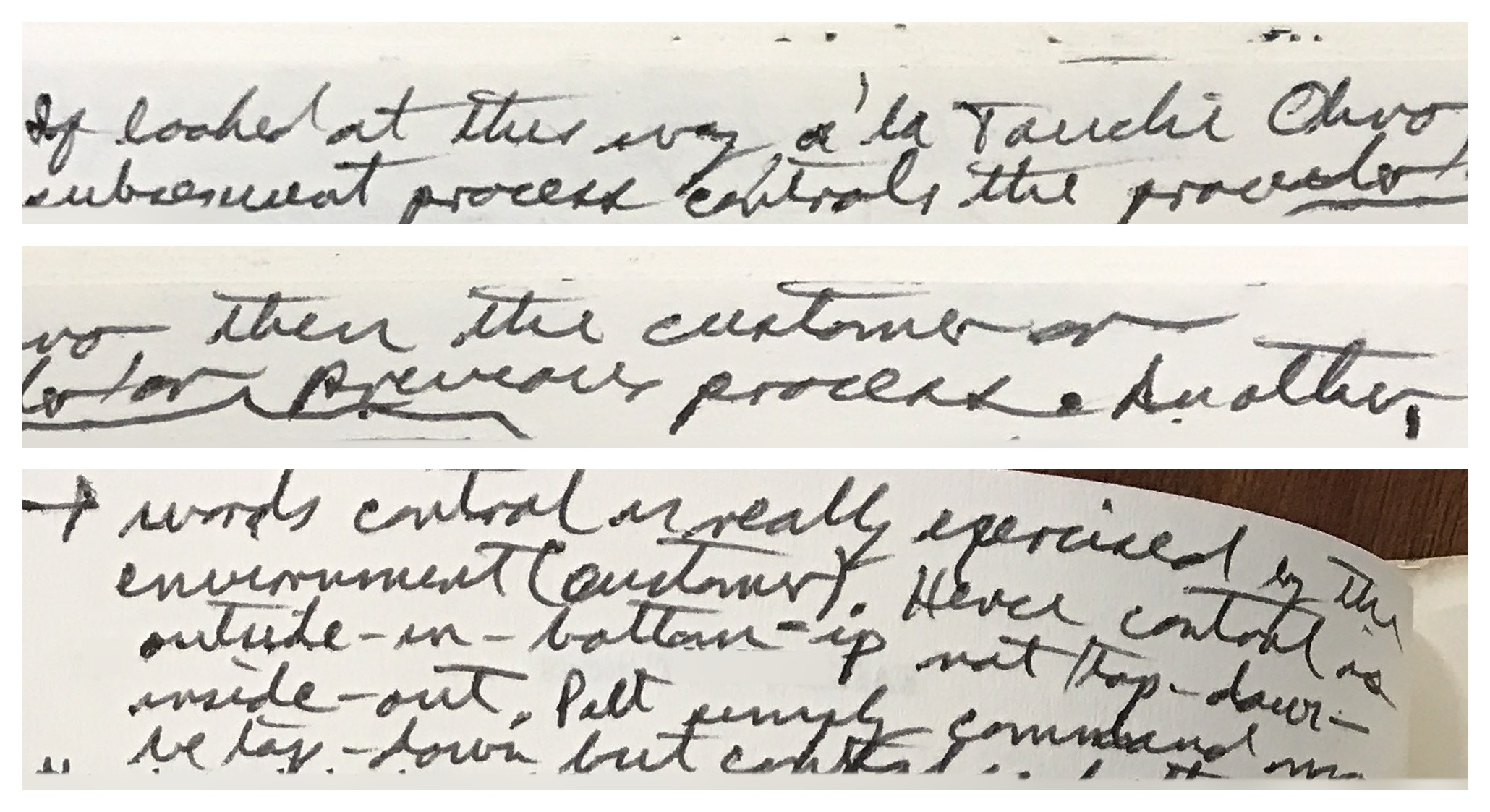
In his copy of Kaizen, next to a passage on the manager’s role, Boyd wrote:
“If looked at this way a’la Taiichi Ohno then the customer or subsequent process controls the … previous process. [In] other words control is really exercised by the environment (customer). Hence control is outside-in—bottom-up not top-down—inside-out. Put simply command may be top-down but control is bottom-up.”
He came back to the idea at Imai’s section titled “The Next Process Is the Customer”: “Tie this idea with Taiichi Ohno’s Kanban and we see control is exerted upstream (one more time).” In TPS terms, that is a pull system, in which the next process draws work from the one before it and the customer sets the pace.
Boyd held other authors to the same standard. In his copy of Aguayo’s book on Deming, beside a passage on the meaning of control, he wrote: “These comments while nice do not really address the … nature of control. If he had read Ohno, Shingo, and others he would appreciate the idea of control much better.”
Why does this matter now?
In Ponch’s experience, most Lean programs took the vocabulary from that 1990 book and left Ohno’s thinking behind. They install kanban boards, count waste and drive results from the top. In the same Deming book, Boyd wrote the warning plainly: “Once again, you must get outside the system!”
Military doctrine did the same thing to Boyd’s own sketch. It turned the sketch into a linear, four-step version and lost the orientation that drives it. Lean and the OODA loop suffered the same loss for the same reason: people copied the visible parts and left out the thinking that made the parts work.
Back to Erie. “You can’t be arrogant in this business,” Boyd told the reporter in 1992. “There’s always somebody else who’s got an idea, and you’d better understand it.” That still holds for anyone running a Lean transformation.
Listen and read further
- No Way Out, Ep. 16: Certain to Zen: OODA, IOHAI, Lean, and More with Chet Richards
- No Way Out, Ep. 22: Insider Secrets Behind the Toyota Production System & Boyd’s OODA Loop with Charlie Protzman
- No Way Out, Ep. 53: Theory of Constraints: Flow, TPS and Boyd’s OODA Loop with Steve Holt
- No Way Out on YouTube: youtube.com/@nowayoutpodcast
- AGLX Consulting: aglx.com
Sources
John R. Boyd Papers, Marine Corps History Division (MCHD), Quantico, Virginia: “Learn from Japanese, retired colonel says,” John Guerriero, Erie Morning News, 1992, MCHD 109904 (Box 2, Folder 3); Boyd’s handwritten notes, MCHD 111469, pp. 17, 38 and 54 (Box 17, Folder 10); Boyd’s OODA loop sketch page, MCHD 111475, p. 1 (Box 17, Folder 15); A Discourse on Winning and Losing outline and notes, MCHD 110119, pp. 16 and 18 (Box 7, Folder 10); Chet Richards, “War, Chaos, and Business,” Revision 5, June 1989, PDF pp. 7, 15, 29, 30 and 41, MCHD 110311 (Box 12, Folder 2); Chet Richards, untitled manuscript (late 1980s), pp. 144 and 150, MCHD 110312 (Box 12, Folder 3).
Boyd’s personal library, Marine Corps History Division, photographed by Brian “Ponch” Rivera: Womack, Jones and Roos, The Machine That Changed the World (pp. 62, 65, 77, and the blank page before Part Two); Imai, Kaizen (pp. 18, 32, 51); Aguayo, Dr. Deming (pp. 75, 138). Book images are cropped to Boyd’s handwriting. The printed book text is left out, and two running heads and a page number that sat between his lines are painted out.
John R. Boyd, A Discourse on Winning and Losing, ed. Grant T. Hammond (Maxwell AFB, AL: Air University Press, 2018): “Patterns of Conflict” (1986), pp. 152-153; introduction, p. 2, for the date of “The Essence of Winning and Losing” (28 June 1995). John R. Boyd, “Destruction and Creation” (1976). John R. Boyd and Thomas P. Christie, Energy-Maneuverability (March 1966). Boyd, remarks at the DoD Agility Conference, Los Angeles, 26 January 1988, as quoted in Richards, “War, Chaos, and Business.”
George Stalk Jr., “Time: The Next Source of Competitive Advantage,” Harvard Business Review (July-August 1988). George Stalk Jr. and Thomas M. Hout, Competing Against Time (New York: Free Press, 1990), pp. 58-59. Taiichi Ohno, Toyota Production System: Beyond Large-Scale Production (Cambridge, MA: Productivity Press, 1988), p. 77 and pp. 75-92. John F. Krafcik, “Triumph of the Lean Production System,” Sloan Management Review 30 (Fall 1988). Robert Coram, Boyd: The Fighter Pilot Who Changed the Art of War (Boston: Little, Brown, 2002). Frank Langfitt, “NUMMI (2015),” This American Life, episode 561, Act Two, 17 July 2015.
Personal communications: Franklin “Chuck” Spinney to Chet Richards, on Boyd’s question about energy-maneuverability. Chet Richards’s recollection of Toyota’s TPS material for prospective suppliers, early 1990s.




You must be logged in to post a comment.