On the Waterfront

A beautiful day for walking around Savannah — temps in the mid-70s and no rain.

Maersk WisconsinAnd it was a busy day on the waterfront. This is the Maersk Wisconsin coming in, passing by the mega-yacht Hyperion, a river boat, and what appears to be a dredge. Click on all pics for a larger view.

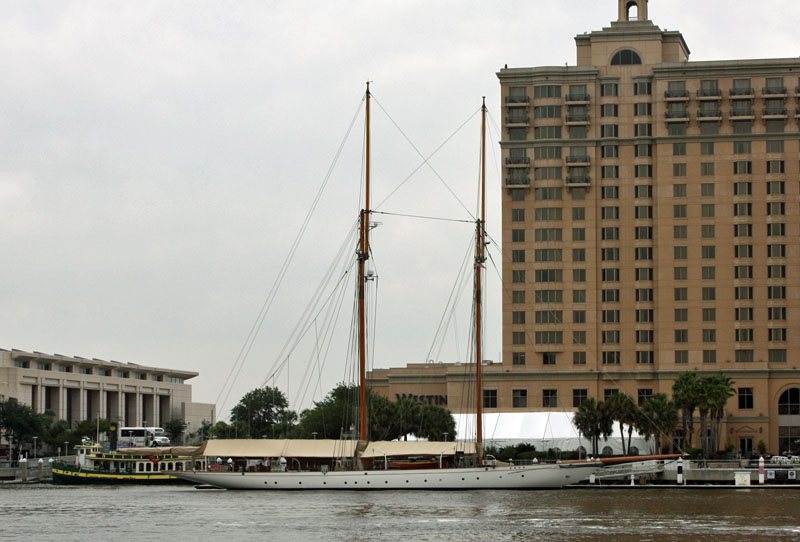
tall_ship_savannahThose of you who know Chuck Spinney (or may recall him from Robert’s Coram’s book), may also know that he claims to be cruising the Med with his wife and some sort of dog. But I swear that this ship is a clone of their’s. I must admit, though, that it’s been a few years since I’ve seen their boat, so I could be mistaken. Still …

If you do visit Savannah, you could choose from big convention hotels (e.g., Hilton, Hyatt, and Marriott) and several smaller hotels and inns. But Savannah also abounds in B&Bs. Here’s one, the Forsyth Park Inn.

Forsyth Park Inn

Breaking Mayer’s Trade-off?

You may recall the controversy that greeted new Yahoo CEO Marissa Mayer’s decision to ban employees from working at home. I suggested that while such a decision might be useful in the turnaround phase, it does send a message of “We don’t trust you” and so could undermine Einheit if kept in place for too long.

Clive Thompson had another take yesterday on Wired.com: What Marissa Mayer Doesn’t (and Does) Get About White-Collar Work

He cites research (an innovative approach!) that shows advantages to both working at home and at the office, depending on the types of work to be done.

“Thinking work” is invisible and hard to observe accurately. Waber studied one company where a handful of superstar programmers complained that they could only be productive at home. So leave them home, right? Except Waber found that when these stars worked in the office, the firm’s productivity as a whole soared, because they’d answer other coders’ questions. Let them work from home and everyone suffered.

He recommends doing both:

Managers and employees need to assess what type of mental work they’re doing on any given day and gravitate to where it’s best suited. Doing Mad Men–style “aha” groupthink? Stay in the office. Need to crush that 90-page memo on paper-clip appropriations? Seems like the kind of thing best handled at home, possibly in your underwear. One-size-fits-all policies—like the one at Yahoo—are too crude for today’s white-collar toil.

Seems reasonable, but the big question still remains unanswered. Do you trust your employees to make this decision for themselves, or, like one of the companies he cites, do you lay down a fiat that thou shall work at the office on MWF and from wherever you want on TTh? That might solve the work-at-home-or-at-the-office issue, but what do you do when a highly productive employee finishes a critical project by working from home on Friday?

As Thompson suggests at the end, the most successful companies may be those that break the trade-off between control and trust and manage to have both. Boyd’s framework is designed to break exactly this trade-off. As I describe in Certain to Win, it rests on Einheit/mutual trust, shaped by such concepts as Schwerpunkt (focus and direction) and Auftragstaktik (roughly, mission “orders”).

Once you have done the hard work to build Einheit (also “unity” and even “team feeling”; c.f., Patterns 74-79, 118), and once people appreciate the need for both creative individual work and for team interaction (this need being part of your Schwerpunkt), then a little leadership should resolve any problems that come up in day-to-day operations.

And the living is easy

Spring day in the Carolina low country looking out on the golf course at Hidden Cypress. Click for a larger view.

Hidden CypressTaken from an elevated walkway through one of the swamps in our development, Sun City Hilton Head.

Note that the sky is indeed Carolina Blue, which is a little odd because although we’re looking towards North Carolina, the border (at South of the Border) is about 200 miles away. To be entirely honest with you, the sky looked about the same in both places. We did drive past Pedro’s place on the way back here from North Carolina today.

Charleston, where the living is also easy, is only about 75 miles up the coast. Like Charleston, rice plantations also dominated this area, and to this day, gated developments are usually called “plantations.”

Is there a future for air travel?

Right now, it’s looking pretty bleak. Increases in fuel costs combined with the hollowing out of the middle class means that airlines will focus increasingly on the top 10-15%. You’ll see service to fewer places, as detailed in this Wall St. J. report, higher prices, and more space devoted to business and first class. Think of what air travel was like back in the 1950s, for example, but without a DC-3 stopping once a day in your home town. Oxford, MS, where I went to high school and college, used to have scheduled service via Southern Airways and the aforementioned DC-3 (later Martin 404s). Today, it’s the “Airport at Ole Miss,” where it primarily serves rich alums flying in for football games. Nearby Memphis is down to 91 scheduled flights a day from over 300 just a few years ago.

On the other hand, the CEO of Bombardier seems optimistic in this condensed interview, also in the Journal. A couple of points that I found interesting:

  • Their new C-series, scheduled to enter service next year, will serve the 100-149 seat market with an aircraft that promises to be “20% more fuel efficient than the best aircraft out there.” Could this make service to St. Augustine profitable again?
  • High speed rail, about half of Bombardier’s business, is booming except in one major market. For example, they’re introducing a new train, the “Zephiro 380, a train that goes [235 miles] an hour, designed in conjunction with our German and Chinese employees.” For trips of less than 1,000 miles, this train could well beat airlines for travel between city centers. Eventually, we may overcome the ideological blinders keeping high-speed rail from becoming a presence in such dense markets as along the east coast, as well as between Chicago and New York (say hi to Eva Marie Saint for me), Chicago and Washington, San Francisco and LA, and the Dallas – Houston – San Antonio triangle.

I don’t know what all this means, but it seems obvious that if we’re going to stay a great nation, much less a great power, we have to have efficient and ubiquitous means of moving around the country.

Is Toyota Safe?

Of course not, although the record profits [CR Note: actually, the best in 5 years; its record was in the FY ending March 2008] it just posted might make you think so.  In an article in today’s New York Times, company President Akio Toyoda takes the “only the paranoid survive” approach:

“Have we really turned into a company that will be profitable and continue to grow no matter what happens to its business environment?” Mr. Toyoda asked.

“I am not sure yet, is my honest answer. An unprecedented crisis even beyond the scale of the Lehman Shock may happen again,” he said, using a common Japanese reference to the global economic crisis. “We’ll only know the answer when such events actually happen.”

Good attitude.  A couple of clouds on the horizon, though. For one thing, Toyota now faces brutal competition not only from Nissan and Honda but from Hyundai / Kia and, for the first time in years, from GM and Ford (Chrysler is still lagging). And the article in the Times talks about “a company-wide cost reduction drive.”  It’s worth remembering that such short-term thinking is really what got them in trouble in the first place.

Although Toyota’s problems were exacerbated by the recent recession, recalls, and the earthquake, they actually began in the early parts of the century when, in an attempt to accelerate its expansion drive and boost profits, it cut back on training and took shortcuts with its vaunted Toyota Production System. In other words, it started to look like any other car company, with the problems that any other car company faced:

Since 2004 the automaker has had to recall 9.3 million vehicles in the U.S. and Japan—its two biggest markets—up from 2.5 million in the previous three years. The problems got so bad that, in July [2006], Toyota CEO Katsuaki Watanabe felt obliged to bow deeply in apology.

You may remember that in January 2010, Consumer Reports cut Toyota from the companies that it automatically recommends.

As the owner of two Toyotas, I certainly wish them well. But I’d like to see some evidence that they’re refocusing on the values that led them to prominence and not  just chasing next quarter’s numbers.

It’s Still a Wonderful World

My order from Apple has two parts. Yesterday, I posted FEDEX tracking information for the first.

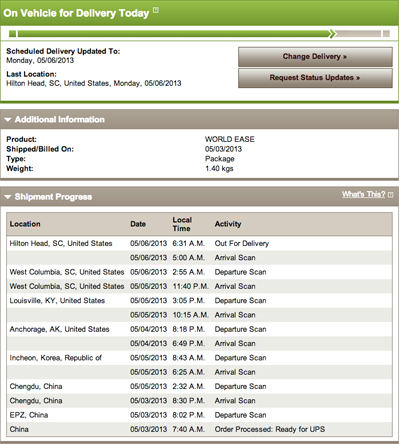
Here’s the second, coming by UPS:

UPS Tracking

Notice that it left China on Friday and is now out for delivery to our house near Hilton Head. By the way, the FEDEX package from yesterday’s post just arrived.

If you’re a local retailer, how do you compete with this? And don’t go whining about sales taxes because Apple collects it. I can think of four approaches:

  1. Have it in stock for customers to feel and play with. This includes accessories.
  2. Instill the EFAS climate among your sales staff. This means Fingerspitzengefühl for both the product and for sales technique (do they know the product inside and out and are they aces at selling?)
  3. Provide a lagniappe. Even if you have to order it for them, give them something extra, something they can take home, in their hands, today.
  4. Sell the whole experience: Provide free coffee (most places won’t let you give out free wine), keep the shop clean, ensure that everybody’s enthusiastic and having fun, and if you do screw up on something, fess up and make it right (screw-ups are your best opportunities to build customer relationships). If you’re the owner, get out on the floor, introduce yourself and mix it up with the customers. If lines get long at checkout (you should wish) lend a hand.

It’s a Wonderful World, part II

Imagine doing this when you were in college, assuming you were an undergrad in the ’60s:

Amazon Shipment

I’m tracking an Apple.com shipment in near realtime from the factory in Suzhou, China, to my house near Savannah, Georgia.

I think this is even more amazing than the first video Skype call I made, from Bergen, Norway, to my wife in Atlanta.

A couple of other thoughts:

  • It only takes a little over 4 days to make the trip, factory to end user. Talk about just-in-time.
  • Even though it was delivered to FEDEX Suzhou after the cutoff, FEDEX sent it out to Shanghai anyway (thanks, FEDEX!)

Monterey Square

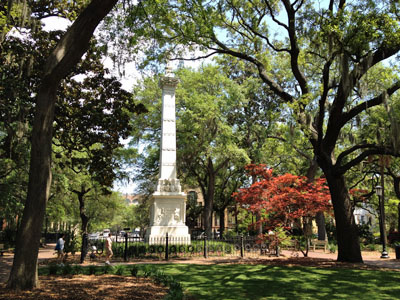
Pulaski MonumentOne of our favorite places in Savannah.

The centerpiece of the square is, somewhat incongruously, the monument to the Polish general and American Revolutionary War hero Casimir Pulaski, who was mortally wounded in the Battle of Savannah, October 9, 1779. The square is named after the American victory in the Battle of Monterrey, Mexico, some 67 years later. (FYI, there was a “Battle” of Monterey, California, during the same war, but except for the mix-up in spelling, it had no relation to this square.)

It’s a breathtakingly beautiful square, one of  22 surviving squares in the city. Many of these date back to the city’s founding in the 1730s, although Monterey is one of the later additions. To make things only slightly confusing, Pulaski Square, also dedicated to the General, lies only a few blocks away.

In addition to the monument, the square is home to the Mercer-Williams House, built for the great-grandfather of composer Johnny Mercer and, facing it across the square, to Congregation Mickve Israel, pictured below right, the third oldest Jewish Congregation in America.
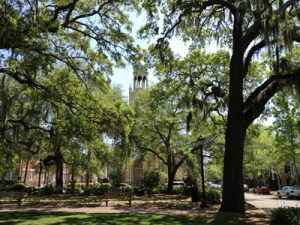
Congregation Mikve IsraelIf you haven’t visited Savannah, it’s well worth a trip. So like its older cousin, Charleston, but so different, with its picturesque squares and somewhat kitschy waterfront. Although it boasts a cathedral to rival any in the US, nobody ever called Savannah the “Holy City,” and it doesn’t exude the studied aristocracy one finds south of Broad.

The city is about a 15 minute drive off I-95 just inside the Georgia/South Carolina border, and easily accessible by nearby Savannah Hilton Head Airport, where Gulfstream bizjets are built. In addition to a Marriott, Hyatt, and Hilton, the squares host a myriad of boutique hotels and B&Bs, and you’ll find the usual assortment of business & tourist hotels nearby (we like the Residence Inn).

A generation ago, you wouldn’t have dared walk around Savannah much away from the waterfront. Then in 1978, the Savannah College of Art and Design was founded, and the transformation has been amazing. We live 20 miles north of downtown and come in about once a month to stroll the squares and parks, stop in at one of the many coffee shops (art colleges seem to attract them), and maybe take in a museum or antebellum home.

More incestuous amplification

Originally, the term refers to the implicit guidance and control link from orientation to observation, which then loops back into orientation. That loop can become locked, so that we only see what we want to see, thereby reinforcing our original orientation.

More generally, it refers to Boyd’s comment at the bottom of Chart 3 of The Essence of Winning and Losing (the infamous OODA “loop” sketch):

Note how orientation shapes observation, shapes decision, shapes action, and in turn is shaped by the feedback and other phenomena coming into our sensing or observing window.

Problems can arise when we limit the range of phenomena so that we don’t detect mismatches in time to do anything about them. Here’s an interesting example, from “What Martial Arts Have to Do With Atheism: An interview with Sam Harris about self-defense and the seduction of faith,” by Graeme Wood at Atlantic.com.

First, an aikido master demonstrating the technique of the “touchless takedown/no-touch knockout” with a group of his students:

And then what happens when he confronts a master who is not one of his students:

[I can’t vouch for the authenticity of either of these. Read the article and decide for yourself.]

Along those same lines, here’s a recent piece in the New York Times that refers to David Freedman’s summary of John Ioannidis’s paper on why so much published, peer-reviewed scientific research is wrong, in that it cannot be reproduced or is contradicted by more precise studies later on. As Freedman’s original article notes:

Simply put, if you’re attracted to ideas that have a good chance of being wrong, and if you’re motivated to prove them right, and if you have a little wiggle room in how you assemble the evidence, you’ll probably succeed in proving wrong theories right.

This is an extremely difficult habit for leaders to break because it requires you fire sycophants (who may be long-time friends or even family members), promote unorthodox or unpleasant employees who habitually tell you the truth, and establish robust ties to the eternal world, even when others inside the organization complain that you’re stepping on their toes.

You’re already doing all this? Oh, really?