Faded glory

Spring is starting in South Carolina’s Lowcountry.

One of the first signs of Spring down here: This old redbud greets visitors to our community.

Every year, though, it puts out fewer blossoms and plays host to more of the ghostly Spanish moss.

I know how it feels.

Boyd and Bolo

January 2 was the 57th anniversary of Operation Bolo, Col Robin Olds’ bold plan to ambush North Vietnamese MiG-21s. Briefly, USAF F-4 Phantom IIs shot down 7 MiG-21s with no losses of their own. Wikipedia has an extensive article on Bolo.

Air Force Col. Robin Olds in Southeast Asia – 1967- commander of the 8th Tactical Fighter Wing. (U.S. Air Force Photo)

So the question arises: Did John Boyd know Robin Olds? Robert Coram mentions Col Olds one time, on page 213 of his bio of Boyd, calling him “legendary,” but doesn’t mention any meetings between them. A potential common thread was Capt Everett “Razz” Raspberry, who had been a student of Boyd’s at the Fighter Weapons School and was Col Chappie James’s wingman on Operation Bolo. Coram details how Razz used the tactics and techniques he learned from Boyd at FWS to great effect in Bolo.

I asked Chuck Spinney, who referred the question to Ray Leopold. Here’s Ray’s answer:


While there’s little doubt in my mind that John Boyd and Robin Olds at least knew of each other, I don’t think they ever collaborated on anything. Bear in mind that Olds, already a triple-Ace, came out of WWII as an Army Air Corps Major, while Boyd was just joining the Army as an enlisted guy destined for our occupation force in Japan.

I had to look this up, but Olds was a Lieutenant Colonel in ’51 and a full Colonel in ’53. He was already a living legend, married to a Hollywood star, and never any indication that Boyd and Olds had ever flown anywhere near one another. Had anything significant happened between the two of them, we would have heard about it, and I never heard anything.

I do recall Boyd making some passing references in small talk about Olds when Olds was in the news for some reason, but nothing of any significance.

I was also there with Boyd the first time (and then every other time) that he visited the AF Academy, and during that first visit he made a point of scheduling an appointment with the Commandant of Cadets (Hoyt S. (Sandy) Vandenberg, Jr., the son of the former AF Chief of Staff, who was the second Commandant of the AF Academy after Robin Olds). I sat with the two of them for about an hour as they talked, and I don’t recall Robin Olds’s name coming up during that conversation.

Regarding Bolo, Boyd respected what Olds, Razz and the others had accomplished, and I think he also had a sense of pride in having briefed so many SEA pilots on his EM work and how they would have the best advantage over their enemy aircraft. I don’t recall Boyd ever mentioning that he had briefed Olds, but he may have. And, I would imagine that if he hadn’t briefed him that Olds was sufficiently interested to have gotten the most pertinent information from either Razz or someone else.

As such, IMHO, Robert’s treatment of this topic, or non-topic, in his book is on target (with his absence of anything significant).


Incidentally, Boyd was already at the Pentagon at the time of Operation Bolo. Coram included Dr. Leopold among Boyd’s acolytes and provided a brief description of his career after the Air Force (p. 441). Perhaps he is best known for being one of the primary creators of the Iridium system, which is still going strong to this very day.

Perils of locked konseptsia

Fascinating new column by Martin van Creveld: ”Konseptsia.”

As he defines it: “a Hebrew word we Israelis often use. It means, roughly, a system of interlocking ideas (sometimes known, in English, as “parameters”) that, taken together, form a framework for thought.”

Readers of this blog will immediately shout “orientation!” and as far as I can tell, you’d be right. I’ll leave it to Martin to illuminate any differences between the concepts.

Details aside, however, Martin’s column is all about locked konseptsia, and he gives three examples: The 1967 War, the 1973 War and the present situation in the Gaza Strip. For each of these, he shows how locked orientation led to disastrous consequences (subsequent heroic efforts to overcome the resulting debacles not withstanding).

So, for example, concerning the events of mid-1967:

As Israel watched, the konseptsia, which said that another war any time soon was highly unlikely, collapsed, triggering a crisis in the government and near panic among the population. In the end it was only by means of a full-scale Israeli offensive against its neighbors that the situation was saved.

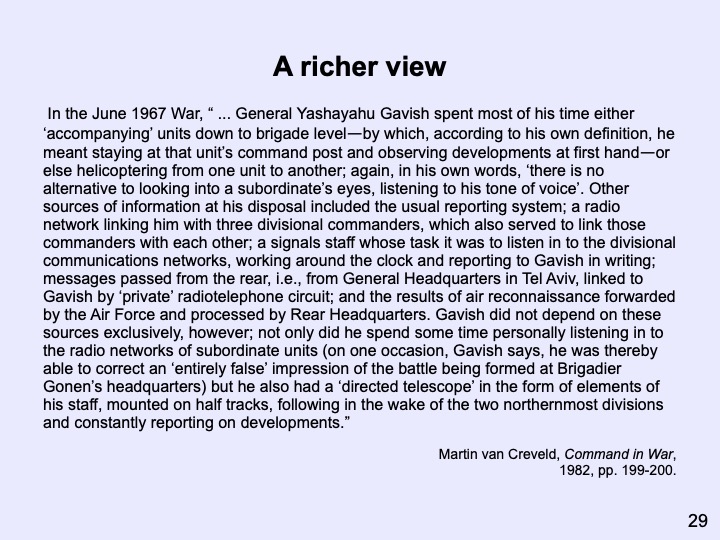
I strongly recommend you read the entire post. Martin van Creveld is one of the world’s most astute military historians and was a significant influence on John Boyd. Here are a couple of charts from Organic Design for Command and Control (all of Boyd’s briefings are available for free download from our Articles page)

and

This notion, of a “directed telescope,” by the way, is very deep and will repay a lot of pondering. I would go so far as to claim (Don Vandergriff — feel free to jump in here) that it is required for mission command to work. To see why this might be, recall that Boyd suggested substituting “Leadership and Appreciation” for “Command and Control,” and here’s his definition of “appreciation”:

Appreciation, as part of leadership, must provide assessment of what is being done in a clear unambiguous way. In this sense, appreciation must not interact nor interfere with system but must discern (not shape) the character/nature of what is being done or about to be done;

Organic Design 34

John Boyd knew Martin van Creveld and recommended his works highly. Perhaps his favorite was Fighting Power (1982) (Expensive, true, but in my view essential to understanding military conflict, including the events of the present day). 

Boyd in Korean

Robert Coram’s Boyd, The Fighter Pilot Who Changed the Art of War, has just been translated into Korean.

It is fitting. As Coram recounted, 1st Lt John Boyd arrived in Korea on March 27, 1953, and on June 30, “Boyd was officially credited with damaging a MiG-15.” It happened on an illegal sortie across the Yalu River, where he was flying wingman for a Royal Air Force exchange officer. It was his only direct combat engagement. Hostilities ended on July 27, before he would have been promoted to element leader and become a “shooter” in his own right. You can read the details beginning on page 49 of the English edition of Boyd.

Through the good offices of Google Translate, I have confirmed that the language is Korean and that the text is indeed Coram’s Boyd (and not, say, Lady Chatterly’s Lover.)

What would Boyd say???

You will remember Colonel Mike Wyly, USMC, ret., from Robert Coram’s book.  I think Robert would agree with me that Mike was much more than an acolyte and was in many ways a peer of John’s.

They were both, for example, colonels when they met. John had years of experience developing and teaching air-air tactics, and Mike had commanded infantry units in combat (Jim Webb, future Secretary of the Navy and U.S. Senator, was one of his platoon leaders).  John had spent a decade researching the basis for what became maneuver warfare, while Mike had written a masters thesis on a related topic and published extensively in the Marine Corps Gazette.

A few days ago, a mutual colleague asked Mike to comment on what Boyd would say about the situation in Israel and Gaza.  Here’s what he wrote:


For the record – here’s MY answer to the question:  “What would Boyd say?”

1. No difference: 

  • Speed – a prompt and speedy OODA when it comes to orienting yourself based on observations, making firm decisions, and turning your decisions into actions.
  • Pit your strengths against enemy weak points.
  • Make multiple thrusts at once into enemy vulnerabilities and into avenues of approach. 
  • Make it look like you are going to do one thing but do something else.
  • Maintain a solid focus of effort (i.e. Schwerpunkt).
  • Be bold.
  • Know when not to obey orders and take the action that will best exploit enemy vulnerabilities.

2. War is a “mind-game”, whether it’s heavy force against heavy, light vs. light, light vs.heavy, or heavy vs. light.

3. It’s not the size of the force that counts. It’s how you employ it. For instance, send me into the jungle to drive a big force that out-numbers me crazy. Or, give me a huge force to concentrate on my outnumbered enemy’s life-blood and I will wipe him out.

Boyd and I used to have these discussions, on and on. Boyd would give me an air-to-air scenario and I’d think it through and reply: “It’s the same on the ground…just terrain features instead of cloud cover, or mountains, etc.

Then I’d pose to him a scenario I had experienced as a rifle company commander in Vietnam. He’d think of a similar situation air-to-air.

In other words, have a fast OODA, moral resolve, and due caution when caution is called for.

I miss him. And the long talks we’d have. Often when the phone would ring in the night and wake me up to that machine-gun voice: “Hey, Mike, I’ve been thinking …


Confusion and disorder

Even if you’ve seen this, it’s well worth a second look.

Even if you know what the OODA loop is — especially if you know what the “loop” is — watch this video. Chuck was present at the creation, and he’s passing along nearly 50 years of experience with Boyd’s concepts.

For example, Boyd says that in a conflict, the key to success is the ability to build and effectively employ snowmobiles. Why? Which snowmobiles? How do we use them? Chuck will give you some insight.

Chuck embeds the “loop” into the entirety of Boyd’s work. As Frans Osinga points out in Science, Strategy, and War, although the OODA Loop is the best known part of Boyd’s writings, in many cases, the only known, it is not the only or perhaps even the most important.

Enjoy.

Where are we going? (and a stab at a fix)

Whisky Tango Foxtrot

by Xenophon

[SEoN Editor’s note: The following is an opinion piece that addresses, to use Boyd’s framework, grand strategy, whose purposes, as suggested on Slide 139 of Patterns of Conflict (available for free download from our Articles page), include:

  • Support national goal;
  • Pump up our resolve, drain away adversary resolve, and attract the uncommitted;
  • End conflict on favorable terms;
  • Ensure that conflict and peace terms do not provide seeds for (unfavorable) future conflict.

As with all guest posts on this site, the opinions expressed are purely those of the author.]


We have a problem

I have a few questions:

  • Why is the United States committing industrial suicide?
  • Why are we not looking at and analyzing the economic models from our global competitors and responding with adjustments of our own to establish counter measures to make us more competitive?
  • Why is our government so addled when it comes to the establishment of industrial and other strategic policies?
  • Why do we continue to pursue a policy of industrial colonialism and chase the cheap labor dollar around the world to the detriment of our own working class?

Continue reading

Who was John Boyd?

Mark McGrath and Brian “Ponch” Rivera discuss this on a podcast with Aaron MacLean. Listen in on Aaron’s site: https://nebulouspodcasts.com/shows/school-of-war/episodes/ep-84:-b.-rivera-and-m.-mcgrath-on-john-boyd

Aaron, incidentally, was featured on a podcast with Mark and Ponch in May: https://nowayout.buzzsprout.com/2109174/12751601-war-conflict-and-lessons-learning-building-better-leaders-with-aaron-maclean

And about a month earlier, I was also on a podcast with them: https://nowayout.buzzsprout.com/2109174/12568242-certain-to-zen-ooda-iohai-lean-and-more-with-chet-richards-phd

Boyd’s acolytes worried that his ideas wouldn’t long survive him. Certainly the Marine Corps’ acquisition of his library was a huge step in ensuring that they did. It seems like the last several years have seen a surge of interest not just in Boyd’s ideas, but, which is vastly more important, using his philosophies to build and test snowmobiles in a variety of domains all across the world.

Inside Detroit’s OODA loops (again)

A couple of quotes from recent articles about the auto industry. The first is from the US, and the second from the UK, but I think you’ll get the idea.

In 2017, for example, there were 11 models available on the U.S. market for less than $20,000, according to Cox data. By the end of 2022, there were four. Then, by March 2023, only 2.

Among the cars discontinued last year was the Chevy Spark, the cheapest of which started at $13,600. Chevy sold more than 24,400 of those cars in 2021 — more than most luxury models can claim. Now, Chevy’s cheapest models cost more than $20,000.

“New cars, once part of the American Dream, now out of reach for many,” Rachel Siegel and Jeanne Whalen, Washington Post, May 7, 2023

And then,

European makers, prominently Ford, abandoning their entry-level models gifts a huge opportunity to predatory Chinese companies.

“Early Chinese cars were like the early efforts from Japanese and Korean makers: bad. No more,” Gavin Green – Car Magazine (UK), June 2023

About 18 months ago, we bought a Volvo XC60, the only car on the lot. It has the Inscription trim package — top of the line at the time — the B5 mild hybrid engine, and the advanced tech package with SAE Level 2 driver automation (same level as Tesla), and several other options. We were a little embarrassed because we really didn’t want anything so fancy, but now, it turns out to be right about the average price for a new car. And yeah, I know, Volvo is owned by Geely, a Chinese auto company (from 1999 – 2010, it was owned by Ford).

Another Podcast

A while back, Mark McGrath and Brian (Ponch) Rivera interviewed me as part of their No Way Out series.

No Way Out with Chet Richards on Apple Podcasts

No Way Out with Chet Richards on SPOTIFY

I had a lot of fun with this, and I hope you enjoy it, too.

As a reminder (for those of you who haven’t had the experience of doing one of these), this video is uncensored, unexpurgated, and most important, unedited. So if you see me making obvious mistakes, or saying something more than usually ludicrous, it’s a deep fake. I swear!

Ponch, incidentally, is co-author of The Flow System, which has a nice section on Boyd’s OODA loop, tying it into the Cynefin framework.