
Accidentally published an unfinished draft (not hard to do in WordPress). It should be up in a day or two.
Boyd’s Theories
Gödel, Destruction, and Creation
One of the most common questions that comes up when people first approach D&C, other than, perhaps, “What in the heck is he talking about??” is why he invokes the three concepts from math & physics: Gödel’s Theorem, the Heisenberg Uncertainty Principle, and the Second Law of Thermodynamics.
I usually hear one of two answers:
- He’s showing off
- They are analogies
The correct answer is “3. None of the above,” but I could be argued into partial credit for answer number 1. He was a fighter pilot, after all.
The Agile Boyd
People who know more about Boyd than the OODA loop often associate him with agility. I’ve heard him described as the High Priest of Agility, much as his predecessor, the Prussian general Carl von Clausewitz is sometimes called the Mahdi of Mass.
This post starts an occasional series on agility within Boyd’s framework. I was prodded into action by an article by Mike Doheny, Venu Nagali, and Florian Weig, “Agile Operations for Volatile Times,” which you may have seen in the McKinsey Quarterly. I don’t know about you, but I find it a little depressing that nearly a generation after The Machine that Changed the World, we are still reading articles touting agility. Tells you something about the state of the art.
Here’s the key sentence:
Notably, these companies aren’t just spotting and mitigating supply chain risks. They are also seeking ways to use volatility to gain advantages over rivals.
What they’re suggesting is that “agility” has something to do with how you “use volatility to gain advantages over rivals.” I couldn’t agree more, leading to the question of how agility fits into Boyd’s framework, which certainly concerns itself with gaining—and exploiting—advantages over rivals.
Oddly, though, mentions of agility are rare indeed in Boyd’s works. If you search Patterns of Conflict, for example, “agility” occurs precisely once, as an item in a list attributed to the German general, Hermann Balck: By example, leaders (at all levels) must demonstrate requisite physical energy, mental agility, and moral authority to inspire subordinates to enthusiastically cooperate and take initiative within superior’s intent. (chart 118) That’s it. Interesting that he singles out mental agility. Even more interesting that the title of this page is “Observations related to Moral Conflict.”
The situation is even more sparse for “Destruction and Creation,” Organic Design, Strategic Game, Conceptual Spiral, and The Essence of Winning and Losing. Not a mention anywhere.
So how is Boyd associated with agility? That’s what we’re going to explore in this series. It turns out that agility does indeed play a central role: You’ll have a hard time understanding his strategy, much less applying it in your own organization, without a deep understanding of his concept of agility. But Boyd did not throw around the term loosely … when he used it at all.
Top of the news
Or at least a couple of interesting items in the Wall St. J. this Friday (before my wife and I compete in a mixed-doubles tennis tournament, which will probably not be so interesting). The Journal is behind a paywall.
Happy days are here again
Fabius Maximus has another post on the financial crisis: US economic update. Everything that follows is a result of what you see here.
I’m not an economist so I can’t comment on his analysis. However, he makes an interesting observation near the end of his post that applies to a lot more than economics:
Under stress people tend to narrow their circle of care. Who is “us” and who is “them”. Coordination both within and between nations becomes less likely; conflict becomes more likely.
Time through the OODA loop
Interesting article in the WSJ today that touches on the role of speed: Companies change their way of thinking (subs. required). One of its messages is that finding and fixing problems quickly is good:
[Intuit founder Scott] Cook said the initiative, termed “Design for Delight,” involves field research with customers to understand their “pain points”—an examination of what frustrates them in their offices and homes.
Intuit staffers then “painstorm” to come up with a variety of solutions to address the problems, and experiment with customers to find the best ones.
Does this mean that time through the OODA loop, which is what this approach describes, is the fundamental driver of business success?
In a sense, it does. If you read the article carefully, or just examine the above closely, you can see that what companies are really getting with their rapid experimentation is better orientation: The more they can create and test their hypotheses, the better understanding they will have.
But it’s what they do with that orientation, compared to what their competitors do, that’s the ultimate driver of success. For one thing, it’s not as simple as I create and test 5 hypotheses and you only did 3 so I win. I could create and test a million hypotheses and never come up with e=mc^2. On the other hand, if we’re in the middle of a world war and I succeed in building a workable atomic weapon before you do, I might have a significant strategic advantage.
Toyota, by the way, takes this approach: For the production system, it’s the time span from customer order to customer delivery that’s important, not the time through any particular machine shop or process, per se. And Apple, you’ll note, seems to introduce products at a fairly regular tempo — when they’ve reached insane greatness. What Apple and Toyota will do is use their higher OODA loop speeds to explore a wider range of possibilities, which gives them more options, within the time interval they’ve selected.
Think fast!
Let me get this out of the way right up front: There is never a time when thinking slow is good. Ever.
So I was a little surprised when a friend alerted me to a piece on the Psychology Today site entitled “Thinking Fast Promotes Risky Behavior,” by Art Markman, a psychologist at the University of Texas. Any well-constructed research will tell you something, will, that is, give you a part or two for a future snowmobile, so I figured it was worth a deeper look. Often you have to dig in see what they did, rather than accept the wisdom of whoever wrote the title.
Patterns of OODA loops
In my brilliant exegesis of Boyd’s Discourse, “Boyd’s Real OODA Loop,” (available through the “Articles” link in the menu bar above), I noted that:
In his presentations on armed conflict—war—Boyd never wrote the term “OODA loop” alone but used the phrase “operating inside opponents’ OODA loops,” which he seemed careful never to define. (p. 9)
Patterns: More pieces and parts
As I suggested in an earlier post, if you look at the structure of Patterns of Conflict, its 185 pages naturally split at no. 126, “Synthesis,” with everything that precedes it forming some type of analysis. In “Destruction and Creation,” Boyd described this analytical process:
… suppose we shatter the correspondence of each domain or concept with its constituent elements. In other words, we imagine the existence of the parts but pretend that the domains or concepts they were previously associated with do not exist. Result: We have many constituents, or particulars, swimming around in a sea of anarchy.
Back from Vegas
Where our first class in the Kennesaw State University’s Executive MBA for Families in Business program held its first class reunion.
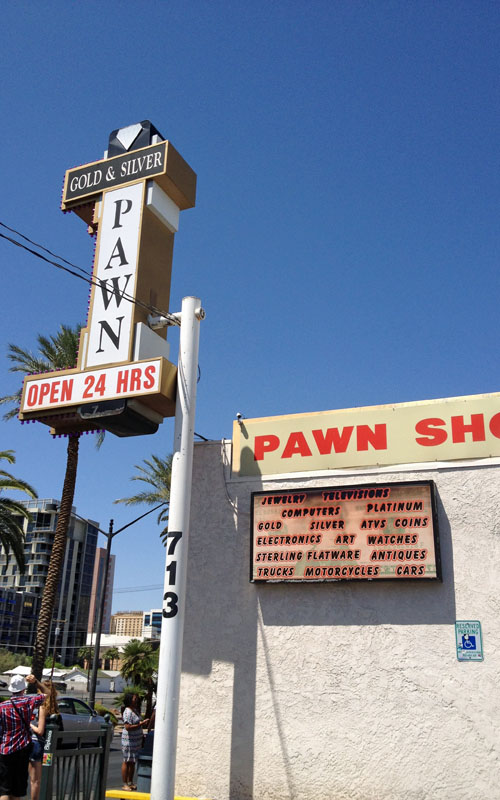 There was a time, of course, when Vegas was a sort of family business. Nowadays, it’s gone corporate. However, there are still some very well known family businesses in the place (left).
We stayed in The Venetian (owned by the Las Vegas Sands Corp.) and in Caesar’s Palace (Caesar’s Entertainment Corp. formerly Harrah’s).
There was a big convention in town, so I sucked up the $339/night price for a room overlooking the parking garage at Caesar’s for Sunday and Monday (ordinarily cheap nights). But on top of that, they wanted, and got, $14.99/day for wireless-only Internet access and asked for, but didn’t get, $25 to use the fitness center for half an hour — I run on the Strip but needed some exercise equipment. There was a Keurig machine in the room — a nice touch for a luxury hotel, I thought, until I saw that they wanted $12 for 4 K-cups. Fortunately a nearby Walgreens had 12-packs for $8.99.
As you can probably tell, I preferred the Venetian, but if you’re in that price range, I would still recommend the grand old lady of the Strip, the Bellagio.
Something about a town where you can step out the main entrance of a 5-star hotel at 4 am to be greeted by a hoard of limos disgorging barely-21s in short skirts and in deep nausea (use your imagination). Nice change from Sun City, but I’m glad to be back with the herons, gators, and noseeums.
The problem with Vegas has always been getting from casino to casino. There are now pedestrian overpasses on the west side from Treasure Island to Mandalay Bay, so walking isn’t as suicidal as it once was. On the east side, there’s still the Monorail ($5/ride or $9/day online), which doesn’t go to the airport, any Strip hotel on the east side north of Harrah’s, or any hotel on the west side at all.
McCarran is still a mess, but it’s getting better. Only about 30 minutes in the security line (Tuesday morning at 10:30 am). The TSA folks were working their butts off, but the airport is what it is. I don’t know who McCarran was, but they must really have hated him/her.
Oh, yes … the class reunion was fantastic. You always wonder if business students really get things like Boyd’s strategy (our program uses Boyd’s framework as our strategic foundation), but from the results they’re showing since they graduated, I feel good about it.
If you want to learn more (and managers in non-family businesses can attend on a space-available basis), please contact the Cox Family Enterprise Center, http://www.kennesaw.edu/fec/
 Slightly East of New
You must be logged in to post a comment.