Revealed!
I’m giving a keynote at the Kanban Global Summit on August 23 in San Diego. Here’s a preview:
See you there!

Revealed!
I’m giving a keynote at the Kanban Global Summit on August 23 in San Diego. Here’s a preview:
See you there!
Shepherd.com has just published my recommendations for your light summer reading. The concept is to explain why people should read one of your books, and then to recommend five others, all around a common theme. I took my inspiration from Boyd, whose basic method was to look for common themes — “invariants” — across a wide variety of domains and then use these as the building blocks for his syntheses.
Here’s an example from his 1987 briefing, Strategic Game of ? and ?
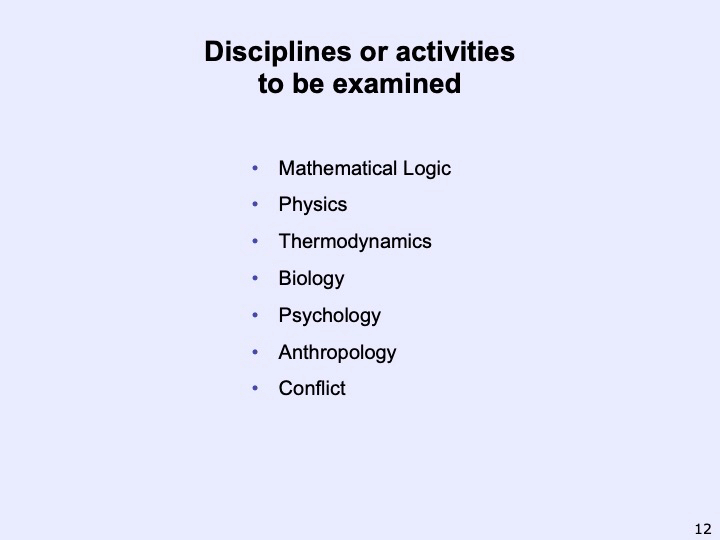
Typical Boyd to begin his presentation on strategy with stuff from mathematical logic and physics. In that spirit, I recommend works from:
And Robert Coram’s Boyd: The Fighter Pilot Who Changed the Art of War.
Just seemed like what every person ought to know. The site limits authors to five books, so I tried to pick subjects that you might have overlooked.
Go check it out: https://shepherd.com/best-books/for-upsetting-your-orientation
A new post by Chuck Spinney on his Blaster blog.
http://chuckspinney.blogspot.com/2022/02/how-narcotic-of-defense-spending.html
Here’s a sample to get you started:
The MICC’s grand-strategic chickens are coming home to roost big time. While war is bad, the Russo-Ukrainian War has the champagne corks quietly popping in the Pentagon, on K Street, in the defense industry, and throughout the halls of Congress. Taxpayers are going to be paying for their party for a long time.
It is no accident that the United States is on the cusp of the Second Cold War.
Future historians may well view the last 30 years as a case study in the institutional survival of the American Military – Industrial – Congressional Complex (MICC), together with its supporting blob now saturating the media, think tanks, academia, and the intelligence community. Perhaps, these future historians will come also to view the Global War on Terror (GWOT) as the bridging operation that greased the transition to Cold War II by keeping defense budgets at Cold War levels after Cold War I ended. Also, 9-11 may have re-acclimated the American people to the climate of fear now needed to sustain Cold War II for the remainder of the 21st Century.
That would be the very first.
One of the most common ways to block change is to challenge, “OK, specifically, what do we do Monday morning?” You really can’t answer with “Oh, read over Patterns of Conflict a dozen times, and then we’ll hold a roundtable on Sun Tzu.” It just doesn’t work. Nor does “Monday morning, right after the meeting on the new promotion criteria, we’ll start working on einheit.*”
And be suspicious of the common suggestion to “create a sense of urgency.” If you really are in a situation where survival on your own terms is at risk, then ensuring a shared perception of reality will be all the motivation you need.
This post offers ideas for creating a solution to the problem of declining competitive power due to cultural reasons. In other words, you have lots of energetic, educated, and experienced people, but compelling products and services aren’t rolling out the door. Corporate entropy: Plenty of energy, but it isn’t accomplishing useful work. In that regard, here’s a short example on Blue Origin vs. Space X: https://arstechnica.com/science/2021/10/revealed-the-secret-notes-of-blue-origin-leaders-trying-to-catch-spacex/

But first, a disclosure. I’ve known David Anderson for some 11 years and have spoken at several of his events. I’ve even been mentioned in one of his books. The reason for bringing up his methodology anyway is that it’s firmly grounded in Boyd’s philosophy and has evolved into a specific answer to “What do we do Monday morning?”
With that in mind, download the “KANBAN Maturity Model: Barriers to Adoption.” Don’t worry about what the words mean at this stage, just read over some of the barriers. Here are a few right at the very first:
LACK OF UNDERSTANDING
LACK OF AGREEMENT
LACK OF TRUST OR INSUFFICIENT EMPATHY
LACK OF CUSTOMER FOCUS OR SERVICE-ORIENTATION
These should seem familiar: Einheit (“mutual trust” was Boyd’s translation)? Schwerpunkt (“focus and direction”)? Orientation (“common outlook/understanding”)? Etc.
There are some real gems as we move through the various maturity levels:
You get the idea. It’s important to keep in mind that these are symptoms. What you need, and what the KMM methodology addresses, are the underlying causes.
I’m certainly not going to claim that this is the only methodology that will get at fundamental causes. But even if you never take the first step up the maturity levels, you might find several useful parts for your snowmobiles in this chart.
Should you be interested in more information, you can visit them at: https://djaa.com. Incidentally, I’ll be doing a keynote at the Kanban Global Summit in San Diego, March 14 – 16, 2022. Not to give away any spoilers, but I shall resurrect “The Lost Arts of Leadership.”
*Observant readers may have noticed the lack of initial caps, or italics, or the odd umlaut in the elements of Boyd’s organizational climate. Got tired of all this, so I’ve declared them to be English words, where we don’t do such things. Consider them recent loan words from German, on a par with autobahn, blitzkrieg, kindergarten, schadenfreude (my personal favorite), and umlaut.
As I’m sure you have been anxiously awaiting. In the meantime, if you haven’t already, go check out Robert Bryce’s interview with Chuck Spinney.
Hello and welcome back to week 9 of the 12-part podcast series. Thanks again for such a positive response. This week we have the second part of the podcast with Chet Richards, author of Certain to Win and long-term friend collaborator with philosopher, John Boyd. We continue reading Boyd backwards as this makes it easier to apply his ideas to normal levels of competition (i.e., non-violent but competitive).
So, if you have yet to listen to part one, I suggest you go there first: Part One.
In this podcast we will be focusing on Organic Design for Command and Control, Patterns of Conflict, and “Destruction and Creation,” and we explore how Chet has applied these ideas in his life. But first, we start with one final insight from Boyd’s Strategic Game of ? and ?
I expect this to be the longest podcast in the series. However, I think it’s worth it – not only for situations where you are stressed right now but worth it for a leadership team that is looking ahead and looking to create a more successful future. Next week, we will be back to an hour or so and the guest will blow your mind! Continue reading
A fascinating interview with one of John Boyd’s closest colleagues.
 Listen here: https://robertbryce.com/episode/franklin-chuck-spinney-author-of-the-defense-death-spiral/ Scroll down on that page for the transcript. Chuck’s exegesis of Boyd’s “Destruction and Creation,” Evolutionary Epistemology, is available on our Articles page, along with a video of his presentation.
Robert Bryce is a Texas-based author, journalist, film producer, and podcaster. He has been writing about energy, power, innovation, and politics for more than 30 years. His books include Smaller Faster Lighter Denser Cheaper and Power Hungry. Bryce is a research fellow at the Austin-based Foundation for Research on Equal Opportunity. His articles have appeared in a myriad of publications including Time, Forbes, Wall Street Journal, and The New York Times. His sixth book, A Question of Power: Electricity and the Wealth of Nations, was published in 2020 by PublicAffairs. He is also the producer of a new feature-length documentary film: Juice: How Electricity Explains the World, which is available on iTunes, Amazon Prime, and numerous other streaming platforms.
BOOKS by Robert Bryce:
Jonathan has kindly provided the intro he wrote for his series, The Art and Science of Success. This is Episode 8:
This week (and next) we are speaking with long time friend and mentor, Chet Richards. Chet is the author of four books, the most famous (and relevant) is Certain to Win: The Strategy of John Boyd, Applied to Business. As many of you will know, John Boyd is the military philosopher whose work, ranging from how to win a war to how we can win in non-violent competitive situations, has had such an impact on our work and on the results we help people achieve.
In this podcast, we look at Boyd’s body of work and, following advice from Chet, we read Boyd backwards. That is, we begin where Boyd finished – looking at how someone can win in life or, in Boyd’s words, how to generate vitality and growth and the essence of winning and losing. We then work our way back to look at how we need to adapt when the situation becomes increasingly challenging or contentious.
At first glance, it may not seem to have much to do with succeeding in the non-violent situations most of us face. However, I have found his work to be the most important work I have integrated into my work. Success in stressful situations does not come from bolting on a few extra steps to a philosophy of action designed for peaceful situations. Success comes from figuring out what works in the most stressful situations imaginable and then stripping the ideas back to suit peaceful situations. Then when the contention or conflict increases, your philosophy is returning to its most natural state. This can give you confidence that your ideas will stand the pressure placed upon them. So I encourage you to give this one a little time to sink in. Now more than ever, we are going to face tests to our philosophy of action.
Here’s the rough outline of our conversation.
00.00 Welcome and Introduction.
02.25 Who was John Boyd and and what did you do with him? (John’s military career, his work figuring what causes someone to win in a dogfight, all the way up to winning in battle).
06.00 Who can handle the fastest rate of change survives.
07.30 Fingertip Intuition (fingerspitzengefuhl) How mastery not resilience is the real key to success in challenging situations.
11.00 Why the Taliban won so quickly.
13.00 The moral (character and relations) is to the physical as three is to one – Napoleon.
15.00 Finding Boyd through Tom Peters – “General, you need to kill more pilots!” Why it’s important to read Boyd backwards.
17.00 The Essence of Winning and Losing. Intuition and the importance of orientation – situational awareness.
21.00 How can we make our under pressure reactions intuitive?
25.50 Boyd and Daniel Kahneman’s Thinking Fast and Slow.
27.30 The Conceptual Spiral – how to win through novelty and mismatches. A.k.a. how to do new stuff?
36.00 Why are mismatches (errors in our understanding or orientation) the most valuable thing to discover?
39.00 How does this relate to both sides of the COVID debate ignoring/shutting down the other?
41.00 Einheit – why mutual trust is essential in a stressful situation.
45.00 Speed and Initiative – what’s the difference and how do they interact?
54.45 Revelation – how to “build snowmobiles” that is how to generate new ideas from the parts of your old ones.
1.02.00 The Strategic Game of ? and ? (The Strategic Game of Isolation and Interaction)
1.06.00 Grand Strategy – how to design a strategy that attracts the neutrals. And the importance of moral isolation.
1.12. Thank you and Close.
A couple of weeks ago, I sat down with a long-time friend and colleague, Jonathan Brown, to talk about John Boyd and discuss some of the major themes of John’s work. To make it more interesting, Jonathan asked me to take the texts in reverse order, that is, starting with The Essence of Winning and Losing, then Conceptual Spiral, and continuing to “Destruction and Creation.”
The first week’s episode made it as far as Strategic Game. Next week’s podcast takes us through Organic Design, Patterns of Conflict, and finally to D&C.
Listen to Part I here: https://player.captivate.fm/episode/e8dab39e-7532-4752-b52f-c715e82150d3
Pandemics. Mutating pandemics. Never ending campaigns followed by never ending counting. Rioting in the streets. Have a great idea for surviving (on our own terms, of course) in these stressful times?
By Artem Grinblat
Republished with permission from https://hackmd.io/@artemciy/how-to-survive
motivation
In order to survive – you want to want to survive.
“13 Reasons Why” TV series is a good recipe: Baker films the reasons not to survive. Invert this. Make a list of reasons to survive. Keep working on them, make space, turn this into a project.
Look for unexpected ideas and inspirations in your past and the present. It might be something you very well know, and something you know nothing about, and things you had no time for or discarded.
frame
Keep tabs on the enemy. If it’s a stress, make a file on it. See how you can exploit it.
To give an example, here are some notes on stress: it “drives all activity”; it’s a currency in “affect regulation”; it can be “your friend”; close encounters with the sources of it sometimes help; “stressors are information” (Taleb); “leadership with monitoring, rather than C&C, seems to be a better way to cope with the multi-faceted aspects of uncertainty, change, and stress” (Boyd); it’s a “fatigue of the body and mind under load” (Gary ‘Smiler’ Turner)”; it makes for a “perfect time for training”; managed, it’s akin to exercise.
In terms of Deliberate Practice – we aim at a richer representation of the subject.
goal
We started with 13 Reasons Why. Then added some Hows. Now put up a What (or two).
Define the positive goal. Make a file on it. Draw it. Film. Find symbols pertaining to it. Keep it in focus.
If you don’t know the goal, leave a blank page to it. Find a temporary substitute. Work on it even without knowing it yet.
Having the goal is pertinent to survival.
redirect
Ask yourself: How these circumstances can help me towards the goal?
Whether something is construed as good or bad initially, chance is, there is an angle or a sequence that can catch the wind of it and propel you forward.
Make some space and time for catching the wind. Level it up to a habit or ritual.
balance
Keep a pace that’s right for you. Allow the project to be around when next you need it. File and avoid the roadblocks. Put in the touches that would help you enjoy that work. Or turn it into a game. Look for cross-field opportunities, when another project can help towards your goal, or when working on your goal can help that other project as well.


You must be logged in to post a comment.