
Most readers of this blog will be familiar with Boyd’s practice of exploring a variety of domains looking for what he called “invariants,” concepts that keep occurring in different fields. Here, for example, is his domain list from Strategic Game of ? and ?
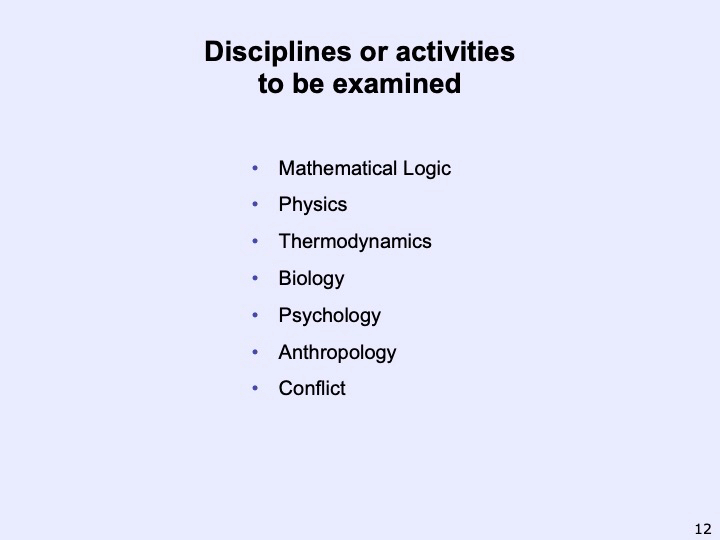
The invariants he found in this collection explain the two question marks (All of Boyd’s works are available for free download from our Articles page).
What you may not be so familiar with is that the process goes both ways. That is, once he distilled out an invariant, it was often applicable to domains outside his original collection. In fact, this was virtually inevitable, as he observed near the end of his life in Conceptual Spiral (1992):
Taken together, the theorems associated with Gödel, Lowenheim & Skolem, Tarski, Church, Turing, Chaitin, and others reveal that not only do the statements representing a theoretical system for explaining some aspect of reality explain that reality inadequately or incompletely but, like it or not, these statements spill out beyond any one system and do so in unpredictable ways (14).
So the OODA loop, which started out as a concept from armed conflict — war — quickly spilled out into business, sports, politics, etc. One could argue that although these aren’t war, they are forms of conflict, thus the application of the OODA loop to them shouldn’t be surprising. But here is something perhaps less expected. This post introduces a paper from Lancaster University in England, “Rethinking reflective practice: John Boyd’s OODA loop as an alternative to Kolb.,” by Mike Ryder and Carolyn Downs (The International Journal of Management Education 20 (2022) 100703), https://www.sciencedirect.com/science/article/pii/S1472811722001057
Let me start by admitting that I have no idea who Kolb was or is and have never heard of “reflective practice.” But what is clear is that the OODA loop is making a major leap from any form of conflict into pedagogy — the art of teaching. Here is the paper’s abstract:
The world is changing and business schools are struggling to keep up. Theories of reflective practice developed by the likes of Schon (1983), Gibbs (1988), Driscoll (1994, 2007) and Kolb (1984, 2015) are outdated and unfit for current purposes. Problems include the chronology of events, the orientation of the observer, the impact of external inputs, and the fact that neither education nor the workplace follow a structured, linear path.
In response to these challenges, we propose a new ‘solution’: John Boyd’s OODA loop. We argue that OODA loops offer the chance to reshape reflective practice and work-based learning for a world in which individuals must cope with ‘an unfolding evolving reality that is uncertain, ever changing and unpredictable’ (Boyd, 1995, slide 1). By embracing the philosophy of John Boyd and his OODA loop theory, business schools can develop greater resilience and employability in graduates, preparing them to embrace change while also embedding the concept of life-long learning to make them better equipped to face the uncertainty that the modern world brings.
I am not going to get involved in debate over reflective practice, whatever that may be. However, having taught Boyd’s philosophy and OODA loop theory in graduate business school, I heartily concur with the last sentence of the abstract.
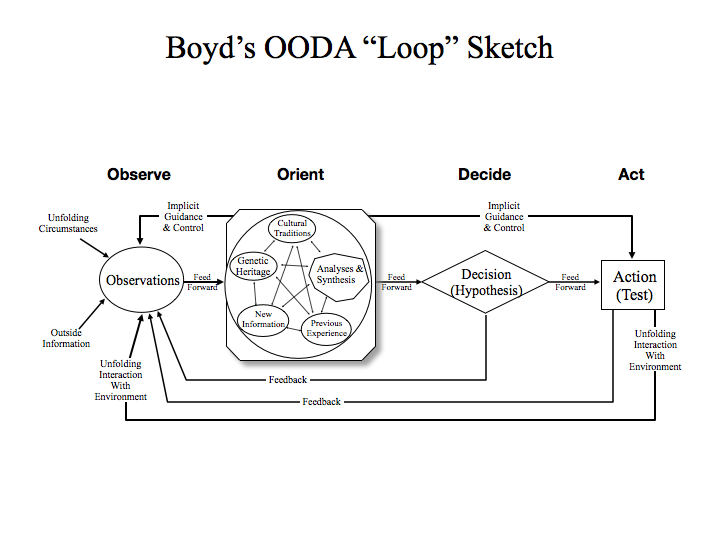
Before you read the paper, one caution. As you will soon discover, I am cited and quoted several times, granting me considerably more credit than I deserve. That being said, this is an excellent exegesis of some of Boyd’s ideas, particularly as they affect the “learning loop,” where we tweak our orientations to keep up with that “unfolding evolving reality” and develop the intuitive actions we need to respond to and influence that world. Boyd described this aspect of the “loop” in Conceptual Spiral, particularly slides 26 – 28, and drew his famous sketch of it in The Essence of Winning and Losing (1996):

Let me illustrate with a few quotes from the paper:
The real value of Boyd’s theory is in its approach to thinking and understanding one’s orientation with respect to the wider world…
A good example might be the student who memorises a long list of management theories and develops excellent speed of recall. While this may be a useful skill to pass an exam, what the student doesn’t gain is the intuitive ability to process factors and apply them to a given situation. This requires a far deeper level of understanding than a textbook or list of management theories can provide. Much rather, it requires knowledge and understanding beyond the formal realms of any given subject: it requires speed of contextual processing, rather than speed of recall.
This is why Boyd’s theory is so useful.
The application of the “loop,” the entire “loop,” to the process of teaching, itself, appears to me to be novel, and for this reason alone, I highly recommend this paper. I’m going to assume most of my audience aren’t professional educators (although we all end up teaching something to somebody at some point …). Whatever your occupation, however, it’s a great example of how ideas spread not by analogy but by first developing a deep understanding of their origins and meanings, and then applying this understanding to new domains.
Boyd first used this approach in “Destruction and Creation,” and, as he explains in the “Abstract” (available on the Articles page), continued to employ it the rest of his life:
Yet, the theme that weaves its way through this Discourse on Winning and Losing is not so much contained within each of the five sections, per se, that make up the Discourse; rather, it is the kind of thinking that both lies behind and makes up its very essence. For the interested, a careful examination will reveal that the increasingly abstract discussion surfaces a process of reaching across many perspectives; pulling each and every one apart (analysis), all the while intuitively looking for those parts of the disassembled perspectives which naturally interconnect with one another to form a higher-order, more general elaboration (synthesis) of what is taking place. As a result, the process not only creates the Discourse but it also represents the key to evolve the tactics, strategies, goals, unifying themes, etc., that permit us to actively shape and adapt to the unfolding world we are a part of, live in, and feed upon.

 week we have the second part of the podcast with Chet Richards, author of Certain to Win and long-term friend collaborator with philosopher, John Boyd. We continue reading Boyd backwards as this makes it easier to apply his ideas to normal levels of competition (i.e., non-violent but competitive).
 Slightly East of New
You must be logged in to post a comment.