
Cracker Barrel succumbs to Boyd

The skyscraper formerly known as the Sears Tower. Chicago, Illinois.

Robert Coram described “Destruction and Creation” as “having a specific gravity approaching that of uranium.” While apt (you can download a copy from our Articles page and draw your own conclusion), Boyd distilled its essence down to a couple of cogent sentences:

According to Gödel we cannot—in general—determine the consistency, hence the character or nature, of an abstract system within itself. According to Heisenberg and the Second Law of Thermodynamics any attempt to do so in the real world will expose uncertainty and generate disorder.

Examples are not hard to find. In a recent column for Inc.com, “Cracker Barrel wanted to cut costs. Instead, it damaged its own brand–again,” author Minda Zetlin noted that the company has gone through a series of mis-steps that define the cliche “mind boggling.” First, they decided to modernize the logo by eliminating anything associated with their homey, country theme — the old man and even the cracker barrel itself — then they got rid of the antiques on the wooden walls (and repainted them an androgynous white).

There was an immediate customer backlash, driving the share price down almost 50%. As Ms. Kalin notes, they did learn from the experience. Sort of. Going into frantic reverse, the company squelched both initiatives. But then, they turned around and did something almost as, shall we say, ineffective. In a panic to cut costs, they issued a directive requiring employees, if at all possible, to only eat at Cracker Barrels while traveling. Once leaked, comments on the directive were brutal. Many were along the line of “even their own employees have to be forced to eat there.”

Ms. Kalin, however, reaches a deeper, more strategic, even Boydian, conclusion: ” … it can prevent employees from checking out other restaurants, looking to see what the competition is doing or discovering new and innovative approaches.” She surmises that the root cause of their problems was that Cracker Barrel execs “were so used to looking at the world from inside their company that they forgot how things looked from the outside.” In other words, success at playing the game inside the company is what got you rewarded and promoted, and over time, this internal focus warped their orientation. As Boyd predicted:

Put another way, we can expect unexplained and disturbing ambiguities, uncertainties, anomalies, or apparent inconsistencies to emerge more and more often. 

I noted this effect, and suggested several antidotes in Certain to Win, chapter VI. Ms. Kalin insists, rightly, that senior execs should interact with customers and “customer-facing employees as part of their regular workweek.” But also, these same senior leaders, not just employees who happen to be on the road, should experience the competition regularly and first hand. Finally, organizations need mechanisms to take all this tactical, front-line knowledge and ensure that it influences their (common implicit*) orientation. Thus are effective actions taken.

In this regard, a shout out to Ford CEO Jim Farley, who imported a Xiaomi SU7, drove it for a while, and described it as “fantastic!” praising its its superior technology, quality, and, specifically, its seamless smartphone integration. There may be hope for Ford.

Here’s a video review of the car, so you can see what he’s talking about.


*As explained on Organic Design 23 (available from our Articles page).

As an aside, last Sunday evening, before seeing this article but aware of CB’s problems, I was returning with a companion from the Rowdy Gaines Invitational Swim Meet in Orlando. Starting with temperatures that broke a 90-year record cold, it had been a long day. So when we stopped for the night in Palm Coast, we wanted some place for dinner that was warm, quick, and close. As luck would have it, there was a Cracker Barrel around the corner. Although it had been a couple of years since my last visit to their chain, it was familiar as soon as we walked in: the roaring fireplace, folksy artifacts, and natural wood walls. Familiar menu, quick service, and a hoot of a waitress. Somehow, it felt like going home. Now why in the world would you want to take that brand and turn it into “just another restaurant”?
Logical End of the K-Shaped Economy

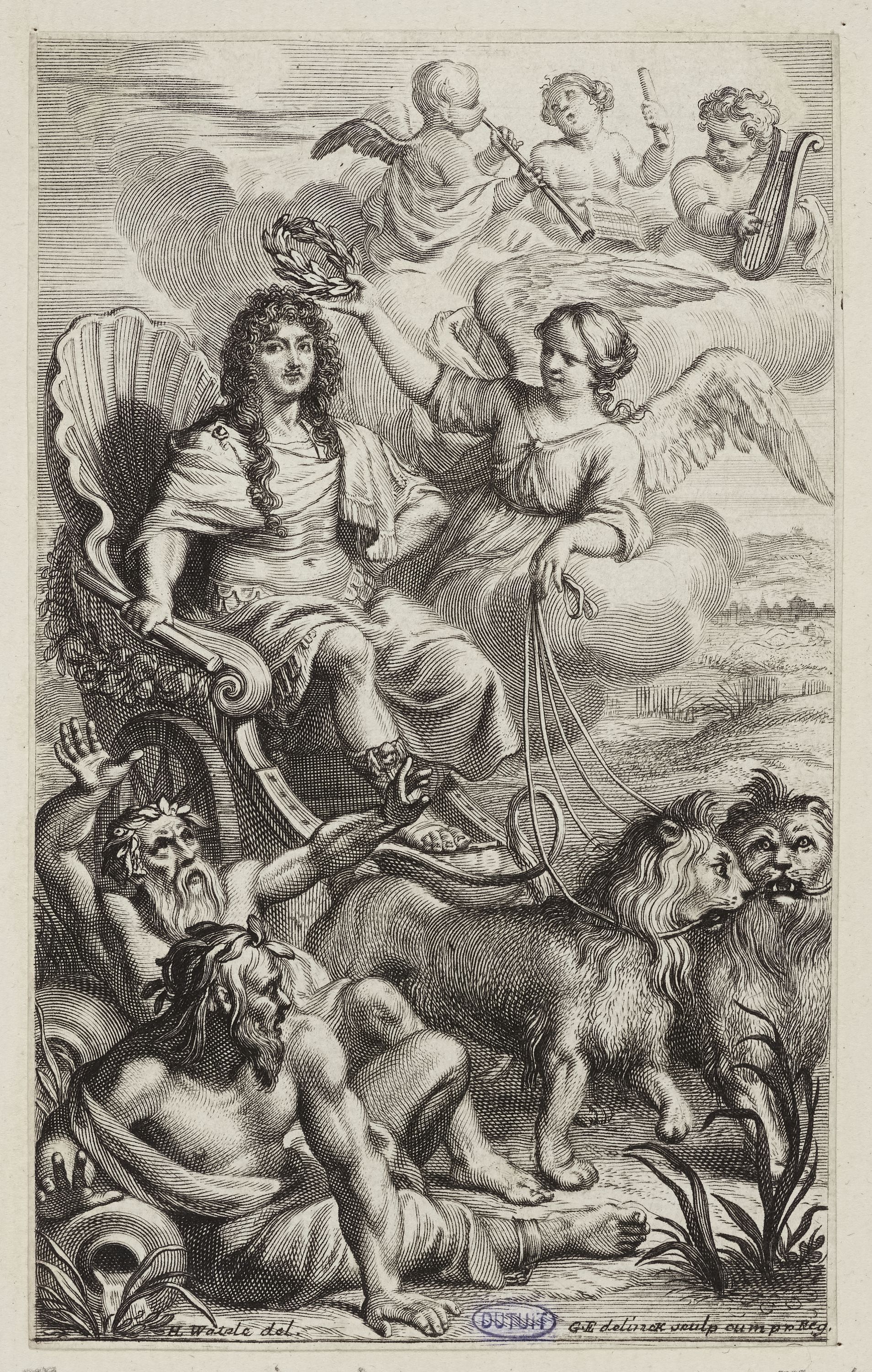
Edelinck, Gérard (n.1640 – d.1707-04-02), Triomphe de Louis XIV (Titre principal). Burin. Petit Palais, musée des Beaux-Arts de la Ville de Paris

[Updated version of my initial press release dated May 2018. I wasn’t wrong, just a bit premature.]

Newly Merged Airline Ends Coach Class Service
A news release

Chet Richards

ATLANTA, Georgia — May 27, 2030— (NYSE:DUA) — DeltaUnited-American (DU-A), the country’s premier global airline, announced today that it is ending coach class service and retiring routes and aircraft that serve the coach market. In conjunction with the move, the airline rolled out a new ultra-premium “Imperial Class.”

According to CFO Jonathan Tripp, the airline obtains 75% of its revenue — and all of its profit — from its premium offerings and upmarket financial services from companies like American Express and Capital One, despite such passengers making up less than 15% of its customers. Over the last five years, however, the airline has begun to face new competition from “semi-private” airlines such as JSX and Blade that offer experiences above first class, which he called “ultra luxury,” sometimes at twice the price.

To better compete in the ultra luxury marketspace, DU-A’s new Imperial Class will occupy the front section of larger aircraft, including select Boeing 777-10s, Boeing 787-10 Dreamliners, and Airbus A350-1500s. Passengers in the new class will travel by helicopter (where available) to special boarding terminals with “transparent” security checks. On board, Imperial Class customers will enjoy staterooms, as is now common on Asian airlines, but with additional amenities including enhanced soundproofing, jacuzzi tubs, salons with fitness, yoga, and massage rooms, and an exclusive on-board lounge. Discrete lightweight carbon fibre walls will separate the Imperial zone from first and business classes.

A unique amenity of Imperial Class is a ratio of one flight attendant per Imperial Suite. “All of our attendants are licensed massage therapists and certified yoga instructors,” noted DU-A Executive Vice President of Marketing and Client Services, Capt. Katherine O’Flannery. Imperial clients will be able to select their attendant online or through the company’s Imperial Courtier service.

“We designed Imperial Class to appeal to the growing number of discerning clients who appreciate the opportunity to show the world what their intelligence and hard work have accomplished,” she elaborated. “Business class, on the other hand, is for high achievers on their way up. I see their work lights on all night,” she explained, “while Imperial is for people who have already made it.” Comparing to semiprivate airlines, she noted that Blade can take you from Chicago to Paris, but “if you want ultra luxury to Beijing, Jo’burg, Buenos Aires, or Singapore, we’ve got you covered.”

When asked about domestic cities where there may not be enough demand to justify all-premium service, she confirmed that the airline plans to stop flying to those places, although they will retain suitable domestic routes with smaller, but still all-premium, aircraft. “Coach just got to be more trouble than it’s worth,” explained Capt. O’Flannery. “Coach passengers always buy the cheapest fares, but they still expect to be treated like royalty. I tell you, though, did you ever see the coach section of a 777 after a 12-hour flight? And those toilets! Our business class clients complain about even being on the same plane with those people, and who can blame them?”

“We’ll let Greyhound or Southwest worry about coach,” insisted Capt. O’Flannery. Commenting on losing the smaller markets now served by DU-A, she suggested that “Imperials who live in Rapid City can fly their Citations into O’Hare where our Rolls will pick them up planeside for flights to Paris and beyond.”

CFO Tripp estimated that the move would initially reduce revenue by some 15-20% but could double the bottom line. Achieving these results, however, will require substantial savings, primarily from headcount efficiencies. “We’re going to have to be vigilant,” he observed, “but the mergers that built DU-A have already structured our senior management bonuses to incentivize the level of savings we’ll need.”

Longer-term, Imperial Class has huge upside potential for revenue enhancement, he concluded. “For this elite segment of the market, price is not only no object, price is the object.”

DU-A unveiled a new corporate motto to complement these initiatives: “The romance of flight for those who can appreciate it.”


[Inspired by “Sorry Virgin – Sex and air travel just don’t mix,” by Natalie Cox, The Guardian, “Comment is Free,” 21 May 2013 http://www.guardiannews.com/commentisfree/2013/may/21/virgin-air-travel-sex-dont-mix%5D

Chet Richards, now retired and living near Hilton Head Island in South Carolina, is a Million Miler on Delta and close to that on Lufthansa. His family is from the South and his father was career Army, so, as he puts it, “we were flying Delta back when they used to swoop down to dust a few crops.” He still has great affection for the airline. Although the vision related in this news release came to him in a dream and originally appeared in this blog on May 27, 2013, the statistics in it are real.