
Once again, social science can help us understand behavior and why, or why not, certain influence strategies may be effective. Jeffrey Pfeffer, Thomas D. Dee II Professor of Organizational Behavior, Stanford University.
What he’s talking about is leadership. Here’s my definition:
Fire up the creativity and initiative of everybody in the organization; harmonize and focus this energy to accomplish the purposes of the organization.
And here’s Boyd’s:
Implies the art of inspiring people to enthusiastically take action toward the achievement of uncommon goals. Organic Design for Command and Control, slide 37 (available from our Articles page)
If you could magically reach in and influence everybody’s mind, leadership under either of these definitions would be much easier. A couple of years ago, I gave a presentation on leadership, The Lost Arts of Leadership, (31.4 MB PDF) to the Kanban Global Summit in San Diego. My thesis was that what Boyd, Pfeffer and I are all talking about is mind control, in particular, over groups of people.
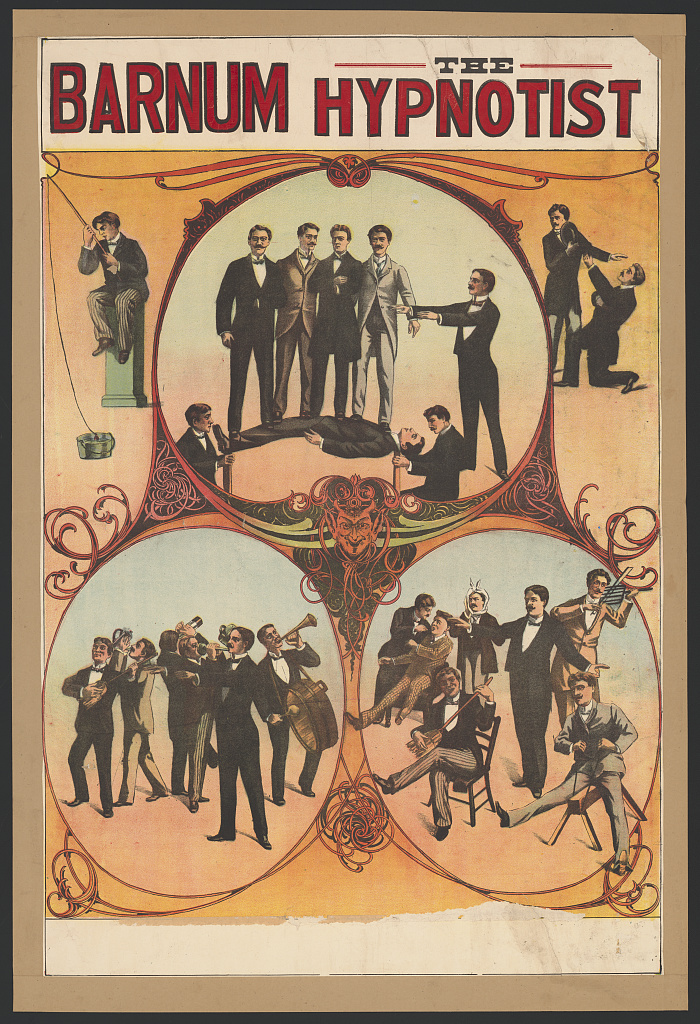
Now before you laugh too hard, note that there are performers who make a good living doing just this, as in the picture above. For a contemporary example, go to Derren Brown’s YouTube channel. If you haven’t watched any of his videos, try one. It doesn’t take much of a stretch to imagine how these techniques could serve the purpose of leadership. And, as I tried to show in my presentation, they have been employed by effective leaders down through history (for better or for worse).
The principles that support leadership also enhance strategy, which can be thought of as leadership but over the opponent rather than within your own organization. The idea of influence strategies — controlling the enemy’s mind, rather than just reacting to his moves — goes way back. Here’s Miyamoto Musashi from 1645:
Using your knowledge of military tactics, think of all the enemies as your own soldiers. Think that you know how to make the enemy move as you wish and try to move the enemy around freely. You are the general. The enemy are soldiers under your command. The Book of Five Rings, Bradford Brown, et al. (1982), p. 78.
I’ve revised the presentation to feature a longer quote by Professor Pfeffer and added a reference in the accompanying notes (152 KB PDF) that provides data on the deleterious effects of picking some arbitrary percentage of employees judged to be poor performers and summarily firing them.
Speaking of the notes, which I highly recommend since they provide commentary and sources that I found interesting but would have made the presentation itself too long, I’ve gone through and (I think) reconciled the notes to the slide numbers.
 Slightly East of New
As someone with 5 decades of experience in a wide range of leadership positions, public and private and volunteers – some very successful, some ugly bombs – I am not excited about any of those definitions. While nice for Napoleon, they are a bit grand for those of us in the trenches.
As for Boyd, if I got “uncommon” goals then I hope I have either uncommon luck or uncommon skills. An understanding of leadership that helped me accomplish regular commonplace goals would be a step up.
As for goals, a big part of the leadership equation is getting followers’ buyin on the specific goals. Even super-duper leaders will have a tough time without that.