
Wellington had considered the relative probability of a French attack at various points; he concluded that the sector from Torres Vedras to the Atlantic was the least likely and could be left mainly in the hands of his static force. Jac Weller, Wellington in the Peninsula, 145.
Deep into Patterns of Conflict, John Boyd finally got around to defining (more or less) the phrase “operating inside the OODA loop”:
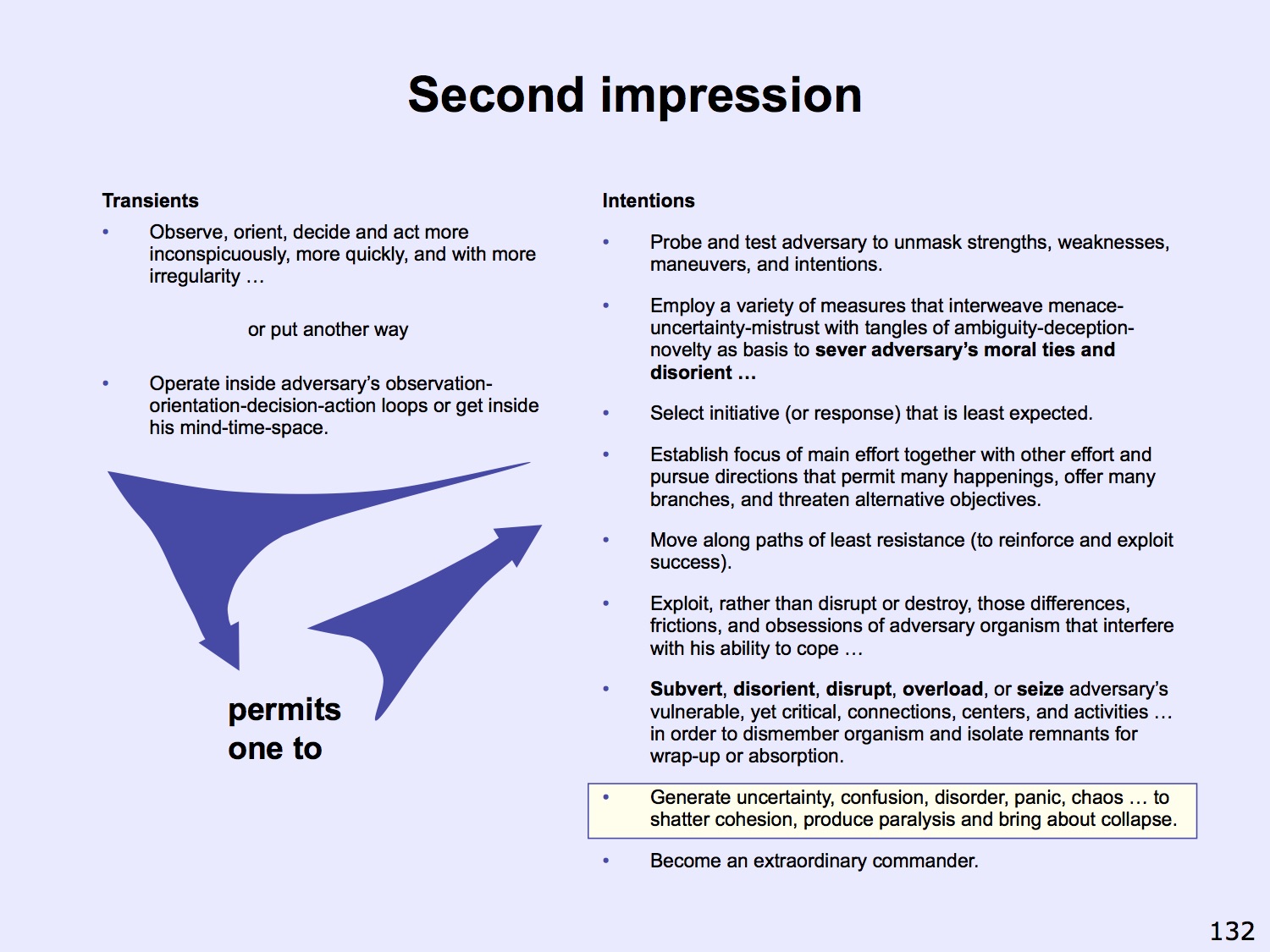
To me, though, the most intriguing thing about this slide is what’s not on it: No mention of probabilities or likelihoods. In fact, the words “probability” and “likelihood” don’t occur in Patterns of Conflict, and you’ll find “likely” just twice, both times as paragraph headings, (“Likely result”).
Why is this? Why wouldn’t you put most of your preparation into what the opponent is most likely to do? Why would you waste time, men, and machinery preparing against something the opponent is highly unlikely to do?
I was reminded of this question again while reading Laurie R. King’s latest, Knave of Diamonds. Sherlock Holmes is passing time practicing his card handling skills dealing three card monte. In that game, the dealer shows the other player three cards, one of which is special — the Ace of Spades, for example — and the other two can be anything, say a couple of minor hearts.
The dealer shuffles the three cards and places them face down. The player, then, wins by picking out the ace. Win and you get back twice your bet.
What is the probability the player wins?
If you said “one third,” you are wrong. The correct answer is zero, which is why in the trade, the other player is called the “mark.”
And which is why my book is called Certain to Win (quoting Sun Tzu), not, More Likely to Do Better.
Wellington, incidentally, virtually always operated inside his opponents’ OODA loops. This explains why, even when outnumbered, he was able to defeat all of the marshals that Napoleon sent against him, and finally defeat Napoleon himself. In the process, he indeed became an extraordinary commander.
We really don’t know what Wellington was thinking in October 1810 when he was disposing his forces at the Lines of Torres Vedras. What I’ve quoted are Jac Weller’s reconstructions a century and a half later for a non-specialist audience. My guess is that instead of rolling the dice, Wellington was thinking something like: If they want to come that way, more power to them. I can hold them with my less capable units while I shift my better forces to deal with them. Wellington was a master of mobile defense, a tactic he often used against the French.
 Slightly East of New
The Borodino Panorama museum in Moscow (built in 1912 at the location of the Council of Fili) is worth a look.