Here’s a tip for you

As I was signing the credit card slip last week, I mentioned to the dentist that he was missing out on a sure source of revenue to the tune of about 18%.

“How? That would double my profit margin.”

“Above the signature, add a line for a tip.”

Ah, the simple solutions are often the best.  We had a polite, if maybe just a little strained, chuckle.

Tipping has always struck me as a bad way to run a business because it doesn’t reinforce the virtues that Boyd associated with superior performance in organizations. As you might recall from Certain to Win, for example, these included his EBFAS climate and his “Theme for Vitality and Growth,” IOHAI.  In particular, it doesn’t seem to do much to promote teamwork, such as wait staff pitching in to help out when one waiter became overloaded, or taking the initiative to solve non-wait-related problems in the restaurant (like tidying up common areas or making suggestions for improvement — kaizen).

Plus, it reinforces a caste system, with some staff on straight hourly wage, some on salary, and one particular group on sub-minimum wage plus tips. Not good for Einheit.

But then, the restaurant business isn’t one I know much about; I don’t have any Fingerspitzengefühl for it.

Turns out, though, that I may be right. Check out restaurateur Jay Porter’s article, “After I banned tipping at my restaurant, the service got better and we made more money.

Note the conclusion, which might come straight out of Boyd:

By removing tipping from the Linkery, we aligned ourselves with every other business model in America. Servers and management could work together toward one goal: giving all of our guests the best possible experience. When we did it well, we all made more money. As you can imagine, it was easy for us to find people who wanted to work in this environment, with clear goals and rewards for succeeding as a team.

One you have everybody together as a team, you can start investing in people and really get the benefit from Boyd’s climate. You may even be able to evolve an implementation of the principles that underlie maneuver warfare and the Toyota Production System/lean production. History suggests that if you do, you’ll wipe the table with the competition (a little pun, sorry).
Incestuous delusion

It’s coming up on 30 years since Chuck Spinney and the group working with Boyd coined the term “incestuous amplification.” You can Google it to see how it has entered the mainstream.

Some of the definitions roughly equate it to “groupthink” or to situations where people limit their associations to those who agree with them.  But the underlying idea can manifest itself in many other ways, none of them beneficial to an organization’s ability to thrive and grow or even to survive.

Chuck’s definition is:  “It occurs when the preconceptions in the decider’s Orientation (which is his/her repository of ideology, belief systems, cultural heritage, previous experiences, education, genetic heritage, etc) misshape the Observations feeding that Orientation.”  As he notes: “Once IA is set into motion and is left uncorrected, it always tears any decision cycle to pieces from within. Boyd showed why there are very fundamental epistemological reasons for this unfolding evolution.” For more detail, see Chuck’s essay “Incestuous amplification and the madness of King George.” Continue reading

Nifty snowmobile

A “snowmobile” is Boyd’s metaphor for creating a solution to a problem, particularly when competitors or opponents — and, therefore, time — enter the picture. The ability to build and employ snowmobiles in the heat of conflict so intrigued Boyd that he made it the heart of his strategy:

A winner is someone — individual or group — who can build snowmobiles, and employ them in an appropriate fashion, when facing uncertainty and unpredictable change. (Revelation)

Here’s a neat new example:  “Not a car or bicycle, but a blend — an ELF vehicle.”

Organic Transit CEO Rob Cotter took technology from aircrafts, boats and bicycles and incorporated them into a “green” 130-pound vehicle.

In Boyd’s framework, a “snowmobile” could be a piece of hardware but more likely it’s a concept or idea for achieving your objective, usually in the face of determined opposition. Even if it is hardware, you have to have an accompanying concept for employing it. Musing on how to do all this eventually led Boyd to his Conceptual Spiral, where snowmobiles become not just hardware or even concepts but underlying virtues like insight, imagination, and initiative. [Conceptual Spiral and the Revelation are available from our Articles page.]

A tip of the hat to Mitch Musgrove out in the San Francisco Bay area for sending me this link!


A couple of delicious articles on Microsoft

First off, I’m  not a Microsoft basher: We have a Windows 7 PC (Dell) that we use for accounting and database work. It was inexpensive and works great more than three years after we bought it.

And I looked at the Surface before buying a Kindle Fire HD 7. Nice little machine, but much too expensive for what I use a tablet for. I didn’t buy an iPad mini, either, for much the same reason. At this point, I should confess that my wife and I own three Macs, an iPad, and two iPhones, and if I can nurse my nearly 5 year old MacBook, which I’m using to write this, until the fall or early 2014, I’ll most likely buy a MacBook Pro.

With that off my chest, there were a couple of great articles this week on the Fall of the House of Microsoft. Continue reading

Temporary insanity

Not long ago, I received an offer to become a “temporary, part-time” faculty member at a local institution. The letter went straight to the shredder, but the thing I remember most was the section that emphasized what I was not entitled to:

  • Health care
  • Any other benefits
  • Physical space at the university
  • Tenure or progress towards tenure in any form
  • Membership in any faculty organization
  • Right to call myself “adjunct”

Other than that, welcome to the team. Continue reading

New Edition of the Origins of Boyd’s Discourse

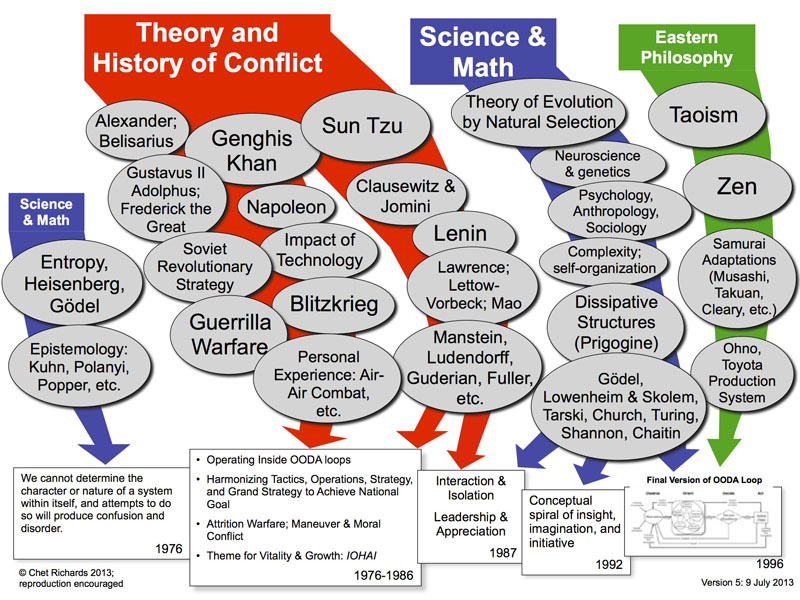
OriginsOfJohnBoydsDiscourseFigureJPEGWhat better way to celebrate US Independence Day, or a slightly belated Canada Day, than with a new edition of “The Origins of Boyd’s Discourse”? Click for a larger view, and a full-sized PDF is now on the Articles page.

Lots of changes, but the basic idea remains the same: To illustrate Boyd’s “many-sided, implicit cross referencing process” at work. As he wrote in his “Abstract”:

As a result, the process not only creates the Discourse but it also represents the key to evolve the tactics, strategies, goals, unifying themes, etc., that permit us to actively shape and adapt to the unfolding world we are a part of, live in, and feed upon.

Some of the changes are:

  • Explicit incorporation of “Destruction and Creation”and Conceptual Spiral
  • Highlighting the theory of evolution by natural selection, which Boyd cites on Patterns 11 as one of the two fundamental sources of his theory of conflict
  • More thematic treatment of the ideas in Patterns of Conflict, rather than just stating their names
  • Edits, rearrangements, formatting, and other kaizen

[If you’re really into the theory of conflict, or just appreciate incredible scenery and intense competition by some of the world’s greatest athletes, the Tour de France is being covered live on the NBCSports cable channel and on various web sites.]

Boyd, Jobs, and Creativity

Steve Jobs, that is. Unfortunately, if you take this path, you may not get a job with Bill Gates or other corporate overlord, and you probably won’t get promoted, but you just might do something wonderful.

Liberal Arts and Humanities Education: Who Is Right—Bill Gates, or the Late Steve Jobs? by Vivek Wadhwa, Fellow, Arthur & Toni Rembe Rock Center for Corporate Governance at Stanford University

When students asked me what subjects they should major in to become a tech entrepreneur, I would say engineering, mathematics, and science. I used to believe that education in these fields was a prerequisite for innovation, and that engineers made the best entrepreneurs.

That was several years ago. Read more

I’ve uploaded a chart I did for zenpundit several years ago showing some of the sources Boyd drew on for the Discourse.  Those of you who have been to the Boyd Collection at Quantico know that he didn’t just dabble in these areas, he devoured them, developing a deep understanding of subjects from military science to quantum mechanics to Taoism. Available on the Articles page.  I’m working on an update, maybe later this month.

At our little PR firm, J. Addams & Partners, we never hired anyone with a PR degree. As the founder, Jeannine Addams often said, if you’re bright and energetic, we can always teach you PR, but we can’t give you a 4-year degree in how to create, write, or think.

Delta CEO: Orientation is the Schwerpunkt

He didn’t actually say that (Boyd did, on Organic Design, 16), but Delta CEO Richard Anderson expressed the sentiment well in a recent interview with the Associated Press. For example:

AP: As you fly around, where do you sit?
ANDERSON: I was in row 28 coming up here. I wear my badge. And I fly in coach.

I really like this, especially because it’s exactly what I recommended that Delta execs should do back when I wrote Certain to Win:

If you’re a high roller with some airline, call your 1-800 telephone number to make a reservation. Try your web site. Stand in line to check in. Check a suitcase. Fly coach. Try to change a reservation. What do you think? Excited by your own stuff? Any sign of magical pizzazz there? Any reason anybody with a choice would do it again? And while you’re back there in coach, talk to people. (p. 157)

I don’t know if he does all of these things, and I also have no idea whether other high Delta execs follow suit (a little pun, sorry). But it’s a very good sign that Delta is getting a lot right.

I’ve also berated loyalty checks — where you only use your company’s products — remember how Detroit auto factories (when there were auto factories in Detroit) used to put signs in their parking lots telling people with imported cars to go park somewhere else?

So I was delighted to read this:

ANDERSON: I’ve done long-haul to Asia. You know what I like to try to do? I like to try to fly on the competition when I go long-haul. I take my little black book and just make notes and observe what’s going on and how the airports are operating, and how your competitors are operating.

Hell yes!  But again, my question would be whether such behavior is part of the Delta culture now; do all Delta personnel fly the competition on a regular basis, and do they report on what they found? Is there an institutional process to use these reports? Put another way, does this information become part of Delta’s common implicit orientation?

Anyway, kudos to Delta. As a Million Miler living in the South, I’ve flown them, and will be flying them, a lot.

Rededication of Boyd Hall

On June 13, 2013, Maj. Gen. John N. T. “Jack” Shanahan, USAF, gave the rededication speech of Boyd Hall at the Weapons Center, Nellis AFB, Nevada.

With the general’s kind permission, I have added a copy of his remarks to our Articles page.  General Shanahan gave a speech for the ages, and if it were possible to have embarrassed Boyd, such encomia might have done the trick.

General Shanahan is the commander of the Air Force Intelligence, Surveillance, and Reconnaissance Agency at Joint Base San Antonio, Lackland, TX. AFISR is the successor unit to my old organization.

Standing on our own two feet

Or not.  I’ve taken up yoga in my old age, both to complement tightness from running and to generally improve posture, breathing, awareness, and relaxation. Sure wish I’d started it about 20 years ago instead after I was 60. Still, 60 is better than 70. Yoga is one activity / philosophy that you can continue to practice as long as you can breathe, so I figure it’s time to get going on it.

SirsasanaThe headstand still needs some work, but it’s coming along. [Click for a larger view, if you promise not to laugh.]  Got a little cocky this morning, let my concentration slip for a millisecond or two, and fell out of it. Typically when that happens you just pull your legs down and do a backwards roll. Problem is that at my age, my inner ears don’t recover as quick as they used to, and I stay queasy for a few minutes. This is also the reason I had to give up roller coasters and probably wouldn’t be any too great as a fighter pilot, either. That and other things.

There are deep parallels between yoga and Boyd’s framework and not just the emphasis on flexibility. In fact, Boyd hardly ever mentions “flexibility” — once in Patterns, on chart 149, for example. Even “flexible” only shows up twice in Patterns, on charts 88 and 128. Somehow, though, you know that Boyd and flexibility are intimately related, but that’s not exactly the connection I have in mind.

More on this later. In the meantime, if you have any thoughts on the subject, please jump in. By the way, I don’t have any information that Boyd ever practiced yoga himself or read much about it. He did take up power walking after he moved to Delray Beach. He also claimed to have a pet alligator.

Namaste.