I visit Austria

Hallstatt

I’d love to, again, but this time it was Austrian economics.

I know very little about Austrian economics, or economics in general, for that matter. Boyd majored in the subject for his undergraduate degree at Iowa (1951), and perhaps you can detect an economic underpinning in his discussions of Soviet revolutionary strategy (Patterns 67-68) and guerrilla warfare (Patterns 90 – 98 and 107 – 109).

It’s also worth noting that he did have at least one book on Austrian economics in his collection:

F.A. Hayek; The Fatal Conceit: The Errors of Socialism, edited by W.W. Bartley III, University of Chicago Press, 1988 annotated

“Annotated” means that he scribbled in the margins and probably on the front and back pages.

With all that in mind, Hunter Hastings, whose LinkedIn description is “Value creation processes built on the principles of Austrian economics,” just published a podcast of our discussion on Boyd and entrepreneurship on his Value Creators Podcast:

As I mentioned in my last post, Hunter and Mark McGrath have written a paper on the many common points between Austrian economics and Boyd’s strategy.
Inside Detroit’s OODA loops (again)

A couple of quotes from recent articles about the auto industry. The first is from the US, and the second from the UK, but I think you’ll get the idea.

In 2017, for example, there were 11 models available on the U.S. market for less than $20,000, according to Cox data. By the end of 2022, there were four. Then, by March 2023, only 2.

Among the cars discontinued last year was the Chevy Spark, the cheapest of which started at $13,600. Chevy sold more than 24,400 of those cars in 2021 — more than most luxury models can claim. Now, Chevy’s cheapest models cost more than $20,000.

“New cars, once part of the American Dream, now out of reach for many,” Rachel Siegel and Jeanne Whalen, Washington Post, May 7, 2023

And then,

European makers, prominently Ford, abandoning their entry-level models gifts a huge opportunity to predatory Chinese companies.

“Early Chinese cars were like the early efforts from Japanese and Korean makers: bad. No more,” Gavin Green – Car Magazine (UK), June 2023

About 18 months ago, we bought a Volvo XC60, the only car on the lot. It has the Inscription trim package — top of the line at the time — the B5 mild hybrid engine, and the advanced tech package with SAE Level 2 driver automation (same level as Tesla), and several other options. We were a little embarrassed because we really didn’t want anything so fancy, but now, it turns out to be right about the average price for a new car. And yeah, I know, Volvo is owned by Geely, a Chinese auto company (from 1999 – 2010, it was owned by Ford).

Another Podcast

A while back, Mark McGrath and Brian (Ponch) Rivera interviewed me as part of their No Way Out series.

No Way Out with Chet Richards on Apple Podcasts

No Way Out with Chet Richards on SPOTIFY

I had a lot of fun with this, and I hope you enjoy it, too.

As a reminder (for those of you who haven’t had the experience of doing one of these), this video is uncensored, unexpurgated, and most important, unedited. So if you see me making obvious mistakes, or saying something more than usually ludicrous, it’s a deep fake. I swear!

Ponch, incidentally, is co-author of The Flow System, which has a nice section on Boyd’s OODA loop, tying it into the Cynefin framework.

Boyd’s OODA “Loop”: What and why?

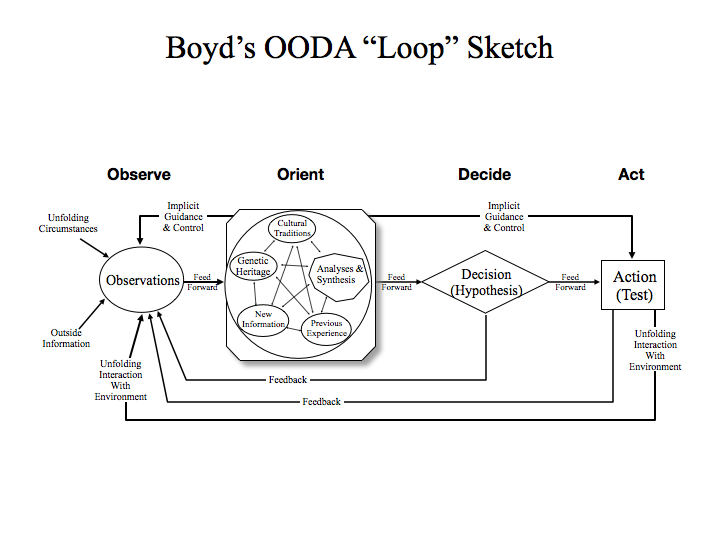
As Frans Osinga pointed out in his 2006 examination of John Boyd’s philosophy of conflict, Science, strategy and war: The strategic theory of John Boyd, the OODA loop is the best known but probably most misunderstood aspect of Boyd’s body of work. Even today, it’s very common to see people describe the OODA loop as a loop. However, when Boyd finally got around to producing a “sketch” of the “loop” (his terms), it was, as I’m sure practically all readers of this blog know, something entirely different.

From “The Essence of Winning and Losing,” 1996.

Why? The reason is that the OODA “loop” is an answer to a specific problem. It is not, for example a model of decision making — in fact, it simply requires you to make implicit and explicit decisions and link them to actions, all the while experimenting and learning.

On November 30, I gave a lecture on this subject to the Swedish Defense University in Stockholm. My host, Johan Ivari, arranged for it to be recorded and made available on the University’s web site. They broke it into two parts:

Part 1 https://play.fhs.se/media/The+OODA-%E2%80%9Dloop%E2%80%9D+lecture+by+Chet+Richards+-+Part+1+-+Setting+the+scene./0_bkfn6gnx

Part 2 https://play.fhs.se/media/The+OODA-%E2%80%9Dloop%E2%80%9D+lecture+by+Chet+Richards+-+Part+2+-+John+Boyd%27s+real+OODA+%E2%80%9CLoop%E2%80%9D+/0_tkvhlxsh

I had a lot of fun with this, and the students asked some great questions. I hope you enjoy it!

By the way, check out some of the other interesting videos on their site.

Magic leadership video now live!

Kanban University has posted the video of my keynote, The Lost Arts of Leadership, and How to Get Them Back, from the Kanban Global Summit in San Diego in August.

Finally, the secret to great leadership is revealed. Shutterstock image.

A couple of points:

  • The speaker’s rostrum was on a platform about 18″ above the floor, and the audience was seated pretty close to it. It made for a dynamic speaking experience, but it also explains why I seem to be bent over a lot.
  • The presentation has several animations which in the interests of readability, the version that accompanies my video doesn’t capture. If you’d like to see them, please download the PDF edition on our Articles page (each stage of a build is a separate slide). Also, I’m using an Apple Pencil to underline, circle, draw arrows and the like. You’ll have to infer these.

There were a lot of interesting presentations. You can view them all on their Conference Archive and their YouTube channel. And don’t forget the helpful and entertaining set of annotations!

Enjoy!!

Antifragility

A subject I know virtually nothing about, apart from the Wikipedia article and a couple of Taleb’s YouTube videos.

That being admitted, here’s the definition from Wikipedia:

Antifragility is a property of systems in which they increase in capability to thrive as a result of stressors, shocks, volatility, noise, mistakes, faults, attacks, or failures.

Certainly sounds like a generalization of “operating inside the OODA loop,” which applies to conflict between sentient organisms and organizations.

I’ll be giving a closing keynote on operating inside the OODA loop at 11:25 ET on November 16 at the Agility, Resilience, and Antifragility 2022 Virtual Conference. It’s free and open to the public, so listen in.

Do you believe in magic?

The Witch of Endor
1 Samuel 28

[11/11/2022 version updates link to annotations] There’s a whole category of leadership practices that are rarely taught nowadays. I’m thinking witchcraft, conjuring, necromancy, divination and the like. People have been practicing these arts for tens of thousands of years — they show up on cave walls and the Bible attests to their power — but you’ll search long and hard to find MBA programs that include them.

So in my keynote at the recently held Kanban Global Summit in San Diego, I set out to remedy this sad state of affairs.

Lycanthropy – a neglected art of leadership
(Shutterstock image)

You can download the PDF (12.3 MB) of my presentation, and I’ve also included a helpful set of notes and annotations. WordPress’s Terms of Service appear to prevent me from including the actual spells, hexes, and curses themselves — a liability thing, you know. This is unfortunate, because we have all had occasions when the ability to transform into a werewolf and rip out somebody’s heart would have proven extremely useful*. But I think you’ll find enough to give your leadership that extra edge you need to be successful in these trying times.

Many thanks to David J. Anderson, founder, honcho, and chief sensei at Kanban University, for inviting me back. The University’s Kanban Maturity Model provides a tested framework for incorporating the OODA loop (the one Boyd intended) into practically any type of organization.

Also, my extreme gratitude to the staff of Kanban University for putting up with all my questions, objections, and negotiations over the past three years — the Summit was originally scheduled for 2020.

And, finally, our host facility, the Rancho Bernado Inn, might be a great place for that mid-winter, or, if you’re from my part of the world, mid-summer getaway.


*If you go around ripping out peoples’ hearts without first transforming into a werewolf, that’s not magic. You may have anger management issues.

Why you should read Certain to Win (and 5 other books)

Shepherd.com has just published my recommendations for your light summer reading.  The concept is to explain why people should read one of your books, and then to recommend five others, all around a common theme.  I took my inspiration from Boyd, whose basic method was to look for common themes — “invariants” —  across a wide variety of domains and then use these as the building blocks for his syntheses.

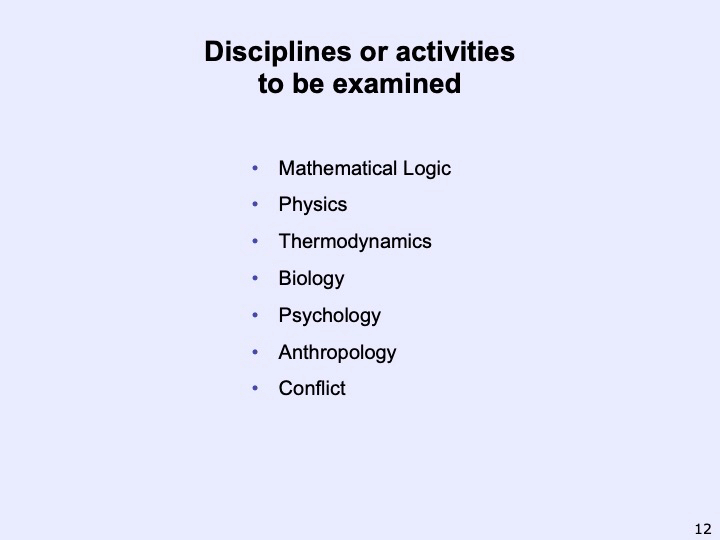
Here’s an example from his 1987 briefing, Strategic Game of ? and ?

SG Slide 12

Typical Boyd to begin his presentation on strategy with stuff from mathematical logic and physics. In that spirit, I recommend works from:

  • Statistics
  • Literature
  • Ancient wisdom & philosophy
  • Anatomy and Physiology

And Robert Coram’s Boyd: The Fighter Pilot Who Changed the Art of War.

Just seemed like what every person ought to know. The site limits authors to five books, so I tried to pick subjects that you might have overlooked.

Go check it out: https://shepherd.com/best-books/for-upsetting-your-orientation