Temporary insanity

Not long ago, I received an offer to become a “temporary, part-time” faculty member at a local institution. The letter went straight to the shredder, but the thing I remember most was the section that emphasized what I was not entitled to:

  • Health care
  • Any other benefits
  • Physical space at the university
  • Tenure or progress towards tenure in any form
  • Membership in any faculty organization
  • Right to call myself “adjunct”

Other than that, welcome to the team. Continue reading

Boyd, Jobs, and Creativity

Steve Jobs, that is. Unfortunately, if you take this path, you may not get a job with Bill Gates or other corporate overlord, and you probably won’t get promoted, but you just might do something wonderful.

Liberal Arts and Humanities Education: Who Is Right—Bill Gates, or the Late Steve Jobs? by Vivek Wadhwa, Fellow, Arthur & Toni Rembe Rock Center for Corporate Governance at Stanford University

When students asked me what subjects they should major in to become a tech entrepreneur, I would say engineering, mathematics, and science. I used to believe that education in these fields was a prerequisite for innovation, and that engineers made the best entrepreneurs.

That was several years ago. Read more

I’ve uploaded a chart I did for zenpundit several years ago showing some of the sources Boyd drew on for the Discourse.  Those of you who have been to the Boyd Collection at Quantico know that he didn’t just dabble in these areas, he devoured them, developing a deep understanding of subjects from military science to quantum mechanics to Taoism. Available on the Articles page.  I’m working on an update, maybe later this month.

At our little PR firm, J. Addams & Partners, we never hired anyone with a PR degree. As the founder, Jeannine Addams often said, if you’re bright and energetic, we can always teach you PR, but we can’t give you a 4-year degree in how to create, write, or think.

Delta CEO: Orientation is the Schwerpunkt

He didn’t actually say that (Boyd did, on Organic Design, 16), but Delta CEO Richard Anderson expressed the sentiment well in a recent interview with the Associated Press. For example:

AP: As you fly around, where do you sit?
ANDERSON: I was in row 28 coming up here. I wear my badge. And I fly in coach.

I really like this, especially because it’s exactly what I recommended that Delta execs should do back when I wrote Certain to Win:

If you’re a high roller with some airline, call your 1-800 telephone number to make a reservation. Try your web site. Stand in line to check in. Check a suitcase. Fly coach. Try to change a reservation. What do you think? Excited by your own stuff? Any sign of magical pizzazz there? Any reason anybody with a choice would do it again? And while you’re back there in coach, talk to people. (p. 157)

I don’t know if he does all of these things, and I also have no idea whether other high Delta execs follow suit (a little pun, sorry). But it’s a very good sign that Delta is getting a lot right.

I’ve also berated loyalty checks — where you only use your company’s products — remember how Detroit auto factories (when there were auto factories in Detroit) used to put signs in their parking lots telling people with imported cars to go park somewhere else?

So I was delighted to read this:

ANDERSON: I’ve done long-haul to Asia. You know what I like to try to do? I like to try to fly on the competition when I go long-haul. I take my little black book and just make notes and observe what’s going on and how the airports are operating, and how your competitors are operating.

Hell yes!  But again, my question would be whether such behavior is part of the Delta culture now; do all Delta personnel fly the competition on a regular basis, and do they report on what they found? Is there an institutional process to use these reports? Put another way, does this information become part of Delta’s common implicit orientation?

Anyway, kudos to Delta. As a Million Miler living in the South, I’ve flown them, and will be flying them, a lot.

Why airlines are like airlines

Great piece by aviation editor Scott McCartney in today’s Wall St. J., “If the World Were Run Like Airlines, Sandwich Prices Would Spike at Peak Hours and ‘Priority’ Elevators at the Hotel Would Cost Extra.” (paywall)

My first thought is, “Be patient, Scott. Give them time.”

In the meantime, here are some off-the-top-of-my-head ideas for why airlines, uniquely among modern industries, can get away with this type of pricing (comments apply to US airlines; I don’t know that much about the others):

  1. They can get away with it because there’s really not that much competition. They may look like they compete, and sometimes they do, but in fact, they’re an oligopoly. If the American-US Air merger is approved, we’ll be down to four major carriers: Delta, United, American, and Southwest.
  2. It is said that when you die and are on your way to Hell, you’ll change planes in Atlanta. Which means Delta in all probability, giving them pricing power at the country’s busiest airport. In Chicago or Houston, it would be United. American gets Dallas.
  3. The customers they want don’t care about the irritations McCartney mentions because business and first class passengers aren’t paying bag fees. Like all industries, airlines want to make a healthy profit at a manageable risk. Easiest way to do that is cater to the folks with lots of money. You can see an obvious sign of that in the new spending requirements for elite status. You can also see the oligopoly element at work.
  4. This suggests a strategy of divvying up those who can afford premium travel. Delta, for example, will get these passengers from Atlanta and most of the South.
  5. The hollowing out of the middle class — and wait until the boomers see how much their 401Ks and interest on CDs will leave them for niceties like air travel — means fewer coach passengers and less margin from those who are left. If you run an airline, lock in your share of the high profit premium passengers now! By any means necessary (to coin a phrase).
  6. Southwest may be a special case and could be where all the coach passengers, those who can afford more than a bus, end up. I don’t know how many that will be, even for Southwest (if they choose to go this route). Southwest started off competing against the bus, but recently they’ve been making eyes at business travelers, too. JetBlue started off in an all-coach configuration, too, but is now adding business class (with mini-suites, no less).
  7. Over time, this will lead to a shrinking down of at least the legacy industry to a luxury provider for those who can afford to pay the price, as I suggested in an earlier post. Because we don’t have much in the way of alternatives in this country for long distance travel, I can only speculate what this means for our continued prosperity.

Newly Merged Airline Ends Coach Class Service

ATLANTA, Georgia — May 27, 2018 — (NYSE:DUA) — DeltaUnited-American (DU-A), the country’s premier global airline, announced today that it is ending coach class service and retiring routes and aircraft that serve the coach market. In conjunction with the move, the airline rolled out a new ultra-premium “Imperial Class,” designed for customers who own smaller jets, are awaiting delivery of their own intercontinental jets, or who appreciate the elevated level of door-to-door service, amenities, and attention to detail that a big airline can provide.

The airline noted that although all-business airlines like Eos and Silverjet have been tried before, but none successfully, the economic climate today is different. DU-A has no problem, for example, selling business-class seats for five times the price of coach, even though the seats only occupy four times the floor space. Competitors like Lufthansa and British Airways profitably operate limited numbers of all-business class flights, and this move is seen as the next logical step. Continue reading

And we thought Apple had lost its touch

Turns out, it’s still highly innovative, just in other areas:

But Irish tax law only considers companies residents of the small European country if they are managed and controlled there. The U.S. Internal Revenue Service, meantime, only counts corporations as American if they are incorporated here.

The result: Apple pays little or no taxes to either country on much of its international revenue, according to the report.

–“Apple Avoids Overseas Taxes, Panel Finds,” WSJ (paywall)

As the article explains, Apple incorporates many of its international operations in Ireland, but “manages and controls” them from Cupertino. One subsidiary didn’t  file a tax return, anywhere, even though it took in nearly $30 BN between 2009 and 2012.

Offense vs. Defense

The question of offense vs. defense is as old as strategy and was discussed most famously by the Prussian general and author, Carl von Clausewitz. Although he maintained the superiority of the defensive (“properly understood”), he was not one to champion a passive approach to war:

Every defensive, according to its strength, will seek to change to the attack as soon as it has exhausted the advantages of the defensive, so therefore, however great or small the defense may be, we still also include in it contingently the overthrow of the enemy as the object which this attack may have and which is to be considered as the proper objective of the defensive. (end of Chapter IV, Book V) Continue reading

Breaking Mayer’s Trade-off?

You may recall the controversy that greeted new Yahoo CEO Marissa Mayer’s decision to ban employees from working at home. I suggested that while such a decision might be useful in the turnaround phase, it does send a message of “We don’t trust you” and so could undermine Einheit if kept in place for too long.

Clive Thompson had another take yesterday on Wired.com: What Marissa Mayer Doesn’t (and Does) Get About White-Collar Work

He cites research (an innovative approach!) that shows advantages to both working at home and at the office, depending on the types of work to be done.

“Thinking work” is invisible and hard to observe accurately. Waber studied one company where a handful of superstar programmers complained that they could only be productive at home. So leave them home, right? Except Waber found that when these stars worked in the office, the firm’s productivity as a whole soared, because they’d answer other coders’ questions. Let them work from home and everyone suffered.

He recommends doing both:

Managers and employees need to assess what type of mental work they’re doing on any given day and gravitate to where it’s best suited. Doing Mad Men–style “aha” groupthink? Stay in the office. Need to crush that 90-page memo on paper-clip appropriations? Seems like the kind of thing best handled at home, possibly in your underwear. One-size-fits-all policies—like the one at Yahoo—are too crude for today’s white-collar toil.

Seems reasonable, but the big question still remains unanswered. Do you trust your employees to make this decision for themselves, or, like one of the companies he cites, do you lay down a fiat that thou shall work at the office on MWF and from wherever you want on TTh? That might solve the work-at-home-or-at-the-office issue, but what do you do when a highly productive employee finishes a critical project by working from home on Friday?

As Thompson suggests at the end, the most successful companies may be those that break the trade-off between control and trust and manage to have both. Boyd’s framework is designed to break exactly this trade-off. As I describe in Certain to Win, it rests on Einheit/mutual trust, shaped by such concepts as Schwerpunkt (focus and direction) and Auftragstaktik (roughly, mission “orders”).

Once you have done the hard work to build Einheit (also “unity” and even “team feeling”; c.f., Patterns 74-79, 118), and once people appreciate the need for both creative individual work and for team interaction (this need being part of your Schwerpunkt), then a little leadership should resolve any problems that come up in day-to-day operations.

Is Toyota Safe?

Of course not, although the record profits [CR Note: actually, the best in 5 years; its record was in the FY ending March 2008] it just posted might make you think so.  In an article in today’s New York Times, company President Akio Toyoda takes the “only the paranoid survive” approach:

“Have we really turned into a company that will be profitable and continue to grow no matter what happens to its business environment?” Mr. Toyoda asked.

“I am not sure yet, is my honest answer. An unprecedented crisis even beyond the scale of the Lehman Shock may happen again,” he said, using a common Japanese reference to the global economic crisis. “We’ll only know the answer when such events actually happen.”

Good attitude.  A couple of clouds on the horizon, though. For one thing, Toyota now faces brutal competition not only from Nissan and Honda but from Hyundai / Kia and, for the first time in years, from GM and Ford (Chrysler is still lagging). And the article in the Times talks about “a company-wide cost reduction drive.”  It’s worth remembering that such short-term thinking is really what got them in trouble in the first place.

Although Toyota’s problems were exacerbated by the recent recession, recalls, and the earthquake, they actually began in the early parts of the century when, in an attempt to accelerate its expansion drive and boost profits, it cut back on training and took shortcuts with its vaunted Toyota Production System. In other words, it started to look like any other car company, with the problems that any other car company faced:

Since 2004 the automaker has had to recall 9.3 million vehicles in the U.S. and Japan—its two biggest markets—up from 2.5 million in the previous three years. The problems got so bad that, in July [2006], Toyota CEO Katsuaki Watanabe felt obliged to bow deeply in apology.

You may remember that in January 2010, Consumer Reports cut Toyota from the companies that it automatically recommends.

As the owner of two Toyotas, I certainly wish them well. But I’d like to see some evidence that they’re refocusing on the values that led them to prominence and not  just chasing next quarter’s numbers.

It’s Still a Wonderful World

My order from Apple has two parts. Yesterday, I posted FEDEX tracking information for the first.

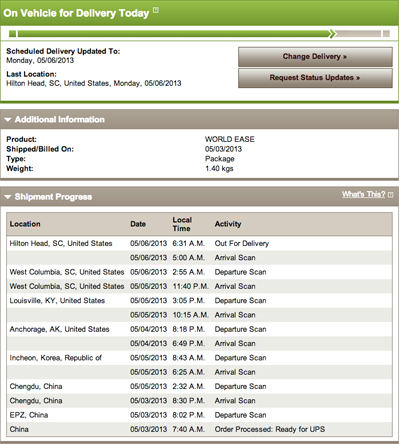
Here’s the second, coming by UPS:

UPS Tracking

Notice that it left China on Friday and is now out for delivery to our house near Hilton Head. By the way, the FEDEX package from yesterday’s post just arrived.

If you’re a local retailer, how do you compete with this? And don’t go whining about sales taxes because Apple collects it. I can think of four approaches:

  1. Have it in stock for customers to feel and play with. This includes accessories.
  2. Instill the EFAS climate among your sales staff. This means Fingerspitzengefühl for both the product and for sales technique (do they know the product inside and out and are they aces at selling?)
  3. Provide a lagniappe. Even if you have to order it for them, give them something extra, something they can take home, in their hands, today.
  4. Sell the whole experience: Provide free coffee (most places won’t let you give out free wine), keep the shop clean, ensure that everybody’s enthusiastic and having fun, and if you do screw up on something, fess up and make it right (screw-ups are your best opportunities to build customer relationships). If you’re the owner, get out on the floor, introduce yourself and mix it up with the customers. If lines get long at checkout (you should wish) lend a hand.