New qi sighting

From Slate.com yesterday:

I’m a frequent Amazon shopper, and over the last few months I’ve noticed a significant improvement in its shipping times. As a subscriber to Amazon’s Prime subscription service, I’m used to getting two-day shipping on most items for free. But on about a third of my purchases, my package arrives after just one day for no extra charge. Sometimes the service is so speedy it seems almost magical. “I Want It Today: How Amazon’s ambitious new push for same-day delivery will destroy local retail,” by Farhad Manjoo. http://slate.me/O8yt5C

Magical — a typical description of a successful zheng/qi operation. Written descriptions date back to Sun Tzu (chapter 5), but the basic idea hasn’t changed: Understand what the other players in your game expect (ideally by helping to shape those expectations), and then when you think the time is ripe, spring the unexpected.

The result in conflict can be paralyzing shock and disorientation (see, for example, Patterns 117). In business, if done well, it can be delighted and fanatically loyal customers, as I describe in Certain to Win, and Apple does so well.

Amazon’s strategy appears to be to use zheng/qi to offset the costs of establishing regional distribution centers and collecting local sales taxes:

[Retailers claim that] If prices were equal, you’d always go with the “instant gratification” of shopping in the real [CR: brick-and-mortar] world. The trouble with that argument is that shopping offline isn’t really “instant”—it takes time to get in the car, go to the store, find what you want, stand in line, and drive back home.

More important, and this is what I find so hard to understand, the people who run retail outlets don’t seem to realize that the one thing they can offer than Amazon can’t is interaction face-to-face with real people. Instead, they appear to regard people purely as costs, and so our experiences with their sales and service forces are often, shall we say, less than satisfying.

[Note: I’m also a subscriber to Amazon Prime and my experiences have been similar.]

Gödel, Destruction, and Creation

One of the most common questions that comes up when people first approach D&C, other than, perhaps, “What in the heck is he talking about??” is why he invokes the three concepts from math & physics: Gödel’s Theorem, the Heisenberg Uncertainty Principle, and the Second Law of Thermodynamics.

I usually hear one of two answers:

  1. He’s showing off
  2. They are analogies

The correct answer is “3. None of the above,” but I could be argued into partial credit for answer number 1. He was a fighter pilot, after all.

Continue reading

The Agile Boyd

People who know more about Boyd than the OODA loop often associate him with agility. I’ve heard him described as the High Priest of Agility, much as his predecessor, the Prussian general Carl von Clausewitz is sometimes called the Mahdi of Mass.

This post starts an occasional series on agility within Boyd’s framework. I was prodded into action by an article by Mike Doheny, Venu Nagali, and Florian Weig,  “Agile Operations for Volatile Times,” which you may have seen in the McKinsey Quarterly. I don’t know about you, but I find it a little depressing that nearly a generation after The Machine that Changed the World, we are still reading articles touting agility. Tells you something about the state of the art.

Here’s the key sentence:

Notably, these companies aren’t just spotting and mitigating supply chain risks. They are also seeking ways to use volatility to gain advantages over rivals.

What they’re suggesting is that “agility” has something to do with how you “use volatility to gain advantages over rivals.” I couldn’t agree more, leading to the question of how agility fits into Boyd’s framework, which certainly concerns itself with gaining—and exploiting—advantages over rivals.

Oddly, though, mentions of agility are rare indeed in Boyd’s works. If you search Patterns of Conflict, for example, “agility” occurs precisely once, as an item in a list attributed to the German general, Hermann Balck:  By example, leaders (at all levels) must demonstrate requisite physical energy, mental agility, and moral authority to inspire subordinates to enthusiastically cooperate and take initiative within superior’s intent. (chart 118) That’s it. Interesting that he singles out mental agility. Even more interesting that the title of this page is “Observations related to Moral Conflict.”

The situation is even more sparse for “Destruction and Creation,” Organic Design, Strategic Game, Conceptual Spiral, and The Essence of Winning and Losing. Not a mention anywhere.

So how is Boyd associated with agility? That’s what we’re going to explore in this series. It turns out that agility does indeed play a central role: You’ll have a hard time understanding his strategy, much less applying it in your own organization, without a deep understanding of his concept of agility. But Boyd did not throw around the term loosely … when he used it at all.

Time through the OODA loop

Interesting article in the WSJ today that touches on the role of speed: Companies change their way of thinking (subs. required). One of its messages is that finding and fixing problems quickly is good:

[Intuit founder Scott] Cook said the initiative, termed “Design for Delight,” involves field research with customers to understand their “pain points”—an examination of what frustrates them in their offices and homes.

Intuit staffers then “painstorm” to come up with a variety of solutions to address the problems, and experiment with customers to find the best ones.

Does this mean that time through the OODA loop, which is what this approach describes, is the fundamental driver of business success?

In a sense, it does. If you read the article carefully, or just examine the above closely, you can see that what companies are really getting with their rapid experimentation is better orientation: The more they can create and test their hypotheses, the better understanding they will have.

But it’s what they do with that orientation, compared to what their competitors do, that’s the ultimate driver of success. For one thing,  it’s not as simple as I create and test 5 hypotheses and you only did 3 so I win.  I could create and test a million hypotheses and never come up with e=mc^2. On the other hand, if we’re in the middle of a world war and I succeed in building a workable atomic weapon before you do, I might have a significant strategic advantage.

Toyota, by the way, takes this approach: For the production system, it’s the time span from customer order to customer delivery that’s important, not the time through any particular machine shop or process, per se. And Apple, you’ll note, seems to introduce products at a fairly regular tempo — when they’ve reached insane greatness. What Apple and Toyota will do is use their higher OODA loop speeds to explore a wider range of possibilities, which gives them more options, within the time interval they’ve selected.

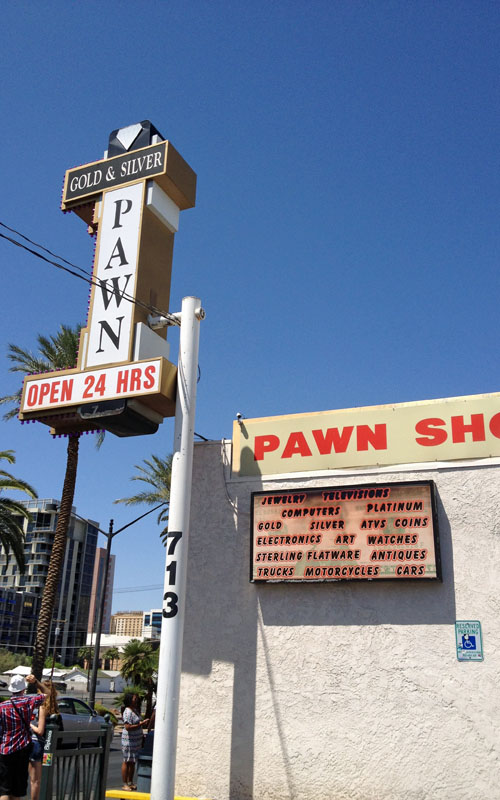
Back from Vegas

Where our first class in the Kennesaw State University’s Executive MBA for Families in Business program held its first class reunion.

There was a time, of course, when Vegas was a sort of family business. Nowadays, it’s gone corporate. However, there are still some very well known family businesses in the place (left).

We stayed in The Venetian (owned by the Las Vegas Sands Corp.) and in Caesar’s Palace (Caesar’s Entertainment Corp. formerly Harrah’s).

There was a big convention in town, so I sucked up the $339/night price for a room overlooking the parking garage at Caesar’s for Sunday and Monday (ordinarily cheap nights). But on top of that, they wanted, and got, $14.99/day for wireless-only Internet access and asked for, but didn’t get, $25 to use the fitness center for half an hour — I run on the Strip but needed some exercise equipment. There was a Keurig machine in the room — a nice touch for a luxury hotel, I thought, until I saw that they wanted $12 for 4 K-cups. Fortunately a nearby Walgreens had 12-packs for $8.99.

As you can probably tell, I preferred the Venetian, but if you’re in that price range, I would still recommend the grand old lady of the Strip, the Bellagio.

Something about a town where you can step out the main entrance of a 5-star hotel at 4 am to be greeted by a hoard of limos disgorging barely-21s in short skirts and in deep nausea (use your imagination). Nice change from Sun City, but I’m glad to be back with the herons, gators, and noseeums.

The problem with Vegas has always been getting from casino to casino. There are now pedestrian overpasses on the west side from Treasure Island to Mandalay Bay, so walking isn’t as suicidal as it once was. On the east side, there’s still the Monorail ($5/ride or $9/day online), which doesn’t go to the airport, any Strip hotel on the east side north of Harrah’s, or any hotel on the west side at all.

McCarran is still a mess, but it’s getting better. Only about 30 minutes in the security line (Tuesday morning at 10:30 am). The TSA folks were working their butts off, but the airport is what it is. I don’t know who McCarran was, but they must really have hated him/her.

Oh, yes … the class reunion was fantastic.  You always wonder if business students really get things like Boyd’s strategy (our program uses Boyd’s framework as our strategic foundation), but from the results they’re showing since they graduated, I feel good about it.

If you want to learn more (and managers in non-family businesses can attend on a space-available basis), please contact the Cox Family Enterprise Center, http://www.kennesaw.edu/fec/

Chart 141, part 2

As a synthesis of all that comes before it, chart 141 will repay a little more study. Like, if you’re at the snowmobile dealer’s, you might want to do more than just admire the paint scheme.

The first thing that might strike you is: What is it with all these levels? There are six, and “grand tactics” has three bullets all to itself. Does it have to be this complicated? Rather than accepting Boyd’s scheme or (God forbid!) trying to memorize it, you might think about this question. If you’re not into large-scale combat on land, then you should ponder whether the notion of “levels” even makes sense for you.

On the next chart, Boyd suggests that for armed conflict,  you’ll need at least two levels, a constructive ideal, represented by the top two, and some concept for compelling opponents to accede to your wishes (the bottom four).  So one thing you might start with is asking if such a scheme makes any sense for other forms of conflict, such as business.

My guess is that because Patterns is primarily concerned with armed conflict on land, Boyd started with the levels that are familiar to practitioners of that art: tactical, operational, and strategic. Roughly these are:

tactical — fighting the battle
operational — what you do between battles; maneuver
strategic — overall concept for the campaign; what you’re trying to accomplish with the battles you do fight

First thing he did is rename the operational level to “grand tactics.”

Next, remember back on chart 2, which I mentioned in an earlier post, one of his purposes was to “help generalize tactics and strategy.” He doesn’t say anything about “grand tactics” or “strategic aim.” In fact, when he briefed chart 2, he would always caution against becoming rigid or dogmatic in your definitions of “tactics” and “strategy.” He’d tell the audience, “strategy” is what you’re trying to accomplish, while “tactics” is how you’re going to do it. If you look at chart 141 again, each level can be thought of as tactics to the more strategic level above it. Put another way, for each level except tactics, the level just below it answers the “how?” question.

This is really interesting. If you are familiar with lean production or the Toyota Production System, you may remember something called the “five whys.” As one of the system’s creators, Taiichi Ohno (Toyota Production System, 1988, p. 17), illustrated it:

1. The machine stopped.
Why?
2. There was an overload and a fuse blew.
Why was there an overload?
3. The bearing was not lubricated properly
Why?
4. The lubrication pump wasn’t working right
Why?
5. The shaft of the pump was worn out.
Why?
6. There was no strainer attached and metal scrap got in.

As Ohno pointed out, if you didn’t go through this process and get to the root cause, you’d replace the fuse and sometime, probably in the near future, you’d have the same problem (and stop production again).

In “The Five Whys,” we’re asking “what caused it?”  If you start at the top of chart 141, you are, essentially, asking, “what are we going to do to make this happen?” or equivalently, “what’s going to cause it?” The distinction is inconsequential. Both produce the insight that leads off IOHAI.

If you start at the top level and ask “How?” five times, you get … six levels.

I’m reasonably sure that Boyd was not aware of the “five whys” when he created chart 141. I have a version of Patterns dated September 1981 that contains this chart with the same six levels (although the definitions did change some in the intervening five years), but as far as I know, Boyd didn’t encounter the five whys concept until he started reading about the TPS in the mid-1980s.

Coincidence? Probably. From his study of Sun Tzu, though, Boyd was familiar with the philosophical infrastructure that underlies both maneuver and moral conflict as well as the Toyota Way (of which the production system is a component). So perhaps five “hows?” just intuitively seemed right to him. This suggests that if your field isn’t armed conflict, you’re still going to want some structure inspired by the five whys/hows.

There’s more we can milk out of chart 141, but this should get you started.

Forget TV, time for Apple to make a car

This reminds me so much of the mp3 player market before October 2001:

Worse, the screen updates fairly slowly — maybe one frame a second. … Over the weekend, I missed a turnoff because the screen showed that I hadn’t reached it yet. Oops.

Like most modern cars’ ambitious electronics systems, this one requires some learning and some studying of the incredibly wretched user manual. There are plenty of typical car-company baffling interface decisions and error messages.

This in the midst of an otherwise glowing review of the new Toyota Prius V in today’s New York Times: http://pogue.blogs.nytimes.com/2012/05/03/the-prius-v-and-its-entune-system

In other words, it’s cool, and it sort of works, but it’s not insanely great.

Surprise! Selling is important

“People in business are clueless about selling, and snobbish too. They view it as a grubby activity, though it is vital to revenue.”

This is the subheading to an article in today’s Wall St. J. (subscription required)

I mean, WTF? People who read the WSJ need to be reminded that selling is “vital to revenue”?

Talk about orientation lock. I guess that so many companies today fall into a couple of categories (occasionally, both):  They are either public with a focus on creative bean counting, or they are still controlled by the founders and harbor a “better mousetrap” mindset. Neither of these see sales as anything other than an unfortunate cost.

You can easily spot such companies. When they decide it’s time for shrinking down, they cut the sales staff by the same percentage as other departments because “everybody has to do their fair share”.

Probably the most stressful position I ever held was in a professional services company (read: beltway bandit) in the DC area. But I will say this for it: It was a boot camp in selling — how to do it and how to train people to do it. I even learned to do it a little myself (a claim that would astonish my former bosses).

In the company right after that one, I watched an incompetent sales campaign blow a $350 million sale. One of the managers of the effort explained that it was no big deal: We’re the only ones making XYZs. Well, 20 years later, they’re still waiting. One of the lessons I learned back in sales boot camp was that you are never essential.  Customers always have something else to spend money on.

In Boyd’s framework, the emphasis is on keeping the initiative, never assuming that your opponent will take any particular action. In business, selling is a large part of taking the initiative. You’re not assuming that your better mousetrap will sell itself because potential customers can always get a free cat from the pound or just decide to live with the little rodents. Instead, you take the initiative and try to direct the money flow in your direction.

Why this isn’t a part of the orientation of everybody in business is beyond me.

The WSJ article is a review of a book, The Art of the Sale by Delves Broughton. One point the book makes is that if you can sell, you can achieve Boyd’s classic injunction, to increase your capacity for independent action. And you don’t have to be H. Ross Perot, who famously left IBM because he was routinely making quota by around the first of February.  I’ve been independent for the last 13 years, and believe me, if I can do it, so can you. Although a stretch in sales boot camp might not be a bad idea.

Boyd’s Really Real OODA Loop

Minor revisions to Boyds Real OODA Loop, dated 13 April 2012 – reflecting some comments and my recent editing of Destruction and Creation.

One way to look at things: D&C describes a cyclical process for creating a system of concepts that we can then use as decision models. So the circular loop is, in a sense, built into it. Patterns of Conflict, as elaborated upon in Organic Design, says that when employing these decision models in an operation or engagement with a thinking opponent, it is best to use the implicit guidance and control link as much as possible (“emphasize implicit over explicit …” Organic Design, 22). The OODA “loop” from The Essence of Winning and Losing, incorporates both of these concepts.

The new edit of D&C is available from the Articles link above and the other briefings  can be downloaded from http://dnipogo.org/john-r-boyd/