Perils of locked konseptsia

Fascinating new column by Martin van Creveld: ”Konseptsia.”

As he defines it: “a Hebrew word we Israelis often use. It means, roughly, a system of interlocking ideas (sometimes known, in English, as “parameters”) that, taken together, form a framework for thought.”

Readers of this blog will immediately shout “orientation!” and as far as I can tell, you’d be right. I’ll leave it to Martin to illuminate any differences between the concepts.

Details aside, however, Martin’s column is all about locked konseptsia, and he gives three examples: The 1967 War, the 1973 War and the present situation in the Gaza Strip. For each of these, he shows how locked orientation led to disastrous consequences (subsequent heroic efforts to overcome the resulting debacles not withstanding).

So, for example, concerning the events of mid-1967:

As Israel watched, the konseptsia, which said that another war any time soon was highly unlikely, collapsed, triggering a crisis in the government and near panic among the population. In the end it was only by means of a full-scale Israeli offensive against its neighbors that the situation was saved.

I strongly recommend you read the entire post. Martin van Creveld is one of the world’s most astute military historians and was a significant influence on John Boyd. Here are a couple of charts from Organic Design for Command and Control (all of Boyd’s briefings are available for free download from our Articles page)
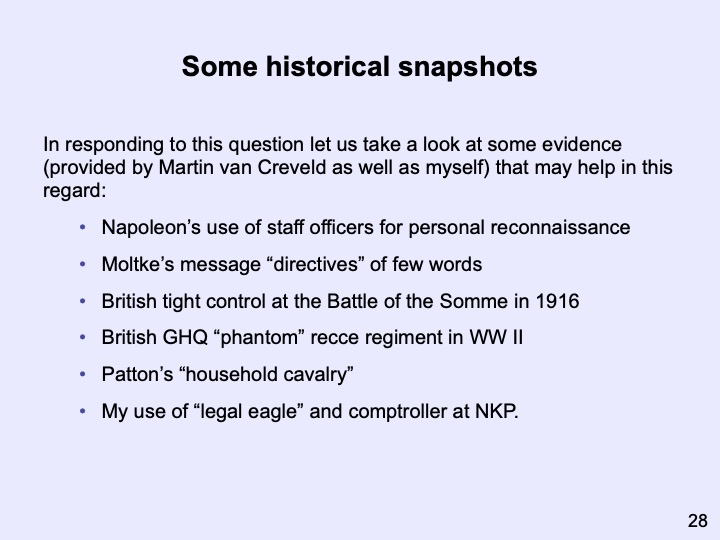
and
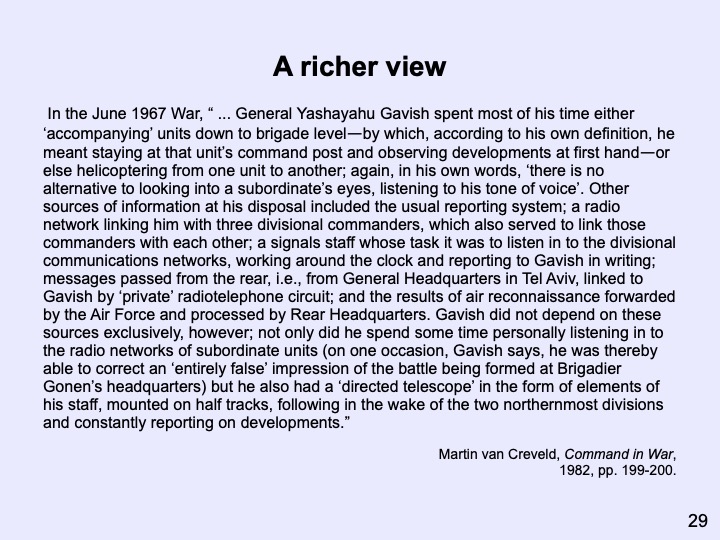
This notion, of a “directed telescope,” by the way, is very deep and will repay a lot of pondering. I would go so far as to claim (Don Vandergriff — feel free to jump in here) that it is required for mission command to work. To see why this might be, recall that Boyd suggested substituting “Leadership and Appreciation” for “Command and Control,” and here’s his definition of “appreciation”:

Appreciation, as part of leadership, must provide assessment of what is being done in a clear unambiguous way. In this sense, appreciation must not interact nor interfere with system but must discern (not shape) the character/nature of what is being done or about to be done;

Organic Design 34

John Boyd knew Martin van Creveld and recommended his works highly. Perhaps his favorite was Fighting Power (1982) (Expensive, true, but in my view essential to understanding military conflict, including the events of the present day). 
What would Boyd say???

You will remember Colonel Mike Wyly, USMC, ret., from Robert Coram’s book.  I think Robert would agree with me that Mike was much more than an acolyte and was in many ways a peer of John’s.

They were both, for example, colonels when they met. John had years of experience developing and teaching air-air tactics, and Mike had commanded infantry units in combat (Jim Webb, future Secretary of the Navy and U.S. Senator, was one of his platoon leaders).  John had spent a decade researching the basis for what became maneuver warfare, while Mike had written a masters thesis on a related topic and published extensively in the Marine Corps Gazette.

A few days ago, a mutual colleague asked Mike to comment on what Boyd would say about the situation in Israel and Gaza.  Here’s what he wrote:


For the record – here’s MY answer to the question:  “What would Boyd say?”

1. No difference: 

  • Speed – a prompt and speedy OODA when it comes to orienting yourself based on observations, making firm decisions, and turning your decisions into actions.
  • Pit your strengths against enemy weak points.
  • Make multiple thrusts at once into enemy vulnerabilities and into avenues of approach. 
  • Make it look like you are going to do one thing but do something else.
  • Maintain a solid focus of effort (i.e. Schwerpunkt).
  • Be bold.
  • Know when not to obey orders and take the action that will best exploit enemy vulnerabilities.

2. War is a “mind-game”, whether it’s heavy force against heavy, light vs. light, light vs.heavy, or heavy vs. light.

3. It’s not the size of the force that counts. It’s how you employ it. For instance, send me into the jungle to drive a big force that out-numbers me crazy. Or, give me a huge force to concentrate on my outnumbered enemy’s life-blood and I will wipe him out.

Boyd and I used to have these discussions, on and on. Boyd would give me an air-to-air scenario and I’d think it through and reply: “It’s the same on the ground…just terrain features instead of cloud cover, or mountains, etc.

Then I’d pose to him a scenario I had experienced as a rifle company commander in Vietnam. He’d think of a similar situation air-to-air.

In other words, have a fast OODA, moral resolve, and due caution when caution is called for.

I miss him. And the long talks we’d have. Often when the phone would ring in the night and wake me up to that machine-gun voice: “Hey, Mike, I’ve been thinking …


How the Narcotic of Defense Spending Undermines a Sensible Grand Strategy

A new post by Chuck Spinney on his Blaster blog.

http://chuckspinney.blogspot.com/2022/02/how-narcotic-of-defense-spending.html

Here’s a sample to get you started:

The MICC’s grand-strategic chickens are coming home to roost big time. While war is bad, the Russo-Ukrainian War has the champagne corks quietly popping in the Pentagon, on K Street, in the defense industry, and throughout the halls of Congress. Taxpayers are going to be paying for their party for a long time.

It is no accident that the United States is on the cusp of the Second Cold War.

Future historians may well view the last 30 years as a case study in the institutional survival of the American Military – Industrial – Congressional Complex (MICC), together with its supporting blob now saturating the media, think tanks, academia, and the intelligence community. Perhaps, these future historians will come also to view the Global War on Terror (GWOT) as the bridging operation that greased the transition to Cold War II by keeping defense budgets at Cold War levels after Cold War I ended. Also, 9-11 may have re-acclimated the American people to the climate of fear now needed to sustain Cold War II for the remainder of the 21st Century.

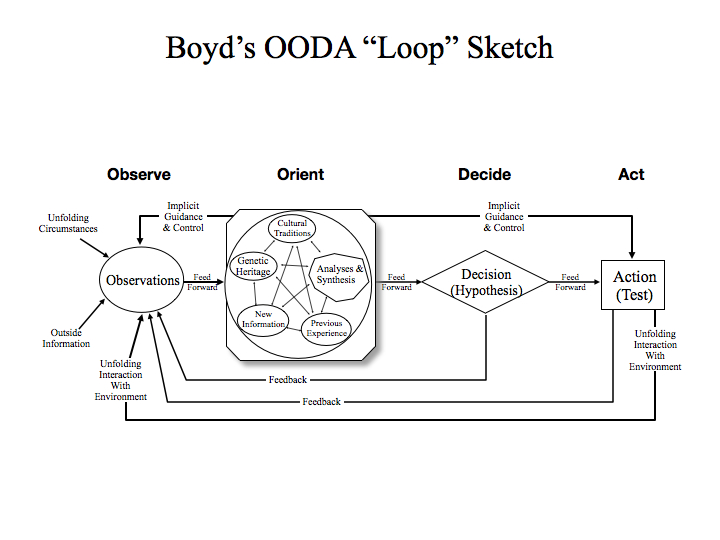
Boyd's OODA 'Loop," Really Final Edition

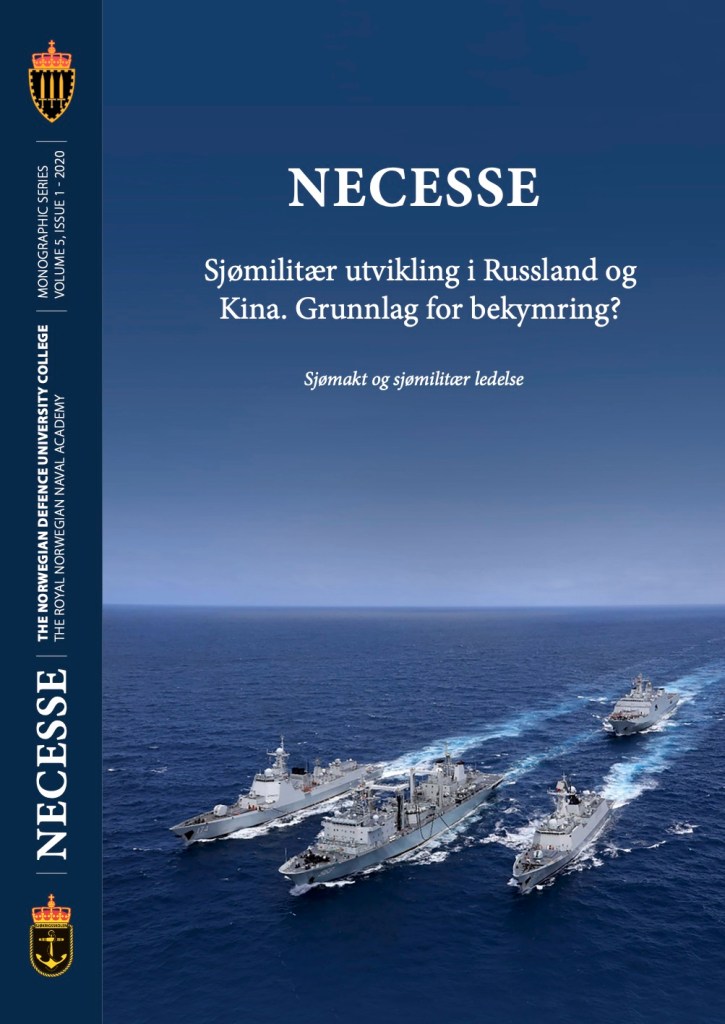
The Norwegian Defense University has just published a new version of “Boyd’s OODA Loop” in their journal, Necesse, edited by Royal Norwegian Naval Academy. I had thought that the previous version was about as close to perfection as can be found on this Earth, but alas Necesse is a peer-reviewed journal, and “Reviewer No. 2” ripped it to shreds. After I calmed down, it was clear that Number 2 was right. So the edition published in the journal is vastly improved over the last version.

As Boyd suggested in his final briefing, The Essence of Winning and Losing (all of Boyd’s works are available for free download on our Articles page), the OODA “loop” is simply a schematic representing three processes and the interplay among them:

  • Using our existing implicit repertoire
  • Creating new and therefore unexpected ways to use our repertoire in the heat of conflict
  • Creating new repertoire, principally by training when not in direct contact with an opponent
From “The Essence of Winning and Losing,” 1996.

In fact, he even called his drawing of the OODA “loop” a “sketch,” strongly indicating that there might be better ways to represent these processes, and over time, people have suggested several.

The folks at Necesse have done a magnificent job of making this rather long and complex paper readable. Although I am sure there are many people involved whom I do not know — you have my sincere gratitude — I would like especially to thank two officers of the Royal Norwegian Navy whom I know quite well and am proud to call colleagues, Commanders Roar Espevik, Main Editor of Necesse, and Tommy Krabberød, who approached me with the idea of a new version of the paper and encouraged me to press on with a major revision as a result of certain peer review comments.

You can download the paper from the Articles page. The current edition of Necesse, which contains the paper, is available at https://fhs.brage.unit.no/fhs-xmlui/handle/11250/2647802, and past issues can be found at https://fhs.brage.unit.no/fhs-xmlui/handle/11250/2559117. It’s an interesting journal. There are quite a few articles in English, and, through the miracle of Google Translate, you should have no trouble with the others. The origin of the name, incidentally, is found on the last page of the journal.

75th anniversary of Operation Hurry On

Nick Engelen

Operation Market Garden evokes images of the classic film A Bridge Too Far, where paratroopers led by Sean Connery fight a pitched battle against the German hordes, while hoping to be relieved by Allied ground forces advancing all the way from the Belgian border towards Arnhem. In September 1944 the Germans were on the backfoot and retreating. In the north of the Belgian borders, there was a huge gap in the German lines. The door to the Third Reich seemed open. Like water, an army attacks the gaps — the voids — and rather than trying to muscle trough the Siegfried line, Field Marshal Montgomery saw the opportunity to take the path of least resistance to bypass these defensive lines and attack the Rurh area, Germany’s industrial heart.

However a 24-hour pause not only made the allies lose momentum but also gave German commanders the opportunity to reorganize their retreating forces and send them right back to grind the allied advance to a halt. This and some other factors resulted in the what’s now called a magnificent disaster wherein more people lost their lives than during the landings in Normandy.

Continue reading

Creating agile leaders

All forms of mission-oriented leadership, from maneuver warfare to the Toyota Production System, share a common foundation: Fire up the creativity and initiative of all members of the organization and harmonize their efforts to accomplish the objectives of the organization. Such an orientation allows them to create and exploit fleeting opportunities before their opponents can understand what is going on.

As Don Vandergriff quotes one of the principal architects of the German blitzkrieg:

The principle thing now is to increase the responsibilities of the individual man, particularly his independence of action, and thereby to increase the efficiency of the entire army. . . .The limitations imposed by exterior circumstances cause us to give the mind more freedom of activity, with the profitable result of increasing the ability of the individual.

HANS VON SEECKT, Commander of the German Army, 1920 -1926

This approach is often called Auftragstaktik, and it is hard to find any military organization that doesn’t claim to be using it.

Continue reading

Magic and illusion: Foundation for leadership

Aspiring leaders typically concentrate on history and case studies, creating theories of success and failure in their disciplines.  This is fine but won’t produce great practitioners in either war or business. As the German General Hermann Balck once told Boyd, “The training of the infantryman can never be too many sided.”  Miyamoto Musashi in 1645 wrote that samurai (much less top-level commanders) should study the arts and sciences and master fields other than their own. And this was just to keep them from getting hacked to bits. And then there’s Steve Jobs with his famous calligraphy course and Zen training. Continue reading

Samhandling: Enabling Auftragstaktik

Samhandlung

Military Strategies for Samhandling in Unforeseen Situations – A Historical Perspective,
do Cdr Tommy Krabberød, Ph.D., and Dr. Jan O. Jacobsen,
Royal Norwegian Naval Academy

Chapter 25 in Interaction: ‘Samhandling’ Under Risk, A step ahead of the unforeseen, Glenn-Egil Torgersen, Ed., Oslo, NO: Cappelen Damm Akademisk, 2018, pp. 467-480.

I know what you’re thinking: OMG! Another post on Auftragstaktik! Just kill me now.

I am assuming that most of my readers are familiar with Auftragstaktik (if not, search this site or Google the term). Even if you are, or perhaps especially, I think you’ll find Krabberød and Jacobsen’s paper well worth your time.

Continue reading

Is it agility or adaptability?

I tend to think of “agility” as adaptability with a time dimension, that is, the ability to adapt more rapidly to new situations than can competitors or opponents.  That may not, however, be the only or even a very good way to think about these concepts.

Here’s an alternative view:

AQ is hot right now – but is it the Adaptability Quotient or the Agility Quotient?

Kristopher Floyd
Founder and CEO, TeamMate AIDao-TheWay

November 13, 2018
Originally published on LinkedIn. Reprinted with his kind permission

Throughout military history, there have been winners and losers. Some of the winners have found disproportionate success due to strategic brilliance; when examining their successes, we find a golden braid that links them all together. This braid is the foundation of an underlying philosophy that dictates how military forces can survive and thrive in hyper-competitive, chaotic, uncertain situations. Continue reading

Boyd in South Africa?

As far as I know, Boyd never made it to South Africa, but a recent book describes how the ideas of maneuver warfare were used by its forces in their highly irregular “border war” (1966 – 1990).  I have not read the book, but here is a recommendation by a colleague who is familiar with some of its primary participants.

If any of you would like to write a review, please contact me.

Maneuver Warfare in Southern Africa
Book recommendation by Morgan Norval*

Speaking of maneuver war, I want to direct your attention to a recent book titled, Mobile Warfare For Africa: On The Successful Conduct Of Wars In Africa And Beyond–Lessons Learned From The South African Border War by Roland De Vries, Camille Burger and Willem Steenkamp. The book explores Lind’s 4th Generation War concept, Boyd’s OODA loop, and utilizing the indirect approach. In fact the book is basically a text on mobile/maneuver war based on its very successful use by the old South African Defense Force. The book also has over a dozen case studies on the subject. The book also comes with a separate atlas which provides maps, illustrations and photos–including three of mine–to help understand the concepts advocated by the book. Continue reading