In our backyard this morning

With Tropical Depression Beryl barreling down, at least so we hope. So far, we’ve had virtually no rain, but it looks like the Okefenokee, which has lost more than half its acreage to fire, is getting a good soak.

When the wind is right (wrong?), we get a lot of smoke from the fires down there, more than a hundred miles away.

The heron is standing in a golf cart track, watching the action on the 13th tee.

Quantum Blues

Legendary bluesman Sam Chatmon (1899 – 1983) would never fly to concerts. If he couldn’t go by car or bus, he didn’t go. When asked why, he explained:

It ain’t that I’m scared of flying. It’s just that if I’m up there and it’s somebody else’s time to go … I don’t want to have to ride down with’em.

You have to let that one sink in for a minute.

Chatmon was from Hollandale, once a vibrant hub of the blues in the Mississippi Delta, on Hwy 61 about 20 miles from my wife’s home south of Inverness.

[Many thanks to the article “Sittin’ on top of the world,” by Hank Burdine in the May/June 2012 issue of Delta Magazine, pp. 38-40.]

Agiity and deception

Fighting for Honor
The history of African martial arts traditions in the Atlantic world
by T.J. Desch Obi
University of South Carolina Press, 2008
346 pages, including 124 pages of notes and bibliography

Reviewed by Chet Richards

Kum yali, kum buba tambe! (He is tricky, so I will win by being tricky, too!)

As a southerner of European ancestry, I had long wondered how slave owners kept control over their victims. On many plantations, slaves vastly outnumbered owners and overseers, and because of the hard nature of their work, many slaves were in much better physical conditions than their owners. Why didn’t the slaves revolt or simply leave?

It turns out that many did. Most Americans are familiar with the Underground Railroad and may even recall the Nat Turner Rebellion (1831), the Fugitive Slave Acts (1793 and 1850) and the Dred Scott Decision (1857). But there are a couple of other ways slaves used to preserve their honor and sometimes even their freedom. One of these was “maroonage,” where they would abandon their plantations and settle in the swamps, rugged hills and dense forests of the South. It has been estimated, for example, that the Great Dismal Swamp of southeastern Virginia and northeastern North Carolina may have harbored maroon communities totaling perhaps 2,000 escaped slaves.

The other was simply to resist. As T. J. Obi meticulously documents in this study, Africans and their descendents brought with them an arsenal of well developed martial arts styles. These provided the basis for preserving honor withing the slave communities and even, on occasion, to resist vicious beatings by overseers.

There were two keys to making this work: deception, because an unarmed defender had to close with his attacker, and agility, to avoid weapons and complete the attack. Obi includes these under the label “tricknology.”

When fighting a white oppressor, the ideal was to strike a butting-style head blow and finish the fight before it even developed. … As such butts had to be delivered at close range to be effective, a fighter had to use trickery to close the distance under some innocuous disguise.  (p. 109)

Readers familiar with Boyd will immediately recognize the concept of “operating inside the OODA loop.”

The book itself is quite academic and heavily footnoted, reflecting its origins in doctoral research. That said, however, it’s not a heavy read and is packed with interesting tidbits. Did you know that maroon communities survive to this day in the mountains of Jamaica, where they won their freedom by successful resistance some 50 years before the official abolition of slavery in that colony? And slave societies developed all manner of methods to conceal their existence from their owners. In one area, for example, the message “weevils in the wheat” meant that overseers had discovered that a meeting was planned and so it was being postponed.

Perhaps the most fascinating conclusion of the book is that African martial arts techniques still survive in the Americas. Perhaps the best known example is the Brazilian capoiera, but Dr. Obi’s research on site in the low country of the Carolinas documents their existence in the Gullah communities and their descendents into the 21st century.

[You want agility? Check out this YouTube video of a capoiera demo. The kicks and sweeps from inverted positions are typical of Angolan fighting styles.]


America’s First Metropolis?

This could rate near the top of the Greatest Wonders You’ve Never Heard Of category. Suppose that here in the United States, in Louisiana, there were the remains of a city older than Troy. We’re not talking about a few mud huts around a campfire but a city of several thousand souls built on more than 7 miles of raised structures and adjacent to a mound containing some 27 million cubic feet of packed earth.

That mound, known as “Bird Mound” for the agreed interpretation of its shape as seen from above, once stood some 100 feet tall. It was apparently built in one spectacular three-month effort. A quick calculation suggests this would require a  worker population of 2,000 – 3,000 people that would have to be fed and managed for this period. Even at its remaining 72 feet, it is the second largest mound surviving in the US, next only to the somewhat later Monks Mound in Illinois.

What really makes Poverty Point interesting is that the 7 miles of living structures are laid out in a precise geometrical pattern of 6 concentric semi circular ridges, each roughly 6 feet high. Obviously this indicates a high degree of planning and social organization — people didn’t just say “I’ll build my hut over there, by that stream.”

And every one of the 27 million cubic feet of earth for the Bird Mound was carried to the site manually in hand-woven baskets. To make it even more intriguing, there is no sign of agriculture. This 400 acre site was apparently built by hunter-gatherers. Think about that in terms of surplus calories.

Enormous kudos to the State of Louisiana for maintaining it in superb condition. Poverty Point is a candidate for UNESCO World Heritage status.

How to get there: It’s about 15 miles off I-20  between Vicksburg and Monroe, about an hour and a half from the Jackson airport. Directions and other information on their web site.

More ideas for an expedition off the beaten path in my next post.

The Help

Or, “Ole Miss Strikes Again,” the first time being, of course, The Blind Side.  (A post in our Southern Ambiance series.)

I was living in Mississippi in 1963 when the story takes place, and despite some of the criticism you may have read, the movie accurately portrays the attitudes of part of the white elite of the time.  For one thing, unlike some of the uneducated redneck population, the white power structure did not, by and large, consider itself racist.  There’s a line in the movie where Hilly (wonderfully played by Bryce Dallas Howard, Hollywood elite herself, and raised in Connecticut) tells Skeeter to be careful because there are racists out there and she could get hurt. This is while Hilly is pushing a law to require bathroom facilities for the black help to be moved outdoors.

For more on this attitude, which seems so patronizing to us today, read William Alexander Percy’s 1941 memoir, Lanterns on the Levee, where he writes in all seriousness, for example, that every southern white man is “owned” by at least one black man (who essentially regards him as another parent and funding source.)  And Percy was considered scandalously liberal for his day.

Continue reading

Covington’s Famous Son

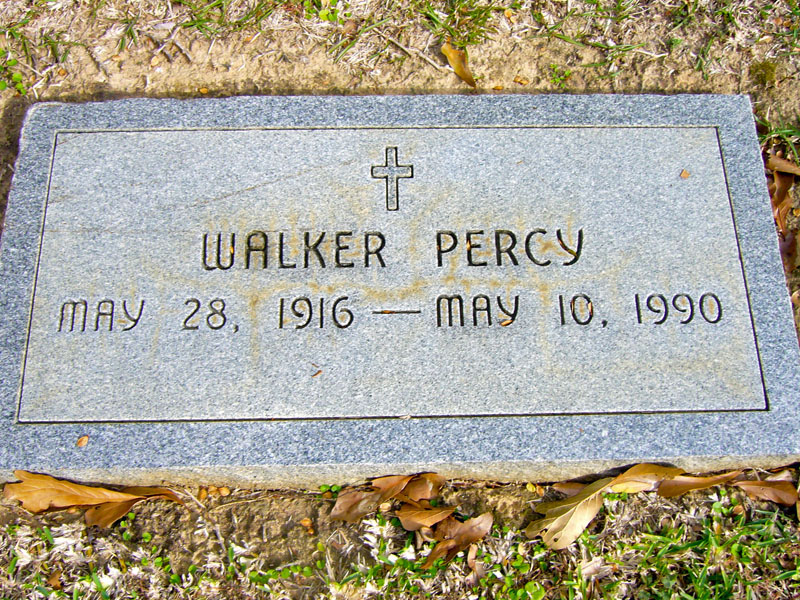
Walker Percy — who was born in Birmingham, AL, spent his formative years with his uncle William Alexander Percy in Greenville, MS, and earned his MD from Columbia — lived in Covington, LA, from 1950 until his death in 1990.  He has long been one of my favorite writers. Today, Ginger and I went exploring for traces of his life here.

We haven’t found his home, yet. But several sources indicated that he was buried in the cemetery at St. Joseph Abbey about three miles north of town. So with the assistance of the handy iPhone, we headed off in that direction.

We had no idea what to expect — guards at the gate? Inquisitors lurking in the parking lot? As it turns out, we shouldn’t have worried. A seminarian pointed us in the direction of the cemetery, where a brother and his friend took us to Percy’s grave site.

After an enlightening 15 minutes or so discussing Catholic influences on Percy’s writing, they left us to contemplate his grave and the ethereal beauty of the abbey grounds.

I can see why one of America’s greatest authors would choose this for his final resting place.

At Miss Eudora’s Place

In Jackson, Mississippi.  We stopped by after visiting Willie Morris in nearby Yazoo City.  Eudora Welty (1910 – 2001) was that fascinating combination of a very private person who was certainly not a recluse.  Although she lived by herself in the family home for years after her mother died, she traveled widely and loved entertaining friends.

Her house in the Fondren District of Jackson has been preserved as it was in 1990, when she was still an active author.  As you would expect for a master craftsman of the written word, her place is a treasure trove of books. She was an eclectic reader, and when her house was readied for public view, curators counted over 5000 of them.

Take the E. Fortification St. exit off I-55.

Although you could walk to downtown Jackson, her home is an oasis of tranquility, and her garden still provides inspiration for any artist. Oddly, her office faced a relatively busy cut-through street, but it let her type her manuscripts while listening to the the sounds carrying over from the music department at Belhaven College across the street.  It also let visitors see if she was in so they could ask for autographs.

Hey, Willie

Again.

My wife and I were shocked when Willie Morris died back in 1999. A couple of years later, we went by his grave to pay our respects, and I guess I should point out that we had met Willie several times, have all his books, and have most of them autographed. Once I asked him for advice on getting published and he gave he his agent’s name and phone number. They must not have been getting along that well. [Click photo to enlarge.]

We were driving from Ginger’s ancestral home in the Delta down to Jackson today when we got the idea to stop by and see Willie again. It wasn’t hard to find the cemetery, but once we got in the place, everything seemed strange, even more than they usually do in cemeteries. After driving around for a while, we got the bright idea to Google “willie morris gravesite” on our iPhones, and after some thrashing about in the 2G world of ATT in Yazoo City, managed to find the phone number of the Yazoo Convention and Visitors Bureau.

A very nice lady told me to start walking back towards the main entrance and look for the black fountain. When I got there, she said to turn around and start walking away from the fountain and there was the grave of the Witch of Yazoo! Shivers started to run down my spine (read Good Old Boy to find out why). “Now, carefully turn to the right and walk 13 steps.” There it was, a new headstone but the same bottle of bourbon. Glad to be back, Willie. How you gettin’ along?

Ben was a better man than thou

From Today’s New York Times, the wisdom of sage Joe Queenan:

Thus, I was thrilled when my son decided to attend Franklin & Marshall College, founded in 1787 with £200 ponied up by Franklin, even though the tuition nearly bankrupted me. I would not have footed the bill had he decided to attend, say, Ole Miss or Central Connecticut State or Oral Roberts. I just wouldn’t have.

So, what did your son get for this budget-busting tuition?  The ability to critique Ben Franklin as does his old man?  Joe, for example, hammers Ben Franklin for being an idiot:

Why would the wise man walk, not run, when escaping from fire, a woman or an enemy? I’d run.

Well, Joe, perhaps as this Ole Miss graduate can explain to you, you might walk, rather than run, for several reasons:

  • So you don’t trip or knock into people, particularly those who are trying to deal with the problem
  • So you don’t give aid and comfort to the enemy by running away
  • So you don’t panic everybody around you
  • So you maintain your options and agility — easier to make an abrupt shift in directions when you don’t have so much momentum
  • So you stay oriented — again easier to do if you keep your head up looking around

Yes, Joe.  Amazing what you can learn at a state land grant university, in this case one offering more than 40 accredited doctoral programs, with the active research programs that support them (compare to F&M’s … zero).  And you didn’t want to write a check to Ole Miss because …

[John Boyd, the person whose work inspired my short list, had degrees from  the University of Iowa and Georgia Tech, both state-supported schools that would not have “nearly bankrupted” Queenan.  Guess that he wouldn’t have written a check to them, either.]