Is the bloom off the rose?

Chris Matyszczyk has a nice piece over on Cnet:  What would Apple have to do to ruin your relationship?

One answer is: Be seen as violating what you consider as the moral bond between you & Apple, and Matyszczyk lists several possibilities:

  • Apple starts to knock off early by producing things that look like, well, knock-offs of other Apple products. Or worse, of things that are already out there.
  • So what if Apple keeps on suing to defend the patently indefensible? What if Apple sues BlackBerry with a claim that it has the patent on the, um, keyboard? Do we suddenly look at Cupertino and feel the love has died? Do we decide that we were in love with a bully and, well, nobody likes a bully? Continue reading

It’s not change

I am affiliated with the Executive MBA for Families in Business program at Kennesaw State University near Atlanta. We use Boyd’s framework as the strategy component of the course, and although the students become proficient in Boyd by program’s end, you sometimes wonder how they’re doing in applying it in their own businesses.

So it’s always good to hear a success story. Here’s an interview that one of our alums, Mikee Johnson, did recently with a business website here in South Carolina. He’s CEO of a lumber treatment company, Cox Enterprises, that weathered the housing downturn and is now back on its expansion track.

You’ll find Boyd woven throughout, but pay close attention around 8:10 where he notes that “it’s not change, it’s the speed of change” that drives business strategy nowadays.

You might recall from New Conception for Air-to-Air Combat (chart 24):

He who can handle the quickest rate of change survives.

If you’re interested in information on the EMBA program (and we may admit non-family students on a space-available basis), please contact the director, Kristi Stoudenmire, at kmcmilla@kennesaw.edu.


Veterans Day 2012

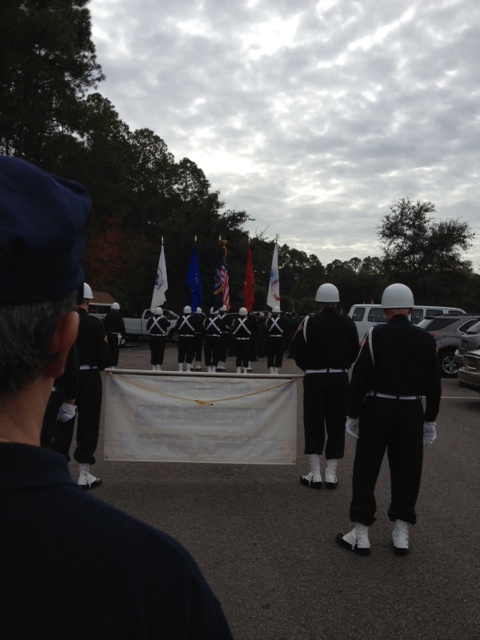
Where I live in South Carolina, we have a Veterans Association, and a couple of times a year, a few of us form up and march in a mini-parade. We have vets from WWII on (you have to be 55 or older to live here), and although most of us are not combat veterans, we feel it’s important to honor those who did go into the line of fire.

My late father definitely falls into the latter category: veteran of Bataan, where he won the Silver Star, and survivor of 3 1/2 years in Japanese prison camps. Later, he commanded the 1st Recon Squadron of the famed 2nd Armored Cavalry Regiment. I wear his 2A/C unit crest on my hat, next to my Air Force pin.

There is a lot of controversy over our occupations of Iraq and Afghanistan, but we need to keep those discussions separate from our acknowledgement of those who served honorably there and in our country’s other battles.

Here’s to you, Dad. Toujuors Pret.

A Romney win

Whether you supported Obama, Romney, or whether the word “support” overstated your interest in the affair, the 2012 presidential election is a wonderful case study in how our orientation guides our observation.

Peggy Noonan has another of her perceptive columns in the November 8 Wall St. J. (subscription required). Early on, she gives a link to her column of three days earlier where she predicted “I think it’s Romney” and then laid out all the reasons why. Looking back, every one of them was an anecdote — a tired-looking Obama, the perceived enthusiasm of the Romney crowds, the number of yard signs in Florida. As she summarized it: “All the vibrations are right.” Continue reading

In his year

Many years ago, I asked a Saudi friend of mine if he didn’t long for the day democracy would come to the Kingdom (Scotch is not that hard to find over there if you know the right people, and he was the right people). He smiled and answered to the effect “Look, I have a business to run. It’s not my job to pick the government. That’s what we have a royal family for, and honestly, I think they do a better job than your system of letting anybody vote, whether they graduated sixth grade or not.” Continue reading

Tom Barnett endorses Romney

Unexpected, to say the least, because Tom usually describes himself as a Democrat. His reasoning is interesting:

The sad truth about a second Obama presidency

Tom is quite familiar with Boyd’s work, and I admit to being a big fan of what he’s trying to achieve. Where we differ is on method: He still supports large armies, talks about power projection, solves the problem of terrorism by “killing bad guys,” and thinks that economics is driven by how many sub-minimum wage workers you have.

On the other hand, he considers our level of strategic thinking as “pathetic.” Here’s a briefing that he gave last year.  Pay close attention to his strategy for dealing with Afghanistan and South Asia. You may not agree with it, but it is refreshingly out of the box.

All in all, we have much more in common than any points of disagreement, and I consider him as one of our best geopolitical strategists. I think that after watching this, you’ll understand why he isn’t a senior figure in the administration, the more the loss for the rest of us.


Ghosts of Ole Miss

Just caught Wright Thompson’s “Ghosts of Ole Miss” on ESPN. The film documents the integration of Ole Miss by James Meredith in September 1962, an event some consider as the last battle of the Civil War.

As it turns out, I was a student at University High School in Oxford on that fateful night, but slept through the whole thing (as did James Meredith).

Native Mississippian and Oxford resident Thompson did a brilliant job of capturing the social climate that led to the riot as well as the long period of rebuilding and redemption. It’s hard for me to explain what Mississippi was like in 1962 and how far we’ve come: We now have, for example, a black homecoming queen and student body president (both elected by the students).

The film also honored the 1962 Ole Miss Rebels, who went undefeated that fall and whose success played not a small role in helping the university recover.

I have three degrees from Ole Miss and would not hesitate to recommend the school to anyone.

Read an interview with Wright Thompson about “Ghosts of Ole Miss.”

In order to think, I act.

That’s a quote from a recent LinkedIn piece, “The Two Types of Speed” by Hiroshi Mikitani, CEO of Rakuten, Inc.

You could say that Hiroshi has summarized Boyd’s Conceptual Spiral in one sentence (talk about a big squeeze!) Another quote from the blog should be familiar to anyone who’s dabbled in Lean: “Fast means you must eliminate waste.” In fact, he insists that you must have a continually functioning process for eliminating waste because waste always comes back (another formulation of the Second Law, by the way).

He’s also making the  point that an organization generally doesn’t act more quickly — reduce the time between order and delivery, for example, or between concept and first production — by doing what it’s doing now, just doing it faster. In fact, that would probably create even more waste.

Check out Hiroshi’s piece. What do you think about Hiroshi’s definition of “agility”?

[Rakuten is the largest e-commerce site in Japan and one of the largest in the world. It owns Buy.com and just invested $50 million in Pintrest.]

A3, Einheit, and the conceptual spiral

Boyd didn’t like to leave anything to chance. While he recognized that uncertainty is the atmosphere of conflict, it affects all sides, like the weather. Unlike the weather, however, you don’t have to take what nature gives you; you can pump up uncertainty in the other side. Boyd’s suggestion for doing this was to conduct experiments on your opponents, learn from these experiments more rapidly than they do, and then use your updated orientation to better shape and adapt to the situation. By doing this, you can throw more novelty at them than they can handle, while at the same time handling theirs with aplomb. Continue reading

Another thing to make you feel old

As if I really needed it.

The Department of Energy has announced that the Titan supercomputer is now open for business at the Oak Ridge National Laboratory. Titan can clip along at 20 petaflops, that’s 20,000 trillion calculations per second.

Back when I first got into computing, the big kid on the block was the IBM 7030 Stretch, which hit an amazing 1.2 mips, that is 1.2 million instructions per second. The computer we were using, the IBM 1620, could do on the order of 700 – 800 additions per second, which was really fast compared to what most people could do by hand.