I don’t know about you, but I find it vary painful to watch myself, particularly if I’m trying to speak extemporaneously. For one thing, it’s too late to shout “Look at the green dot at the top of the screen!” Not to mention “Don’t talk so fast!” and “Quit mumbling!”
It gives you great respect for editors and for people who do this sort of thing well, like my two co-hosts, Matt Devost and Bob Gourley of OODA loop.
A couple of small corrections. When I was talking about my programs at the Pentagon, they included the F-14, F-15, Lightweight Fighter, and A-10, not the F-18 (which grew out of the LWF program several years after I left)*. And the magazine streaming service is Apple News+ not Amazon News+, which doesn’t exist, although I do stream music through Amazon Music Unlimited.
Skimming back over it, though, I think you’ll enjoy it. Probably not as bad as I first imagined, thanks again to my co-hosts.
* I may have actually said “A-10.” I also had the F-5E. So much going on — it was a great time to be part of tactical air.
The Norwegian Naval Academy uses Boyd’s framework as a basis for cadet education. So they started wondering: How would John’s concepts translate to the current fight against the coronavirus?
The concept of Auftragstaktik is more complicated than just “Tell them what to do, then walk away.” The root of “Auftragstaktik” is a German word for “contract,” and that’s how Boyd describes mission command in Patterns, (p. 76):
A contract, even a conceptual one, means negotiation and salesmanship, as you can see. For example, does the subordinate understand how their mission fits into the overall operational concept? Are you confident that they have the requisite tactical skills to accomplish the mission? Do they have the character and determination to see the mission through, even to change it without orders if that is what is required to meet the commander’s intent? The amount of latitude you give your subordinate and the way you phrase your mission order will depend on how you answer questions like these.
Giving an effective mission order, therefore, is a skill to be acquired not a checklist to be memorized. As such, it takes a fair amount of training and a lot of practice to get good at it. And you should not be surprised to find out that the best way to teach Auftragstaktik is via … Auftragstaktik.
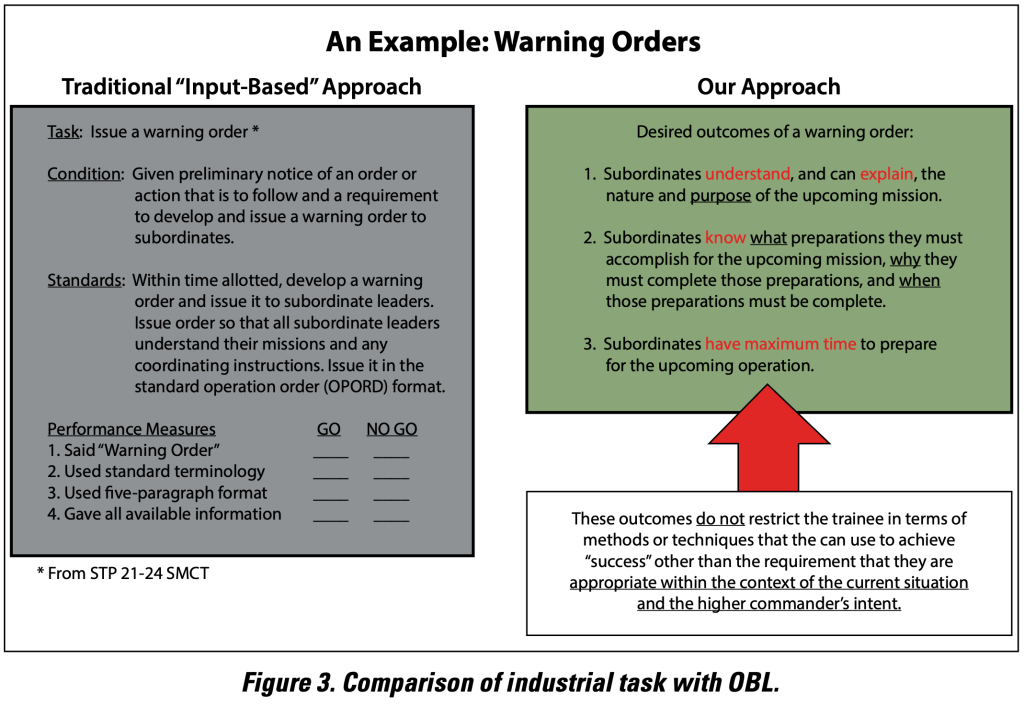
Here’s an example from Chris Casey’s and Don Vandergriff’s article, “The Future of TECOM,” in the June 2020 issue of Marine Corps Gazette. It neatly encapsulates the whole philosophy of mission command:
I love this chart! On the left, you see the checklist mentality: Did they comply with the internal, organizational requirements? On the right, what Casey and Vandergriff call “outcomes-based learning”: Did they achieve the objective “within the context of the current situation and the higher commander’s intent”? During the negotiation process, the commander must ensure that there is no confusion on these matters.
Another reason I like this is that you can see all of the other elements of Boyd’s organizational climate:
Schwerpunkt — “the context of the current situation and higher commander’s intent;” answers the “Limitation” from Boyd’s slide.
Einheit — in the sense of “mutual trust,” of course, but also mutual understanding of the “context of the current situation,” what Boyd called a “common outlook” or “similar implicit orientation.”
Fingerspitzengefühl — In a rapidly changing situation, most communication has to be implicit. The commander, for example, must be able to read the subordinate and intuitively decide if a common outlook is established, the negotiation is complete, and the subordinate is committed.
Perhaps you can help me on this, but I don’t see any reason this approach won’t apply to business or to any competitive endeavor among organizations.
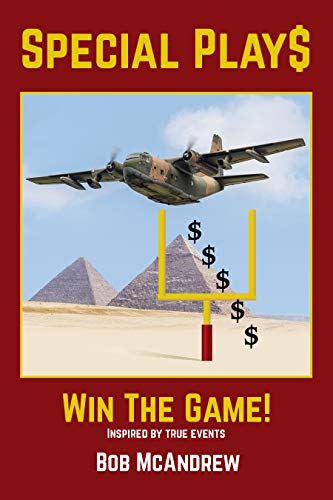
Special Play$: Win the Game! Bob McAndrew Amazon, April 28, 2020
[Note: I worked for Bob McAndrew when he was Director of International Sales at the Lockheed plant in Marietta, GA, where they still build the C-130 Hercules cargo plane. I did not, however, have anything to do with Egypt. The true events that inspired this novel might have happened before I joined International Sales (There was an Egyptian bribery scandal at Lockheed in the late 1980s. Here’s a brief description from the LA Times: https://www.latimes.com/archives/la-xpm-1995-01-28-fi-25231-story.html.)]
Here’s the problem. Your company makes airplanes both for the US Department of Defense and for sales to most of the rest of the world. The only countries you can’t sell to are the bad guys du jour — think North Korea, Iran, Venezuela, Cuba, etc. This means you spend a lot of time trapsing around what used to be known as the “Third World,” where the company issues you a sick sack full of assorted medicines and wishes you the best of luck. Compared to many places we worked, Egypt was quite nice.
Another problem, apart from staying alive, is that many prospective customers tend to define “corruption” quite a bit differently that we do. This map will give you the idea (red is bad): https://www.transparency.org/en/cpi/2019/results. As an American company, we were bound by the Foreign Corrupt Practices Act, which prescribes severe penalties for violating our standards of corruption, regardless of what the locals typically do.
Meanwhile, the factory was constantly churning out airplanes, and we had to go sell them to somebody. Somehow. Positions in the corporate hierarchy, not to mention salaries and bonuses, were at stake, so the pressure to move the product was high.
Finally, although we made the only aircraft of its kind — 4-engine turboprop, heavy-duty transport suitable for troops and cargo as well as humanitarian relief, all into and out of short, poorly prepared air fields — money is “fungible,” that is, it can move around and be used for all sorts of things other than cargo aircraft. So even though we had no direct competition, there were always lots of competing uses for what little money most of these countries did have. And some of our competitors for this money didn’t seem to worry as much about foreign corrupt practices as we did.
Put all this together and you can start to understand why people sometimes cut ethical corners.
Bob McAndrew tells a tale of one such campaign. If you’re interested in how big time corruption — as the US defines it — works, this is the book for you. Imagine Goodfellas meets Deal of the Century.
I’ll be honest, great literature it’s not. Every few pages, he weaves in a summary of a 49ers game, leading to their victory in the 1990 Super Bowl. I’m as big a Joe Montana fan as anybody, but I’m still trying to figure out what this adds to the story. You may find it works for you, but to me, it was distracting. And character development is a little weak. Frankly, after some 200 pages, I had no sympathy, and little empathy, for the characters and figured most got what they deserved. Was justice served? Don’t forget that this is inspired by “true events,” so Bob was constrained in what the Fates could do.
As for the story itself, though, it moves right along. You get to be a spider on the walls of all kinds of conspiratorial meetings and then watch how they play out. You’ll see how the participants ensure they are taken care of, and how they deal with potential roadblocks (no, not floating face down in the Nile.) Once you get into it, it can easily become a page turner, and with little effort, I can see a Netflix movie.
All in all, a light and entertaining addition to your quarantine reading list.
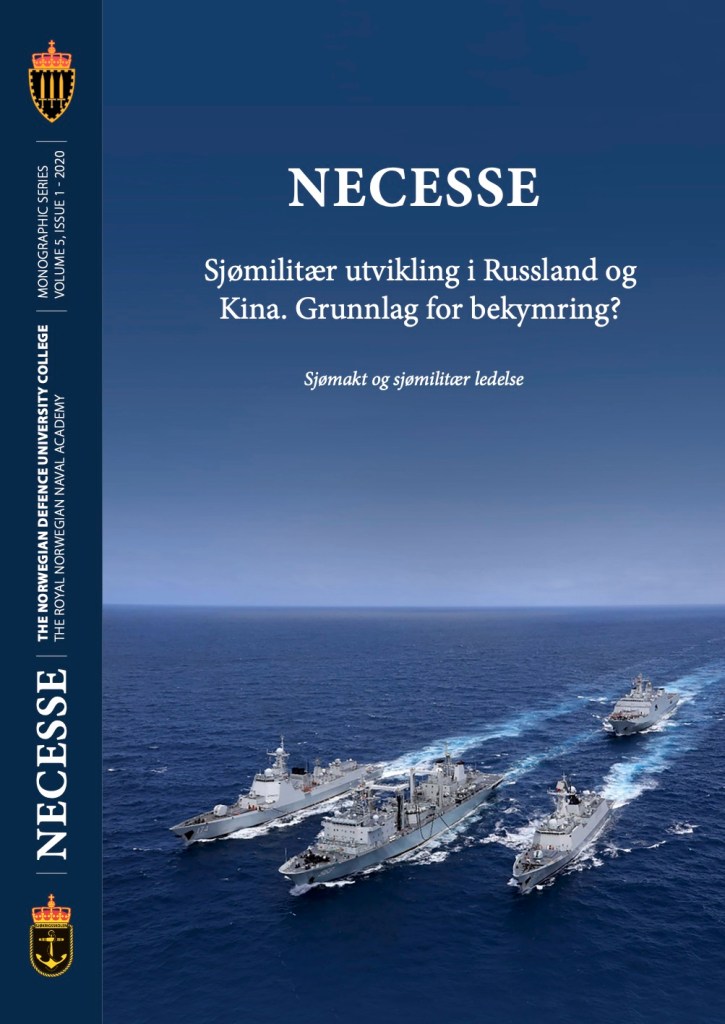
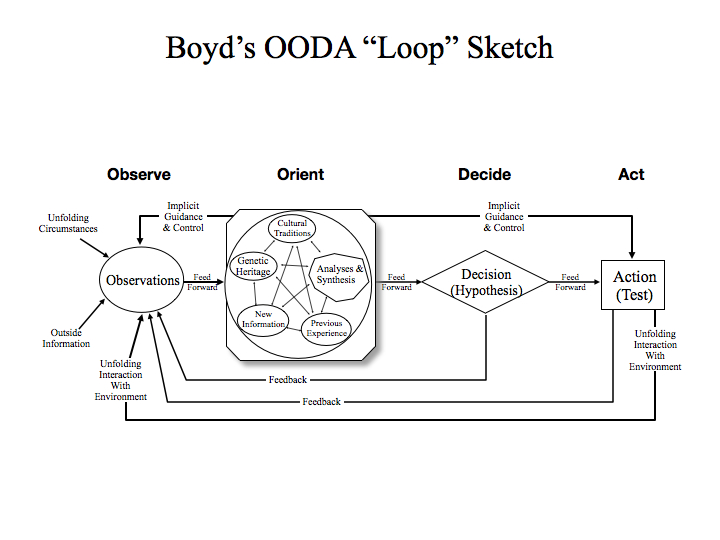
The Norwegian Defense University has just published a new version of “Boyd’s OODA Loop” in their journal, Necesse, edited by Royal Norwegian Naval Academy. I had thought that the previous version was about as close to perfection as can be found on this Earth, but alas Necesse is a peer-reviewed journal, and “Reviewer No. 2” ripped it to shreds. After I calmed down, it was clear that Number 2 was right. So the edition published in the journal is vastly improved over the last version.
As Boyd suggested in his final briefing, The Essence of Winning and Losing (all of Boyd’s works are available for free download on our Articles page), the OODA “loop” is simply a schematic representing three processes and the interplay among them:
Using our existing implicit repertoire
Creating new and therefore unexpected ways to use our repertoire in the heat of conflict
Creating new repertoire, principally by training when not in direct contact with an opponent
From “The Essence of Winning and Losing,” 1996.
In fact, he even called his drawing of the OODA “loop” a “sketch,” strongly indicating that there might be better ways to represent these processes, and over time, people have suggested several.
The folks at Necesse have done a magnificent job of making this rather long and complex paper readable. Although I am sure there are many people involved whom I do not know — you have my sincere gratitude — I would like especially to thank two officers of the Royal Norwegian Navy whom I know quite well and am proud to call colleagues, Commanders Roar Espevik, Main Editor of Necesse, and Tommy Krabberød, who approached me with the idea of a new version of the paper and encouraged me to press on with a major revision as a result of certain peer review comments.
You can download the paper from the Articles page. The current edition of Necesse, which contains the paper, is available at https://fhs.brage.unit.no/fhs-xmlui/handle/11250/2647802, and past issues can be found at https://fhs.brage.unit.no/fhs-xmlui/handle/11250/2559117. It’s an interesting journal. There are quite a few articles in English, and, through the miracle of Google Translate, you should have no trouble with the others. The origin of the name, incidentally, is found on the last page of the journal.
Some pictures from Mandeville, which is right across Lake Pontchartrain from New Orleans.
Many of the homes on the north shore were destroyed by Katrina in 2005. New construction has to be elevated, like this one.Looking the other way, South, towards New Orleans.The Beach House, a popular lunch spot, about a block north of the lake.Inside the Beach House.Azaleas in full bloom. This is actually nearby Slidell.It might be Lent now, but be sure that the good times will roll again!
My fascination with dragons started when as a boy. I’ve heard that a crane would beat a snake, deflecting and countering with its beak, that tiger beats crane, overcoming its defences with a flurry of paws, that snake beats tiger, finding a gap for precision strike, and that dragon beats them all, having four legs as a tiger, tail as a snake and long neck as a crane.
As fire-breathing cat-snake-birds, the dragons might represent our fear of predators but also, as Jordan B Peterson notes in this five minutes video, our strength when we conquer or tame them. They are also a symbol of flexibility and adaptation, of being able to show and combine efficiently what might be different and even opposite traits. And we might share this flexibility with dragons.
Operation Market Garden evokes images of the classic film A Bridge Too Far, where paratroopers led by Sean Connery fight a pitched battle against the German hordes, while hoping to be relieved by Allied ground forces advancing all the way from the Belgian border towards Arnhem. In September 1944 the Germans were on the backfoot and retreating. In the north of the Belgian borders, there was a huge gap in the German lines. The door to the Third Reich seemed open. Like water, an army attacks the gaps — the voids — and rather than trying to muscle trough the Siegfried line, Field Marshal Montgomery saw the opportunity to take the path of least resistance to bypass these defensive lines and attack the Rurh area, Germany’s industrial heart.
However a 24-hour pause not only made the allies lose momentum but also gave German commanders the opportunity to reorganize their retreating forces and send them right back to grind the allied advance to a halt. This and some other factors resulted in the what’s now called a magnificent disaster wherein more people lost their lives than during the landings in Normandy.
As you can probably surmise, we had a great time with the kids and grandkids over Christmas. We all went in and rented a townhouse for a week on the Sea Pines Resort, and as a bonus, we were only a 5-minute walk from Harbour Town.
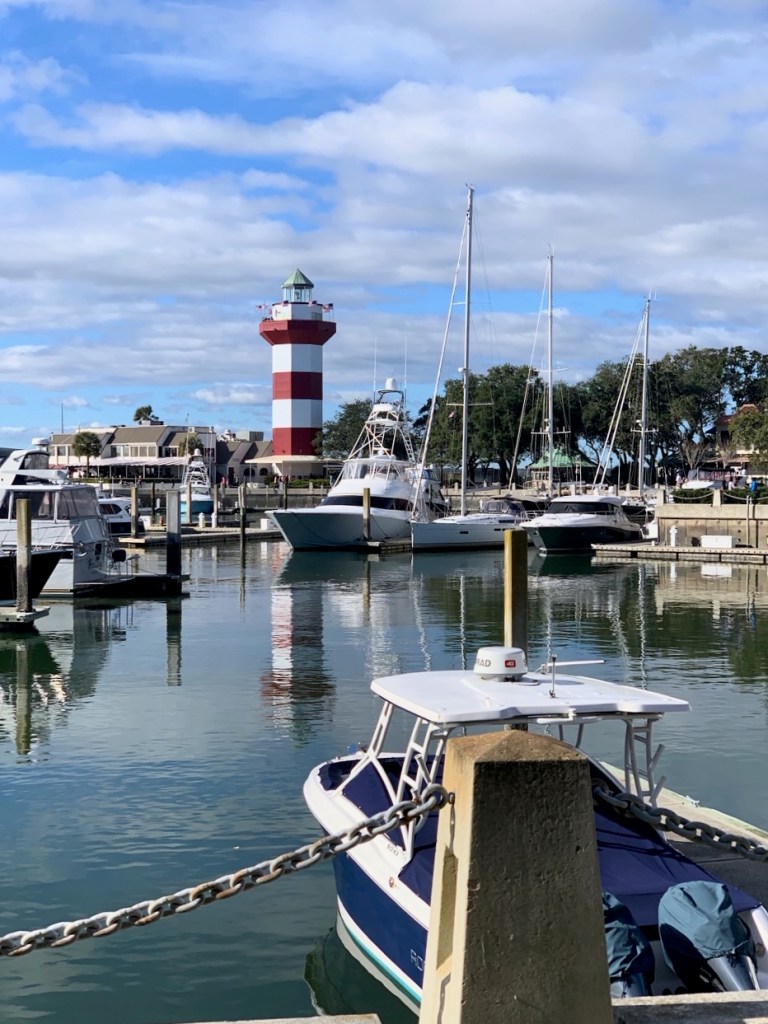
So one last picture, from the Marina on Christmas Eve:
We’ve been coming to Hilton Head since my Dad started teaching at nearby Georgia Southern in the late 1960s. Now we’re retired about 12 miles away.
With all that’s going on in the world, I thought you might appreciate some ambiance from the South Carolina Lowcountry.
The Harbour Town Lighthouse, on the southern end of Hilton Head Island. Evening of December 25th, 2019.Sunset, seen from Coligny Beach on the Atlantic side of Hilton Head Island on December 26th, 2019. The island tilts northeast to southwest, so near the Winter solstice, sunsets are visible from the “eastern” side.A wood stork getting in a little fishing at dawn on January 3rd, 2020. Sun City Hilton Head.













You must be logged in to post a comment.