
Reality or simulation? Is there a difference?

The Endorian Sorceress Causes the Shade of Samuel by Dmitry Nikiforovich Martyanov, 1857. Shutterstock image.

About a month ago, German physicist Sabine Hossenfelder ran a YouTube video “Physicists Prove That Universe is not a Simulation.” As I understand the argument, they showed that if the universe were a simulation, it would have to obey the conclusions of Gödel’s Theorem, but that the real, observable universe doesn’t.

Dr. Hossenfelder wasn’t entirely convinced, and I’m certainly not qualified to judge, but check it out for yourself.

Then, just a few days ago, Mark McGrath and Ponch Rivera posted a No Way Out podcast, “Beyond the Linear OODA Loop: Jon Becker on Authentic Boyd Strategies,” where their guest maintains that we are living in a simulation. So what gives?

The difference is that Becker is not addressing the entire physical universe but is echoing John Boyd’s observation that:

To make these timely decisions implies that we must be able to form mental concepts of observed reality, as we perceive it, and be able to change these concepts as reality itself appears to change. The concepts can then be used as decision models for improving our capacity for independent action. “Destruction and Creation,” p. 2.

In other words, what we are living in is a simulated world generated by our mental models, and so our (simulated) world is indeed governed by Gödel’s Theorem. Becker, then, draws some interesting conclusions about how to live and operate in this environment.

Recognizing that we are living in a simulation, there are things we can do. We can not only mitigate the effects on ourselves by following Becker’s suggestions — e.g., recognize the effects of our egos, incorporate a range of perspectives (including those from the external environment), and always remember that orientation is a process and not a picture — but also exploit the fact that our impression of the unfolding situation is a simulation. We can do this in at least a couple of ways: internally to our organization as leadership and externally to it, as strategy. With John Boyd, everything is about mitigating and exploiting, with the latter providing the schwerpunkt.

Back in 2022, I did a presentation on the internal implications — that is, on leadership — of living in a simulation. After watching Jon’s podcast, I made a few updates to the notes accompanying that presentation. The fundamental conclusions, though, haven’t changed. For millennia, there have been people who recognized that what we regard as reality is actually a mental construct. Over the centuries, some of these folks evolved tools for manipulating this fact. So it stands to reason that leaders and strategists today could benefit from exploiting these tools. We refer to many of these as “magic.”

Think of them as the chi to the cheng you find in most management, leadership, and strategy tomes. Serious leadership gurus and strategists have dismissed them as tricks or “slight-of-hand.” Entertainment but good for little else. But the deeper question is, “Why do they work?” And why do they work even though you know the performer on stage is trying to fool you? It’s just like in a conflict: Your opponent knows you’re trying to deceive them. But you have to do it, anyway. If you look carefully, you’ll find that many of the most successful leaders down through history have found these techniques and made good use of them.

You can download the presentation here, and the notes, which I strongly recommend because I don’t think the presentation by itself will make a lot of sense, here. The Witch of Endor, by the way, makes her appearance on slide 53.

[The links in the paragraph above go to the versions that were current when this column was published in December 2025. Any more recent versions are posted on our Articles page.]

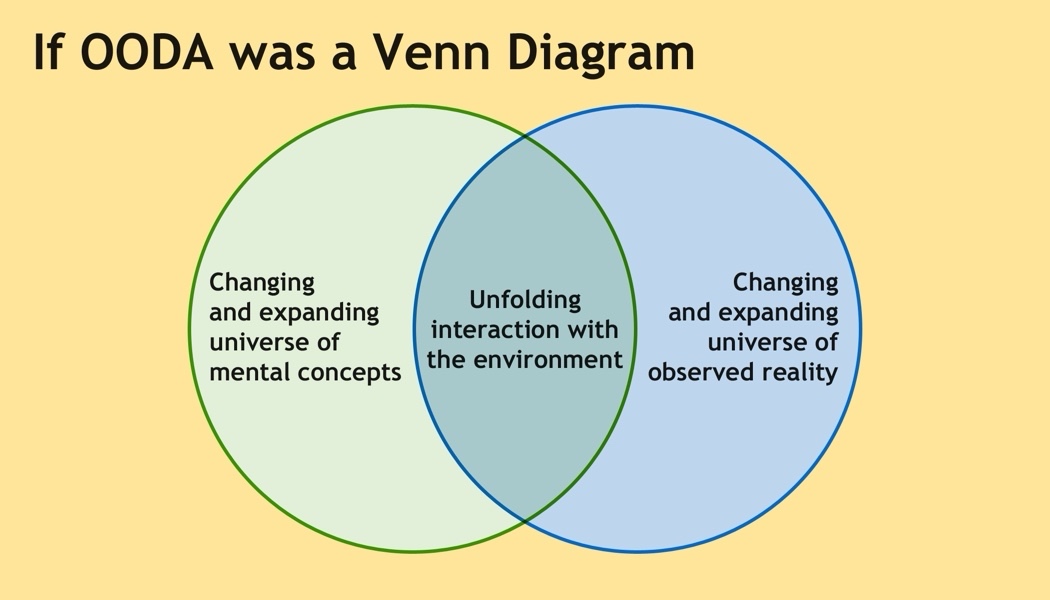
If OODA was a (revised) Venn diagram

Codde, Pieter Jacobsz (b.1599-12-11 – d.1678-10-12), Intérieur de corps de garde (Titre principal), 1626. Huile sur bois. Petit Palais, Musée des Beaux-Arts de la Ville de Paris.

Clinton D. Pope
Chief Quality Officer
Indian Health Service, Phoenix, AZ

[Editor’s note #2: Mr. Pope has revised his Venn diagram at the bottom of this post. Kaizen for Boyd’s snowmobile.]

[Editor’s note: When people start playing around with Boyd’s OODA “loop” sketch from The Essence of Winning and Losing — available from our Articles page — what usually emerges is something even more complicated than what Boyd produced. Although many of these reveal interesting insights, my personal feeling is that we need someone to come along, absorb all these various efforts, and experience an “Aha!” moment that produces a new OODA “loop” sketch as elegant as, but no more complicated than, Boyd’s. To help that process along, it might be useful to revisit Boyd’s purpose for that sketch: a framework to help us “to comprehend, shape, adapt to and in turn be shaped by an unfolding evolving reality that is uncertain, everchanging, and unpredictable.” Perhaps meditate upon and internalize this objective before we start drawing more arrows? With that in mind, here’s an OODA “loop” without any arrows.]

This will likely be lost on some as the Venn diagram doesn’t mention observations, orientation, decision, or action.

However, OODA is a model of how we interact with the environment, both shaping and being shaped by the environment.

Mental concepts and observed reality are both ever changing and expanding.

To “survive” (e.g. obtain more favorable interactions with the environment), we need better means to observe what’s really going on as accurately as possible and from multiple perspectives; we need to analyze and synthesize new and existing information to orient current state in relation to desired state with a sense of how to position for a more favorable state; we need to facilitate decision making that is timely (not the fastest, but well timed) and based on available indicators; and we need to confidently act with the intention to learn (this is to test the hypothesis or prediction of the decision).

The OODA Loop is cyclical, but not linear in nature. For instance, orientation and observation are always happening. They don’t stop so that you can make decisions and act. Likewise, in every action or inaction, in every decision or indecision, you are always interacting with the environment. You don’t exist except in the environment. The “dialectic engine” is always humming.

The difference between those who survive and those who are eliminated is the ability to effectively orient and adapt to the changing environment.

If OODA was a Venn diagram

Codde, Pieter Jacobsz (b.1599-12-11 – d.1678-10-12), Intérieur de corps de garde (Titre principal), 1626. Huile sur bois. Petit Palais, Musée des Beaux-Arts de la Ville de Paris.

Clinton D. Pope
Chief Quality Officer
Indian Health Service, Phoenix, AZ

[Editor’s note: When people start playing around with Boyd’s OODA “loop” sketch from The Essence of Winning and Losing — available from our Articles page — what usually emerges is something even more complicated than what Boyd produced. Although many of these reveal interesting insights, my personal feeling is that we need someone to come along, absorb all these various efforts, and experience an “Aha!” moment that produces a new OODA “loop” sketch as elegant as, but no more complicated than, Boyd’s. To help that process along, it might be useful to revisit Boyd’s purpose for that sketch: a framework to help us “to comprehend, shape, adapt to and in turn be shaped by an unfolding evolving reality that is uncertain, everchanging, and unpredictable.” Perhaps meditate upon and internalize this objective before we start drawing more arrows? With that in mind, here’s an OODA “loop” without any arrows.]

This will likely be lost on some as the Venn diagram doesn’t mention observations, orientation, decision, or action.

However, OODA is a model of how we interact with the environment, both shaping and being shaped by the environment.

Mental concepts and observed reality are both ever changing and expanding.

To “survive” (e.g. obtain more favorable interactions with the environment), we need better means to observe what’s really going on as accurately as possible and from multiple perspectives; we need to analyze and synthesize new and existing information to orient current state in relation to desired state with a sense of how to position for a more favorable state; we need to facilitate decision making that is timely (not the fastest, but well timed) and based on available indicators; and we need to confidently act with the intention to learn (this is to test the hypothesis or prediction of the decision).

The OODA Loop is cyclical, but not linear in nature. For instance, orientation and observation are always happening. They don’t stop so that you can make decisions and act. Likewise, in every action or inaction, in every decision or indecision, you are always interacting with the environment. You don’t exist except in the environment. The “dialectic engine” is always humming.

The difference between those who survive and those who are eliminated is the ability to effectively orient and adapt to the changing environment.