Reality or simulation? Is there a difference?

The Endorian Sorceress Causes the Shade of Samuel by Dmitry Nikiforovich Martyanov, 1857. Shutterstock image.

About a month ago, German physicist Sabine Hossenfelder ran a YouTube video “Physicists Prove That Universe is not a Simulation.” As I understand the argument, they showed that if the universe were a simulation, it would have to obey the conclusions of Gödel’s Theorem, but that the real, observable universe doesn’t.

Dr. Hossenfelder wasn’t entirely convinced, and I’m certainly not qualified to judge, but check it out for yourself.

Then, just a few days ago, Mark McGrath and Ponch Rivera posted a No Way Out podcast, “Beyond the Linear OODA Loop: Jon Becker on Authentic Boyd Strategies,” where their guest maintains that we are living in a simulation. So what gives?

The difference is that Becker is not addressing the entire physical universe but is echoing John Boyd’s observation that:

To make these timely decisions implies that we must be able to form mental concepts of observed reality, as we perceive it, and be able to change these concepts as reality itself appears to change. The concepts can then be used as decision models for improving our capacity for independent action. “Destruction and Creation,” p. 2.

In other words, what we are living in is a simulated world generated by our mental models, and so our (simulated) world is indeed governed by Gödel’s Theorem. Becker, then, draws some interesting conclusions about how to live and operate in this environment.

Recognizing that we are living in a simulation, there are things we can do. We can not only mitigate the effects on ourselves by following Becker’s suggestions — e.g., recognize the effects of our egos, incorporate a range of perspectives (including those from the external environment), and always remember that orientation is a process and not a picture — but also exploit the fact that our impression of the unfolding situation is a simulation. We can do this in at least a couple of ways: internally to our organization as leadership and externally to it, as strategy. With John Boyd, everything is about mitigating and exploiting, with the latter providing the schwerpunkt.

Back in 2022, I did a presentation on the internal implications — that is, on leadership — of living in a simulation. After watching Jon’s podcast, I made a few updates to the notes accompanying that presentation. The fundamental conclusions, though, haven’t changed. For millennia, there have been people who recognized that what we regard as reality is actually a mental construct. Over the centuries, some of these folks evolved tools for manipulating this fact. So it stands to reason that leaders and strategists today could benefit from exploiting these tools. We refer to many of these as “magic.”

Think of them as the chi to the cheng you find in most management, leadership, and strategy tomes. Serious leadership gurus and strategists have dismissed them as tricks or “slight-of-hand.” Entertainment but good for little else. But the deeper question is, “Why do they work?” And why do they work even though you know the performer on stage is trying to fool you? It’s just like in a conflict: Your opponent knows you’re trying to deceive them. But you have to do it, anyway. If you look carefully, you’ll find that many of the most successful leaders down through history have found these techniques and made good use of them.

You can download the presentation here, and the notes, which I strongly recommend because I don’t think the presentation by itself will make a lot of sense, here. The Witch of Endor, by the way, makes her appearance on slide 53.

[The links in the paragraph above go to the versions that were current when this column was published in December 2025. Any more recent versions are posted on our Articles page.]

Evolutionary Epistemology Evolves

Version 2.62, dated March 2025, is now available for download from our Articles page.

In his biography of Boyd, The Fighter Pilot Who Changed the Art of War, Robert Coram observed that when, after some 4 years of intense research and editing, “Destruction and Creation” finally appeared in September 1976, it had “a specific gravity approaching that uranium. It is thick and heavy and ponderous, filled with caveats and qualifiers and arcane references that span theories never before connected.” (323). Yet, everybody who has studied Boyd agrees that it is fundamental to Boyd’s body of subsequent work.

It was to make this masterpiece (for that is what it is) comprehensible to human beings that one of Boyd’s closest associates, Franklin C. (Chuck) Spinney, created a briefing entitled Evolutionary Epistemology. To illustrate Boyd’s ideas, Chuck chose the field of cosmology, how our knowledge of what’s going on above our heads has changed over time. For thousands of years, nothing much happened. Then in a space of less than 500 years, the Earth has gone from the center of all creation to just one minor hunk of rock circling a nondescript star in an unremarkable galaxy. Evolutionary epistemology.

Cosmology provides an accessible framework for illustrating the fundamental ideas in “Destruction and Creation.” I mean, stars, planets, the sun — things we all see every day, unlike perhaps, charm quarks, muons, and Z bosons (although the standard model of particle physics is a contemporary example of evolutionary epistemology).

My hope, and I’m reasonably sure Chuck agrees, is that by opening up “Destruction and Creation” to a wider audience, Evolutionary Epistomology will not only make a dense scholarly work more accessible but will provide you with a new set of tools so that, to quote Boyd (Conceptual Spiral, 38), you “can comprehend, cope with, and shape—as well as be shaped by—that world and the novelty that arises out of it.”

Chuck has kindly provided the following set of comments to this edition:


The only significant change is the addition of Slide 4 in this version, which is a kind of historical vector diagram showing my understanding of the evolutionary sequence of Boyd’s thinking.

Taken together, slides 4 and 5 place the role of “fighter pilot” in a perspective for those who claim (incorrectly) that his ideas are the tactical idea of a fighter pilot. His paper “Destruction and Creation” placed him on a totally different intellectual pathway. The addition of Slide 4 to the EE briefing reinforces Chet’s point in Slide 5 — which is an accurate and imaginative way to portray the intellectual sourcing of John’s thinking.

First, in D&C, John focused on the evolution of hard scientific/engineering knowledge. John was trying to understand how he and Tom Christie synthesized Energy-Maneuverability Theory in the 1960s. E-M theory revolutionized ideas for designing fighter aircraft. This was new and very important, particularly for the front-end conceptual design level. Ironically, E-M started off as a way for uncovering the best air-to-air tactics for dogfights between two dissimilar aircraft, but then it morphed into a way for identifying the crucial tradeoffs in a conceptual design of a new aircraft. John and Tom won all sorts of scientific and engineering awards for this latter achievement.

John was obsessed with trying to understand why he uncovered this revolutionizing idea when far better scientists and engineers had not. At the time, he had no idea where this effort in his D&C paper was taking him, other than trying to understand how he created such a novel and effective way of looking at a long-standing design problem. Some of his closest long-time friends thought his musings were crazy.

I am quite certain of this, because we talked about the fact that he had no idea where his D&C research was taking him. Ray Leopold, John, and I talked about this continuously when I first met John in 1973. At the time, Ray and I were only 28 years old, and having technical backgrounds, we were both fascinated with his research.

Chet was in the D&C picture then, but Ray and I did not know him yet. Chet’s chart, Slide 5, can be thought of as an evolutionary caricature or, more accurately, a synthetic portrait, of where John evolved the ideas that underpin his ideas for the OODA loop — particularly with regard to his OODA sketch and its subtle relationships to the nature of competition, learning, and ultimately the creation of novelty as expressed in his Conceptual Spiral briefing [Note: Also available on our Articles page].

The Appendix is for an unstructured informal “classroom style” discussion on how Boyd’s ideas might be used in a general sense to relate to some known military campaigns. I used it from time to time in classroom discussions with military officers in a variety of low-level to high-level DoD schools.


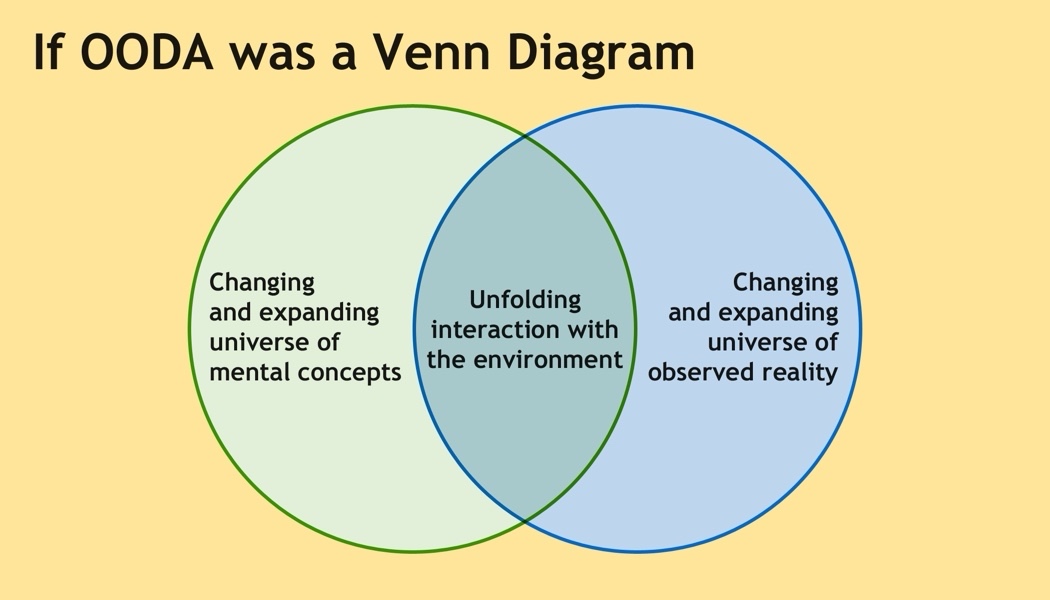
If OODA was a (revised) Venn diagram

Codde, Pieter Jacobsz (b.1599-12-11 – d.1678-10-12), Intérieur de corps de garde (Titre principal), 1626. Huile sur bois. Petit Palais, Musée des Beaux-Arts de la Ville de Paris.

Clinton D. Pope
Chief Quality Officer
Indian Health Service, Phoenix, AZ

[Editor’s note #2: Mr. Pope has revised his Venn diagram at the bottom of this post. Kaizen for Boyd’s snowmobile.]

[Editor’s note: When people start playing around with Boyd’s OODA “loop” sketch from The Essence of Winning and Losing — available from our Articles page — what usually emerges is something even more complicated than what Boyd produced. Although many of these reveal interesting insights, my personal feeling is that we need someone to come along, absorb all these various efforts, and experience an “Aha!” moment that produces a new OODA “loop” sketch as elegant as, but no more complicated than, Boyd’s. To help that process along, it might be useful to revisit Boyd’s purpose for that sketch: a framework to help us “to comprehend, shape, adapt to and in turn be shaped by an unfolding evolving reality that is uncertain, everchanging, and unpredictable.” Perhaps meditate upon and internalize this objective before we start drawing more arrows? With that in mind, here’s an OODA “loop” without any arrows.]

This will likely be lost on some as the Venn diagram doesn’t mention observations, orientation, decision, or action.

However, OODA is a model of how we interact with the environment, both shaping and being shaped by the environment.

Mental concepts and observed reality are both ever changing and expanding.

To “survive” (e.g. obtain more favorable interactions with the environment), we need better means to observe what’s really going on as accurately as possible and from multiple perspectives; we need to analyze and synthesize new and existing information to orient current state in relation to desired state with a sense of how to position for a more favorable state; we need to facilitate decision making that is timely (not the fastest, but well timed) and based on available indicators; and we need to confidently act with the intention to learn (this is to test the hypothesis or prediction of the decision).

The OODA Loop is cyclical, but not linear in nature. For instance, orientation and observation are always happening. They don’t stop so that you can make decisions and act. Likewise, in every action or inaction, in every decision or indecision, you are always interacting with the environment. You don’t exist except in the environment. The “dialectic engine” is always humming.

The difference between those who survive and those who are eliminated is the ability to effectively orient and adapt to the changing environment.

If OODA was a Venn diagram

Codde, Pieter Jacobsz (b.1599-12-11 – d.1678-10-12), Intérieur de corps de garde (Titre principal), 1626. Huile sur bois. Petit Palais, Musée des Beaux-Arts de la Ville de Paris.

Clinton D. Pope
Chief Quality Officer
Indian Health Service, Phoenix, AZ

[Editor’s note: When people start playing around with Boyd’s OODA “loop” sketch from The Essence of Winning and Losing — available from our Articles page — what usually emerges is something even more complicated than what Boyd produced. Although many of these reveal interesting insights, my personal feeling is that we need someone to come along, absorb all these various efforts, and experience an “Aha!” moment that produces a new OODA “loop” sketch as elegant as, but no more complicated than, Boyd’s. To help that process along, it might be useful to revisit Boyd’s purpose for that sketch: a framework to help us “to comprehend, shape, adapt to and in turn be shaped by an unfolding evolving reality that is uncertain, everchanging, and unpredictable.” Perhaps meditate upon and internalize this objective before we start drawing more arrows? With that in mind, here’s an OODA “loop” without any arrows.]

This will likely be lost on some as the Venn diagram doesn’t mention observations, orientation, decision, or action.

However, OODA is a model of how we interact with the environment, both shaping and being shaped by the environment.

Mental concepts and observed reality are both ever changing and expanding.

To “survive” (e.g. obtain more favorable interactions with the environment), we need better means to observe what’s really going on as accurately as possible and from multiple perspectives; we need to analyze and synthesize new and existing information to orient current state in relation to desired state with a sense of how to position for a more favorable state; we need to facilitate decision making that is timely (not the fastest, but well timed) and based on available indicators; and we need to confidently act with the intention to learn (this is to test the hypothesis or prediction of the decision).

The OODA Loop is cyclical, but not linear in nature. For instance, orientation and observation are always happening. They don’t stop so that you can make decisions and act. Likewise, in every action or inaction, in every decision or indecision, you are always interacting with the environment. You don’t exist except in the environment. The “dialectic engine” is always humming.

The difference between those who survive and those who are eliminated is the ability to effectively orient and adapt to the changing environment.