The Manchurian Blitzkrieg: A Japanese Perspective

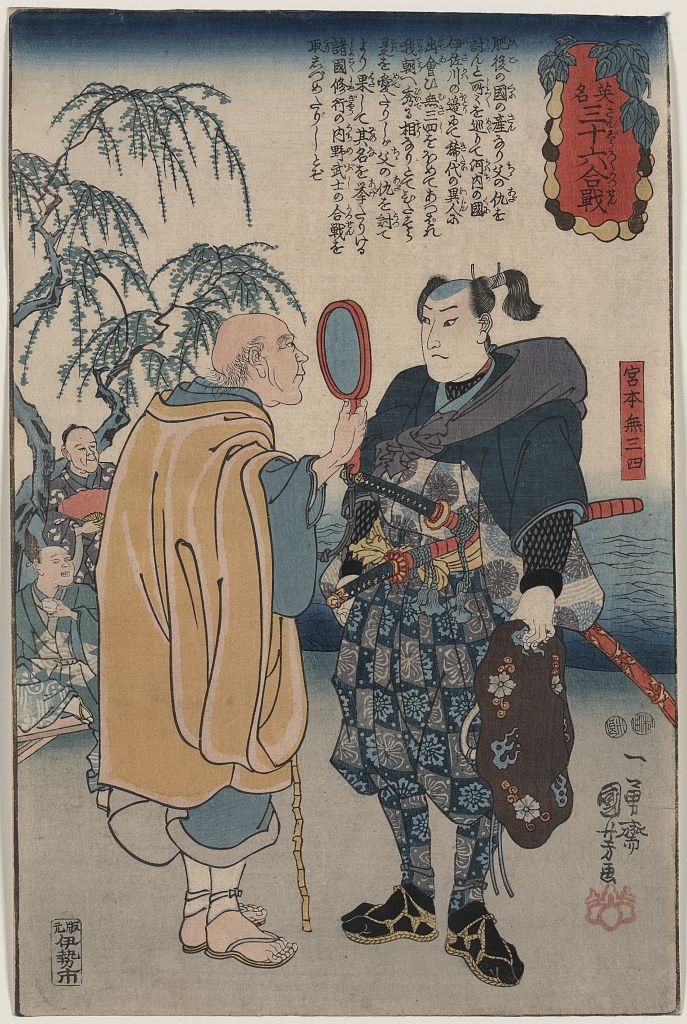
“The Famous Samurai: Miyamoto Musashi” print by Utagawa Kuniyoshi (1798-1861)

This post publishes a comment by LtCol Hiro Katsura, Japanese Ground Self-Defense Force. Colonel Katsura is completing a Ph.D. dissertation that focuses on the internalization of mission command in the U.S. Marine Corps, particularly examining how competence is cultivated among NCOs who are expected to operate with delegated authority.

[Editor’s note: This is a follow-up to my post on the Soviet invasion of Manchuria in August 1945.]


As you mentioned, this campaign is an extremely important case study in strategic history.

The surprise attack at midnight on 9 August caught the Kwantung Army completely off guard. This was the result of several overlapping factors: the inability to anticipate the Soviet redeployment of mechanized forces across more than 9,000 km from Europe in only three months; Japan’s continued hope that the USSR might mediate a conditional peace settlement; and the simultaneous three-front offensive, which created defensive chaos—further compounded by inadequate communications.

At the time, the Kwantung Army still had over 700,000 men on paper, but most of its elite units and equipment had already been siphoned off to the Pacific. What remained was qualitatively weakened: undertrained troops, shortages of ammunition and fuel, and outdated armor—mainly Type 95 light tanks with 37mm guns, plus a handful of Type 98s. These conditions greatly amplified the effect of the Soviet surprise. Even so, the discipline of the Japanese Army is striking—reports say that even after the commander announced Japan’s defeat and the order to disarm, many officers and staff still argued for continued resistance.

Taken together, this explains why Boyd described the Soviets as moving inside Japan’s OODA loop. It was not only a matter of operational tempo, but also a fatal mismatch between Japanese perceptions and reality, which paralyzed decision-making.

I am reminded of a lecture I once attended in Tokyo by David Glantz.* He also described the Manchurian operation as a classic Soviet blitzkrieg. One anecdote he shared was particularly memorable: the name “August Storm” came from an offhand comment by his eight-year-old daughter at the dinner table. Years later, one of his former students—by then a SAMS graduate and a planner for the Gulf War—remembered that story and suggested the name Desert Storm. Glantz laughed that the true origin traced back to a little girl’s imagination—a curious thread in the tapestry of military history.

On a personal note, one of my mentors had been in Manchuria at that time. After the surrender he was captured and spent eight years in Siberian detention. Knowing his story gives this campaign a very human weight for me. And of course, your own father’s presence there makes this history resonate all the more strongly.


*Colonel, US Army, ret., historian who has published extensively on Soviet military history and doctrine, including:

He is probably best known for When Titans Clashed: How the Red Army Stopped Hitler (1995, revised 2015), which he co-wrote with Jonathan M. House.

The Day My Dad Shot Tito’s Dog

Josip Broz Tito (1892 – 1980)

Editor’s Note: Among my father’s many accomplishments — including medals for valor on Bataan, surviving Japanese prison camp, and tenure as a college professor — he is also the only person known to have shot one of the prized hunting dogs belonging to Yugoslav dictator Josip Broz Tito and live to tell the tale. Here is that story, in his own words:


SITUATION A few years after the end of WW II the United States Government was still giving all kinds of aid, including military, to friendly foreign countries.

YUGOSLAVIA Yugoslavia was accepted as a friendly nation, even though Marshal Tito was still very much a communist dictator.  We started providing military equipment and training to Yugoslavia, and an American Military Assistance Staff was organized as an adjunct to the US Embassy in the capital city of Belgrade. I was a member of this staff.  We arrived there in January 1952.

STAFF Our staff was composed of a major general* and 14 other officers ranking from captain to colonel, with a sufficient number of enlisted men for clerical duties. The officers were on diplomatic status and carried diplomatic passports.

THE HUNT

One Thursday morning, after we had been there well over a year, the general called all officers into his office to tell us that he had received an invitation. When no one volunteered, and following much discussion, he selected me to go in his place. In due course, I was issued a personal invite:

Since I had no gun, he loaned me his, a single-shot, 12 gauge double-barrel shotgun, and furnished the shells, number 6 shot (whatever that means).**

So I went. A lieutenant colonel doesn’t refuse a request from his commanding general.

Tito on the hunt, several years later

SATURDAY MORNING We, about 23 hunters of varying proficiencies, departed Belgrade and drove about 120 miles out into the boondocks. We were to kill fox, rabbit, pheasant, and quail. It was to be an European style hunt, with the locals driving the game towards us in the morning and dogs doing the honors in the afternoon.

After arriving out in the country near a large forest, we were each introduced to our local assistant and given a number of rules which included: 

  1. Stay in your stand. Your local assistant will remain out of sight during the shooting, but will come immediately when called.
  2. We are not to leave our stand without calling the assistant. 
  3. Other assistants will make noises on the other side of the forest and drive the game toward us.
  4. Shoot only into the forest. 
  5. Do not go into the forest or retrieve or touch any game; the assistant takes care of these duties. 
  6. Wait for the sound of a distant horn before starting the shoot.
  7. And discontinue the hunt at the second sound of the horn.

During this first stand, about two hours, I shot a large gray fox before I heard the second horn. My assistant joined me as we went to another stand. While there, I shot a rabbit. About eleven o’clock we heard the horn and broke for an excellent picnic lunch.

After lunch we got the word confirming that the locals would no longer be driving the game. Instead, a number of hunting dogs would be doing the driving. Within the hour, I heard considerable shooting and the assistants yelling, “Pheasants! Pheasants!”  Soon, one pheasant is flying by in front of me. I shoot and down he goes. About an hour or so later, I saw a rabbit about the size and color of the one I shot this morning. It stopped behind some bushes near enough for me to get a shot. Since I cannot see him that clearly, I stand very still and wait. Almost immediately, he hops to the next bush.  I estimate the location of his head and fire. Sure enough, I have my second rabbit.

THE END It is nearing late afternoon when the horn sounds the signal to unload the guns and follow your assistant. Just back of my stand, laid out in the order of their demise, were my old gray fox, a rabbit, the pheasant, and my last: A dead dog! One of Tito’s prized hunting dogs!!! For a moment, my blood ran cold. I had caused a diplomatic incident and would be broken in rank and sent home in disgrace.

But my assistant slapped me on the back and said, “Mighty Hunter, do not worry. The Marshal has many dogs” and was joined by raucous laughter all around.


*I believe this was MG John Harmony

**My father was raised in rural Arkansas and certainly knew how to hunt. However, I expect nearly all of this was with a rifle.

Last Blitzkrieg of WWII

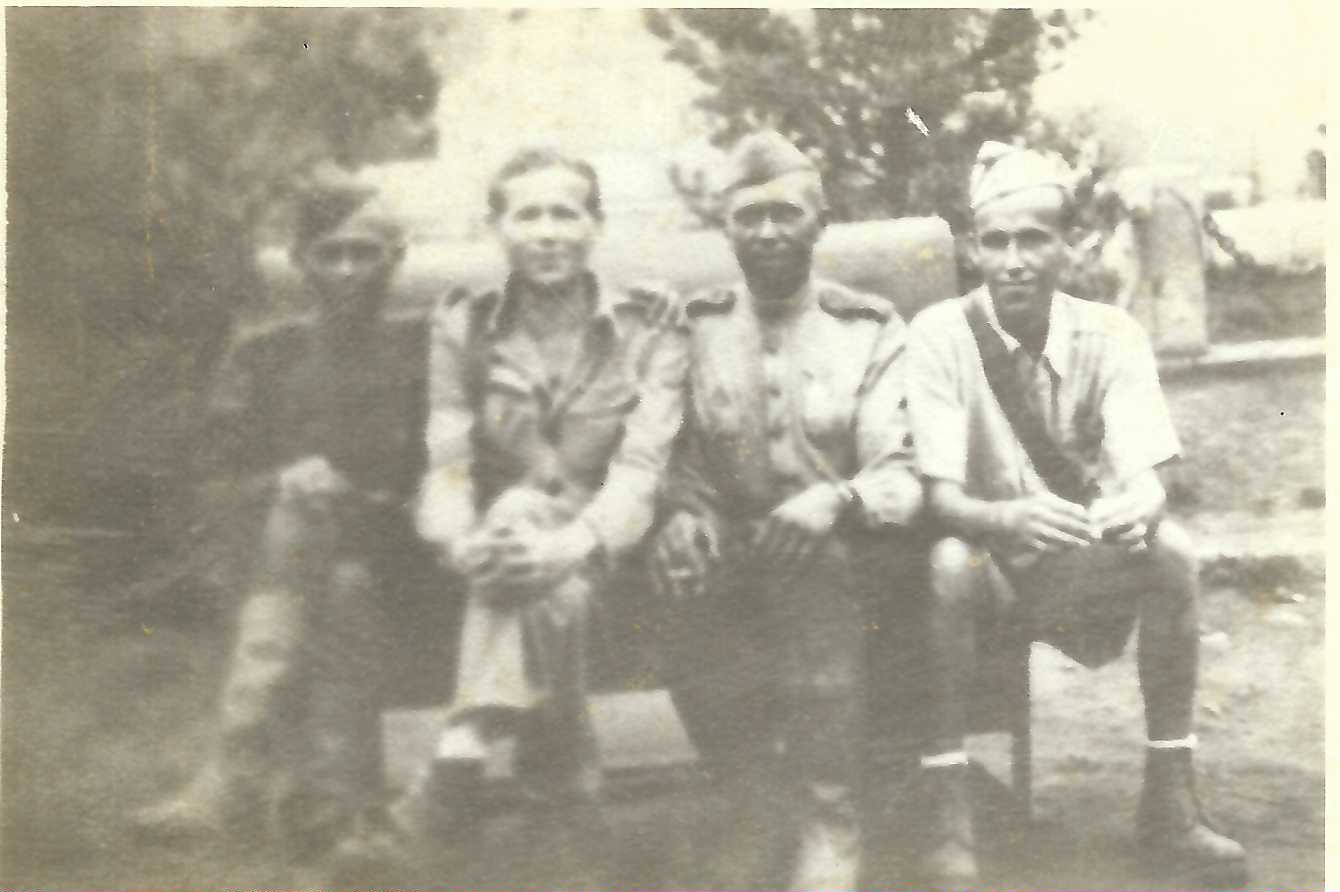
The person on the far right is my late father, then-Captain Grover C. Richards, Jr. He and a fellow POW posed for this photo with two Red Army soldiers who had just liberated Camp Hoten in Mukden, Manchuria, (now Shenyang, Liaoning province) in mid-August 1945.

The Soviets invaded Manchuria on August 9, 1945, exactly 80 years ago as I write this. Boyd considered that operation as one of the two examples of a blitzkrieg that was superbly executed, highly successful, and overlooked outside a small group of students of military history and strategy. The other was the Battle of the Kerch Peninsula (December 1941 – May 1942).*

It was an enormous operation, involving over 2 million troops from both sides. The Red Army alone employed over 5,000 tanks, many of them them modern T-34s, nearly 30,000 artillery tubes and Katyusha rocket launchers — the famous “Stalin’s Organs” — and nearly 4,000 aircraft. Although the action took place in an arena of war the size of western Europe, the battle was over in 11 days.

If you are familiar with Boyd’s terminology, we can describe the Soviet strategy simply as: They operated inside the Japanese OODA loops. Although outmanned, outgunned, and often surrounded, many Japanese units fought tenaciously to the last. But if your opponent is inside your OODA loops, it is ultimately to no avail.**

One of the factors that made this campaign so interesting was that the bulk of the Soviet forces had to move from western Europe, where they had participated in the defeat of Nazi Germany, to far eastern Siberia, a distance of roughly 6,000 miles. This was accomplished in the space of three months. As described by Wikipedia:

They (the Japanese) had estimated that an attack was not likely before the spring of 1946, but the Stavka (Soviet high command) had in fact been planning for a mid-August offensive, successfully concealing the buildup of a force of 90 divisions. Many Soviet units had crossed Siberia in their vehicles to avoid straining the rail link.

The Japanese were caught completely by surprise upon receiving the Soviet declaration of war an hour before midnight on 8 August, now facing a simultaneous invasion on three fronts that began just after midnight on 9 August.

Here is a YouTube video that gives an overview of the campaign (only the first half is on Manchuria). Although the quality is uneven, you should be able to pick out many of the elements of blitzkrieg strategy: Deception and surprise; high tempo of operations; bypassing and isolation of strong points; and advance via multiple thrusts to probe and test the opponent and generate ambiguity:


* On Boyd’s chart of “Blitzkrieg Results,” Patterns 89, under “Successful,” Kerch is “Summer 1942.” The Manchurian operation is also listed.

**As described in glorious detail on slide 132 of Patterns of Conflict.

My father retired from the Army as a LTC on June 30, 1961, became a college professor, and retired the second time as Chair of Psychology of what is now Georgia Southern University in 1981. He died in Jacksonville, FL, on September 29, 1996, and is buried in Arlington. His military awards included the Silver Star for actions on Bataan.

John, Pierre, and Harry

Many years ago, large corporations published well written, well edited, and often lavishly produced magazines that showcased their products and, inter alia, demonstrated their enormous resources and competence.

First flight, however inadvertent, of the YF-16, January 20, 1974. US Air Force photo

In 1991, one of these, General Dynamics’ Code One, published a wide ranging interview with Harry Hillaker, the chief designer of the F-16. It is a tour de force. Hillaker was there at the very beginnings of the effort to develop a new fighter optimized for close-in air-to-air combat. At the time, the Air Force was deep into bringing the F-15 into production. As Hillaker describes it, the F-15 was a continuation of the standard fighter lineage: You want to go faster? Add another engine. You want to go farther? Make it bigger to carry more fuel. Being larger also meant it had more capacity to carry weapons and electronics, particularly the ability to employ radar-guided missiles, which could operate well beyond the visual rage of the pilot.

The result was an airplane that, while demonstrating significant air-to-air performance improvements over its predecessor, the McDonnell Douglas F-4, was correspondingly more expensive. Many at the time also felt it would be more difficult to maintain, particularly under wartime conditions. Incidentally, John Boyd was heavily involved in the F-X program of the late 1960s, which became the F-15.*

Hillaker recalls how a small group of pilots, analysts, and engineers — the “Fighter Mafia” — adopted a completely different philosophy: Employ advanced technologies, particularly fly-by-wire flight control systems and designed-in instability, to develop a fighter that was much smaller than the F-15 while optimized for the type of close-in dogfighting that characterized air battles during the Vietnam War. At first, this group consisted only of Hillaker, Pierre Sprey, and Boyd.

To see how this all came together to produce the F-16, read the article.

Biographical note: At the time, I was a staffer in the TACAIR shop of an obscure branch of the Office of the Secretary of Defense, the Office of Program Analysis and Evaluation, the much subdued descendent of McNamara’s “whiz kids.” As the point of contact in our office for the Lightweight Fighter program, which included both the YF-16 and the Northrop YF-17, I probably met Harry Hillaker, although I truly don’t remember.

Lockheed Martin continued publishing Code One until 2016. They still maintain the archive and publish a newsletter, Vector Star.


*Robert Coram describes Boyd’s role in the F-X/F-15 in his bio, Boyd: The FighterPilot Who Changed the Art of War, chapter 15.

What are the chances of that?

Wellington had considered the relative probability of a French attack at various points; he concluded that the sector from Torres Vedras to the Atlantic was the least likely and could be left mainly in the hands of his static force. Jac Weller, Wellington in the Peninsula, 145.

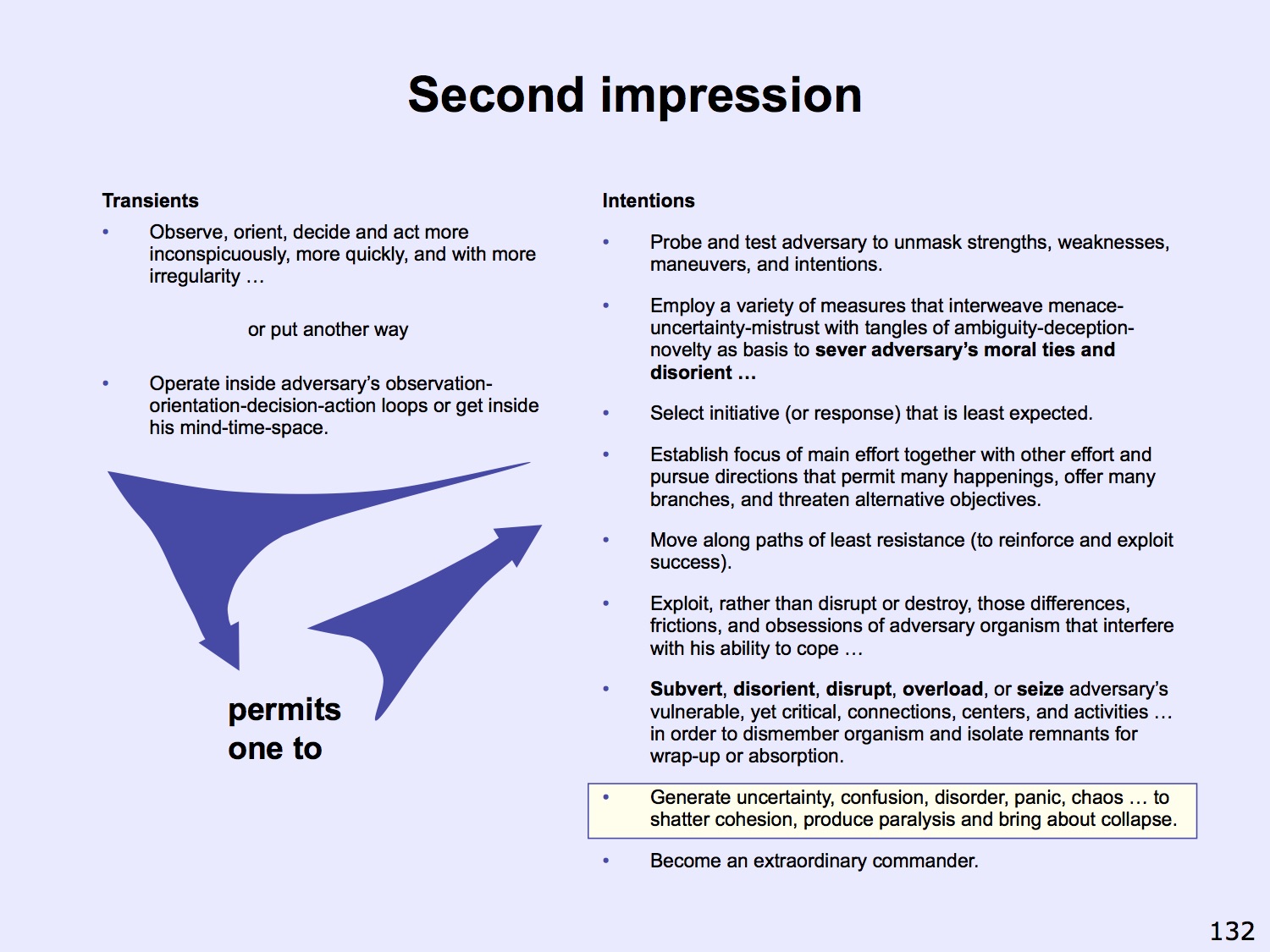
Deep into Patterns of Conflict, John Boyd finally got around to defining (more or less) the phrase “operating inside the OODA loop”:

Second Impression

To me, though, the most intriguing thing about this slide is what’s not on it: No mention of probabilities or likelihoods. In fact, the words “probability” and “likelihood” don’t occur in Patterns of Conflict, and you’ll find “likely” just twice, both times as paragraph headings, (“Likely result”).

Why is this? Why wouldn’t you put most of your preparation into what the opponent is most likely to do? Why would you waste time, men, and machinery preparing against something the opponent is highly unlikely to do?

I was reminded of this question again while reading Laurie R. King’s latest, Knave of Diamonds. Sherlock Holmes is passing time practicing his card handling skills dealing three card monte. In that game, the dealer shows the other player three cards, one of which is special — the Ace of Spades, for example — and the other two can be anything, say a couple of minor hearts.

The dealer shuffles the three cards and places them face down. The player, then, wins by picking out the ace. Win and you get back twice your bet.

What is the probability the player wins?

If you said “one third,” you are wrong. The correct answer is zero, which is why in the trade, the other player is called the “mark.”

And which is why my book is called Certain to Win (quoting Sun Tzu), not, More Likely to Do Better.


Wellington, incidentally, virtually always operated inside his opponents’ OODA loops. This explains why, even when outnumbered, he was able to defeat all of the marshals that Napoleon sent against him, and finally defeat Napoleon himself. In the process, he indeed became an extraordinary commander.

We really don’t know what Wellington was thinking in October 1810 when he was disposing his forces at the Lines of Torres Vedras. What I’ve quoted are Jac Weller’s reconstructions a century and a half later for a non-specialist audience. My guess is that instead of rolling the dice, Wellington was thinking something like: If they want to come that way, more power to them. I can hold them with my less capable units while I shift my better forces to deal with them. Wellington was a master of mobile defense, a tactic he often used against the French.

Cooking the books

Dr Ray Leopold*

Of course, defense spending numbers are being manipulated: It’s in the DNA of those most intimately involved. That type of manipulation is well beyond the natural human concept which says that if you measure something, you change it. It is far more insidious.

I daresay that most of those in-the-know never expected anything other than manipulated numbers.  They’re not really jaded, they’re just behaving as Europeans, and a few others, have dealt with one another for centuries!

In a more colloquial context, I consider myself a veteran of three wars:  The Pentagon Wars, The Spectrum Wars, and The Telecommunications Wars, and I think you may find what I’m about to write is a bit different than you’ve seen before.  Jim Burton — who used the title The Pentagon Wars — along with many of you, too, have done a great job of covering The Pentagon Wars, but IMHO they were kids’ play compared to the Spectrum Wars and the Telecommunications Wars, and these other two will probably survive the walls of the Pentagon.  (Spectrum, of course, relates to ‘wireless’ while Telecom relates to all commercial communications.) 

For better context, maybe some of you are not aware that I was in the middle of ‘making the right things happen’ at WARC-92 in Spain, which allocated spectrum for HDTV, next-generation cellular phones, and Non-Geostationary Satellite Services (NGSS), and I was also in the midst of our FCC’s 1993 Negotiated Rulemaking for that NGSS spectrum, which much of the world had then also adopted.   FYI, WARC = World Administrative Radio Conference, held by the The International Telecommunications Union (ITU), which is an arm of the UN.

Strategy, Tactics and Documented Warfare precede Sun Tzu, but when you get to putting numbers on resources and then get involved in planning, no-planning (in the Boyd context), counting, accounting and reporting on those things, I think we’re in the nth iteration, where n = the number of generations of humanity.

When it comes to Europe, I will tell you that these kinds of things go back at least 450 or 500 years to revenue sharing associated with the money from postage stamps among those same countries.  When the telegraph was created, some people may think that it was aligned with railroads, but I think you will find that, even though telegraph lines oftentimes went along railroad lines, the revenue side of telegraphy was assigned to the post offices.  

In Europe, they created their PTs — their national and international postal & telegraph offices.  Then, of course, those PTs evolved as PTT s when the telephone came along, and those rules they created for those postal activities, then postal and telegraph activities, and finally postal, telegraph and telephone activities are still embedded in all that is done at the ITU in Geneva, Switzerland.

So, when NATO and the UN came along shortly after WWII, those bureaucrats who began to staff their offices were already well-schooled in dealing internationally with numbers and revenue streams, with all of the skullduggery of centuries of their versions of rules, regulations, protocols, and procedures for officially cooking the books to their individual likings.  They were also well aware that their different nations didn’t necessarily calculate things or interpret them in a common way, but they always got along until they didn’t!!  

(Little wonder that they had so many wars and how many searched for a New World!  What surprises me more is how many folks here in America become so enamored with that Old World.)

On a personal note, there is also little wonder how John Boyd quickly concluded that we had to focus on the budget when we launched our development planning work on The Air Staff in June of 1973.  I do still have a paper copy of that planning and budget set of charts that he and I had used together when we had first briefed our work across the Air Staff from Nov 5, 1973 to May 31, 1974, and I’m especially glad that Chuck Spinney got excited about it, too; otherwise I may have never gotten back to engineering and those other two wars 

When he and I had done those briefings together, John Boyd (who was spending most of his own time on the lightweight fighter) used to point out how I was the only full-time AF-wide development planner on the Air Staff (until Chuck came along to become the second), then I left amidst a rather interesting battle among a couple of four stars. and caught my breath again teaching engineering at the AF Academy, and Chuck became the only one; but Boyd got me back to the OSD (Office of the Secretary of Defense) Staff (where Chuck was, too) for the early ’80s.  I had learned much from John which then made me unusually effective in those other wars, too. 

There may now be quite enough books written about all of that, and I’m especially pleased with the books the two of you (Winslow Wheeler & Chet) have written!**


*Robert Coram included Dr. Ray Leopold among Boyd’s acolytes in Boyd, The Fighter Pilot Who Changed the Art of War, and provided a brief description of his career after the Air Force (p. 441). Among his many accomplishments, Ray is perhaps best known in these times for being one of the primary creators of the Iridium system, which is still going strong to this very day. You may also be interested Ray’s thoughts on Boyd, Robin Olds, and Operation Bolo included in an earlier post.

**Here are a couple of the better known: The Wastrels of Defense and If We Can Keep It, respectively. You can download a PDF of IWCKI from our Articles page.