A pencil draft of the OODA loop arrived in the mail one day in early 1995 with a note from John Boyd asking me to turn it into a computer graphic. We went back and forth several times — I’d mail him updates, and he’d call up and want to talk. As I recall, the big bone of contention was the shapes of the arrows within the Orient block: which should be solid and which dashed, and in which directions the arrows should point.
He was particularly worried about the arrows from new information and previous experiences into genetic heritage. In the end, though, he decided not make any distinctions and just connect each of the bubbles to each of the others with solid arrows. Over the next several months, he added three more slides explaining what he wanted the OODA “loop” to do. Again, lots of back-and-forth.
By January 1996, Boyd had finished his revisions to The Essence of Winning and Losing. It was his last work, significant because in it he defines for the first time on paper what he meant by an OODA loop. Although he had been using the term since his first major presentation, Patterns of Conflict (created 1977 – 1986), It was virtually always combined with the preposition “inside,” in phrases like “operating inside their OODA loops.”
In fact, in the 319 slides that he created before TEoWL, he used the phrase “OODA loop” by itself, whether abbreviated or spelled out, on only 5 pages. On none of these did he actually define it
Portrait of the philosopher Duns Scotus (c. 1265-1308), artist unknown, c. 1650. Bodleian Libraries, University of Oxford
If it meant “Observe, then orient, then decide, then act,” there would be no need for further explanation, other than defining the terms. The fact that we’re talking about TEoWL suggests Boyd had something else in mind.
To guide us through Boyd’s process of constructing the loop, TEoWL begins with the concept of an “implicit repertoire.” These are the practices we need to “make intuitive within ourselves” as Boyd put it, in order to deal with those urgent and unpredictable requirements that the situation, including opponents in a conflict, throws at us. TEoWL asks where this set of practices comes from and how we add to it as circumstances change.
Put another way: From the infinite set of possible practices that we might create and train for, and given that there are only 24 hours in a day, how do we select? That is the question at the heart of TEoWL, and the answer he came up with is an OODA “loop.”
A few points to keep in mind:
The purpose of the “OODA loop ‘sketch’” on page 3 is to “clarify” a set of statements he makes on the first page of the presentation and the interactions among them. These statements all address how we manage our implicit repertoire.
He called it a “sketch.” To use his snowmobile analogy from Strategic Game (1987), you might think of it as Model 1.
However, we know from research into his files at the Library of Marine Corps University, he created many prototypes before he settled on this particular one. My personal guess is that if he had lived (he died on March 9, 1997), there would have been additional releases.
What I have done is to break down the elements of TEoWL into what I hope are digestible portions in a largely graphical format. My primary audience is the collection of people who are adapting Boyd’s sketch to serve their various purposes. I thought it might be useful for them to briefly review Boyd’s derivation of the “loop.” In other words, it is for those philosophical engineers who are developing Models 2, 3, etc., which is, I am sure, what Boyd would be doing if he were alive today.
This presentation, along with all of Boyd’s presentations and lots of other stuff, are all available from our Articles page.
Codde, Pieter Jacobsz (b.1599-12-11 – d.1678-10-12), Intérieur de corps de garde (Titre principal), 1626. Huile sur bois. Petit Palais, Musée des Beaux-Arts de la Ville de Paris.
Clinton D. Pope Chief Quality Officer Indian Health Service, Phoenix, AZ
[Editor’s note #2: Mr. Pope has revised his Venn diagram at the bottom of this post. Kaizen for Boyd’s snowmobile.]
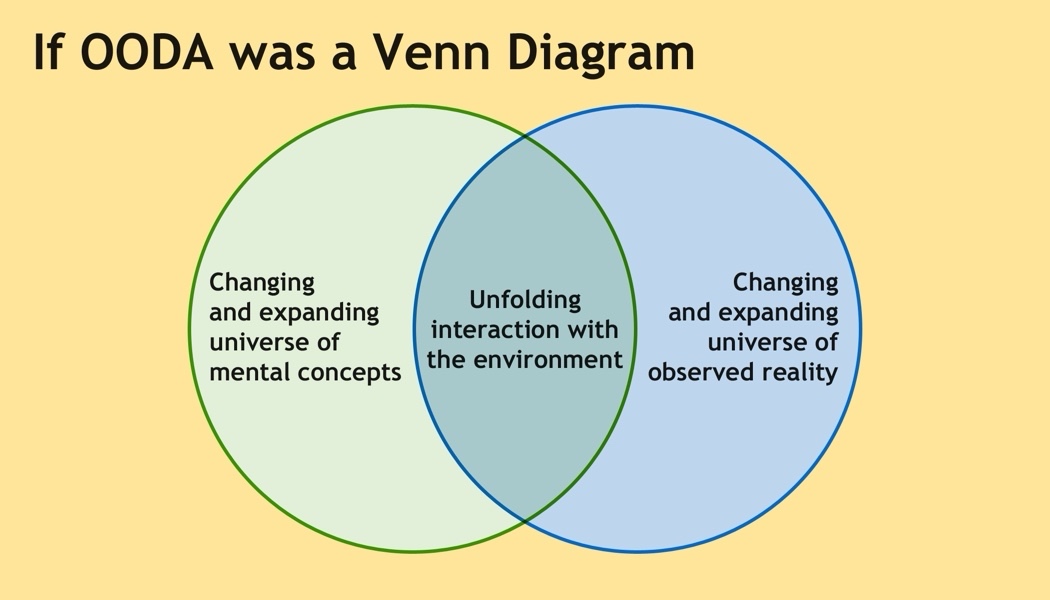
[Editor’s note: When people start playing around with Boyd’s OODA “loop” sketch from The Essence of Winning and Losing — available from our Articles page — what usually emerges is something even more complicated than what Boyd produced. Although many of these reveal interesting insights, my personal feeling is that we need someone to come along, absorb all these various efforts, and experience an “Aha!” moment that produces a new OODA “loop” sketch as elegant as, but no more complicated than, Boyd’s. To help that process along, it might be useful to revisit Boyd’s purpose for that sketch: a framework to help us “to comprehend, shape, adapt to and in turn be shaped by an unfolding evolving reality that is uncertain, everchanging, and unpredictable.” Perhaps meditate upon and internalize this objective before we start drawing more arrows? With that in mind, here’s an OODA “loop” without any arrows.]
This will likely be lost on some as the Venn diagram doesn’t mention observations, orientation, decision, or action.
However, OODA is a model of how we interact with the environment, both shaping and being shaped by the environment.
Mental concepts and observed reality are both ever changing and expanding.
To “survive” (e.g. obtain more favorable interactions with the environment), we need better means to observe what’s really going on as accurately as possible and from multiple perspectives; we need to analyze and synthesize new and existing information to orient current state in relation to desired state with a sense of how to position for a more favorable state; we need to facilitate decision making that is timely (not the fastest, but well timed) and based on available indicators; and we need to confidently act with the intention to learn (this is to test the hypothesis or prediction of the decision).
The OODA Loop is cyclical, but not linear in nature. For instance, orientation and observation are always happening. They don’t stop so that you can make decisions and act. Likewise, in every action or inaction, in every decision or indecision, you are always interacting with the environment. You don’t exist except in the environment. The “dialectic engine” is always humming.
The difference between those who survive and those who are eliminated is the ability to effectively orient and adapt to the changing environment.
Codde, Pieter Jacobsz (b.1599-12-11 – d.1678-10-12), Intérieur de corps de garde (Titre principal), 1626. Huile sur bois. Petit Palais, Musée des Beaux-Arts de la Ville de Paris.
Clinton D. Pope Chief Quality Officer Indian Health Service, Phoenix, AZ
[Editor’s note: When people start playing around with Boyd’s OODA “loop” sketch from The Essence of Winning and Losing — available from our Articles page — what usually emerges is something even more complicated than what Boyd produced. Although many of these reveal interesting insights, my personal feeling is that we need someone to come along, absorb all these various efforts, and experience an “Aha!” moment that produces a new OODA “loop” sketch as elegant as, but no more complicated than, Boyd’s. To help that process along, it might be useful to revisit Boyd’s purpose for that sketch: a framework to help us “to comprehend, shape, adapt to and in turn be shaped by an unfolding evolving reality that is uncertain, everchanging, and unpredictable.” Perhaps meditate upon and internalize this objective before we start drawing more arrows? With that in mind, here’s an OODA “loop” without any arrows.]
This will likely be lost on some as the Venn diagram doesn’t mention observations, orientation, decision, or action.
However, OODA is a model of how we interact with the environment, both shaping and being shaped by the environment.
Mental concepts and observed reality are both ever changing and expanding.
To “survive” (e.g. obtain more favorable interactions with the environment), we need better means to observe what’s really going on as accurately as possible and from multiple perspectives; we need to analyze and synthesize new and existing information to orient current state in relation to desired state with a sense of how to position for a more favorable state; we need to facilitate decision making that is timely (not the fastest, but well timed) and based on available indicators; and we need to confidently act with the intention to learn (this is to test the hypothesis or prediction of the decision).
The OODA Loop is cyclical, but not linear in nature. For instance, orientation and observation are always happening. They don’t stop so that you can make decisions and act. Likewise, in every action or inaction, in every decision or indecision, you are always interacting with the environment. You don’t exist except in the environment. The “dialectic engine” is always humming.
The difference between those who survive and those who are eliminated is the ability to effectively orient and adapt to the changing environment.
Of course, defense spending numbers are being manipulated: It’s in the DNA of those most intimately involved. That type of manipulation is well beyond the natural human concept which says that if you measure something, you change it. It is far more insidious.
I daresay that most of those in-the-know never expected anything other than manipulated numbers. They’re not really jaded, they’re just behaving as Europeans, and a few others, have dealt with one another for centuries!
In a more colloquial context, I consider myself a veteran of three wars: The Pentagon Wars, The Spectrum Wars, and The Telecommunications Wars, and I think you may find what I’m about to write is a bit different than you’ve seen before. Jim Burton — who used the title The Pentagon Wars — along with many of you, too, have done a great job of covering The Pentagon Wars, but IMHO they were kids’ play compared to the Spectrum Wars and the Telecommunications Wars, and these other two will probably survive the walls of the Pentagon. (Spectrum, of course, relates to ‘wireless’ while Telecom relates to all commercial communications.)
For better context, maybe some of you are not aware that I was in the middle of ‘making the right things happen’ at WARC-92 in Spain, which allocated spectrum for HDTV, next-generation cellular phones, and Non-Geostationary Satellite Services (NGSS), and I was also in the midst of our FCC’s 1993 Negotiated Rulemaking for that NGSS spectrum, which much of the world had then also adopted. FYI, WARC = World Administrative Radio Conference, held by the The International Telecommunications Union (ITU), which is an arm of the UN.
Strategy, Tactics and Documented Warfare precede Sun Tzu, but when you get to putting numbers on resources and then get involved in planning, no-planning (in the Boyd context), counting, accounting and reporting on those things, I think we’re in the nth iteration, where n = the number of generations of humanity.
When it comes to Europe, I will tell you that these kinds of things go back at least 450 or 500 years to revenue sharing associated with the money from postage stamps among those same countries. When the telegraph was created, some people may think that it was aligned with railroads, but I think you will find that, even though telegraph lines oftentimes went along railroad lines, the revenue side of telegraphy was assigned to the post offices.
In Europe, they created their PTs — their national and international postal & telegraph offices. Then, of course, those PTs evolved as PTT s when the telephone came along, and those rules they created for those postal activities, then postal and telegraph activities, and finally postal, telegraph and telephone activities are still embedded in all that is done at the ITU in Geneva, Switzerland.
So, when NATO and the UN came along shortly after WWII, those bureaucrats who began to staff their offices were already well-schooled in dealing internationally with numbers and revenue streams, with all of the skullduggery of centuries of their versions of rules, regulations, protocols, and procedures for officially cooking the books to their individual likings. They were also well aware that their different nations didn’t necessarily calculate things or interpret them in a common way, but they always got along until they didn’t!!
(Little wonder that they had so many wars and how many searched for a New World! What surprises me more is how many folks here in America become so enamored with that Old World.)
On a personal note, there is also little wonder how John Boyd quickly concluded that we had to focus on the budget when we launched our development planning work on The Air Staff in June of 1973. I do still have a paper copy of that planning and budget set of charts that he and I had used together when we had first briefed our work across the Air Staff from Nov 5, 1973 to May 31, 1974, and I’m especially glad that Chuck Spinney got excited about it, too; otherwise I may have never gotten back to engineeringand those other two wars.
When he and I had done those briefings together, John Boyd (who was spending most of his own time on the lightweight fighter) used to point out how I was the only full-time AF-wide development planner on the Air Staff (until Chuck came along to become the second), then I left amidst a rather interesting battle among a couple of four stars. and caught my breath again teaching engineering at the AF Academy, and Chuck became the only one; but Boyd got me back to the OSD (Office of the Secretary of Defense) Staff (where Chuck was, too) for the early ’80s. I had learned much from John which then made me unusually effective in those other wars, too.
There may now be quite enough books written about all of that, and I’m especially pleased with the books the two of you (Winslow Wheeler & Chet) have written!**
*Robert Coram included Dr. Ray Leopold among Boyd’s acolytes in Boyd, The Fighter Pilot Who Changed the Art of War, and provided a brief description of his career after the Air Force (p. 441). Among his many accomplishments, Ray is perhaps best known in these times for being one of the primary creators of the Iridium system, which is still going strong to this very day. You may also be interested Ray’s thoughts on Boyd, Robin Olds, and Operation Bolo included in an earlier post.
**Here are a couple of the better known: The Wastrels of Defense and If We Can Keep It, respectively. You can download a PDF of IWCKI from our Articles page.
In 1992, John Boyd released his last major presentation, Conceptual Spiral. Coming in at 38 slides and just shy of 3,000 words, it is roughly 10 times the size of his next and final presentation, The Essence of Winning and Losing (TEoWL).
While his presentations through 1987 concern armed conflict, Conceptual Spiral displays 18 “outstanding contributions” to science, from Sir Isaac Newton to Chaitin and Bennett (1985), and similarly 39 from engineering.
In trying to understand Conceptual Spiral, it is important to keep in mind that although the slides can be read as a stand-alone document, Boyd generally did not give out hard copies to people who hadn’t sat through the presentation. Many of the slides are complex and present challenges to figuring out what Boyd intended. Fortunately there is a complete recording of Boyd giving Conceptual Spiral to an audience at Air University as part of an Air Force project, SPACECAST 2020 . The folks at AGLX have captured this presentation and transcribed it into written form, with Boyd’s slides embedded, which you can download as a PDF from their site. We also did a podcast on Conceptual Spiral.
I was heavily involved in Conceptual Spiral. Boyd would call and go over alternative phrasings for the various slides, asking what made the most sense, which alternatives read better, and so on. Even with this, I got a lot out of the transcript.
For example, you will notice that Boyd is still describing the OODA “loop” as a real, sequential loop. If, however, you read the transcript carefully, you can detect that his concept of the “loop” is showing the first glimmers of change. He is beginning to realize that the OODA loop he talks about here (he doesn’t use the term “OODA loop” in the text of Conceptual Spiral itself) is incomplete. As he concluded as far back as “Destruction and Creation” (1976), all theories for describing reality must be incomplete, so this fact came as no surprise to him. He takes a step in remedying this in his next briefing, The Essence of Winning and Losing.
This realization, though, does not invalidate the conclusions of Conceptual Spiral. The loops of Conceptual Spiral are the engines that power the OODA “loop” sketch of TEoWL because, as Boyd explains in Conceptual Spiral, they not only “change reality through novelty,” they are also what changes our orientations to correspond with that dynamic reality. As he makes explicit on the first slide of TEOWL, their operation also allows us to create and employ the implicit guidance and control feeds of the “loop.”
If your organization does not continuously generate new product ideas and new strategies, as well as improving the processes for introducing them to the external world, every passing day leaves you more open to competitors who will.
Even if you have read the text of Conceptual Spiral and even if you have heard Boyd give the presentation, studying the transcript will repay your investment in time.
[Be sure and check out the Q&A section at the end. Although the recording did not capture the questions themselves, you’ll be able to infer their gist, and Boyd’s answers are clear.]
Even if you’ve seen this, it’s well worth a second look.
Even if you know what the OODA loop is — especially if you know what the “loop” is — watch this video. Chuck was present at the creation, and he’s passing along nearly 50 years of experience with Boyd’s concepts.
For example, Boyd says that in a conflict, the key to success is the ability to build and effectively employ snowmobiles. Why? Which snowmobiles? How do we use them? Chuck will give you some insight.
Chuck embeds the “loop” into the entirety of Boyd’s work. As Frans Osinga points out in Science, Strategy, and War, although the OODA Loop is the best known part of Boyd’s writings, in many cases, the only known, it is not the only or perhaps even the most important.
Boyd’s acolytes worried that his ideas wouldn’t long survive him. Certainly the Marine Corps’ acquisition of his library was a huge step in ensuring that they did. It seems like the last several years have seen a surge of interest not just in Boyd’s ideas, but, which is vastly more important, using his philosophies to build and test snowmobiles in a variety of domains all across the world.
I had a lot of fun with this, and I hope you enjoy it, too.
As a reminder (for those of you who haven’t had the experience of doing one of these), this video is uncensored, unexpurgated, and most important, unedited. So if you see me making obvious mistakes, or saying something more than usually ludicrous, it’s a deep fake. I swear!
Ponch, incidentally, is co-author of The Flow System, which has a nice section on Boyd’s OODA loop, tying it into the Cynefin framework.
An officer responds to a call reporting an active threat (active shooter) who is killing innocent people inside an office building. When the officer arrives, he is alone. Backup is at least ten minutes away and people are getting killed inside the building.
The officer makes the courageous decision to enter the building and attempt to eliminate the threat.
How would you do it? On pages 72 and following, the authors of Outcomes Based Learning describe an 8-step technique you could use. As you read through it, you’ll notice that it requires a fair amount of skill with your weapon and the ability to keep your focus in a time-critical crisis situation, not to mention a lot of courage. How would you teach officers to do it?
The way this topic might be taught is to make eight slides illustrating the actions at each step (just copy the illustrations from the book). You stand at the front and deliver a lecture. The students take notes and then take a written test, usually true-false or multiple choice to make grading easier. Those who achieve the required minimum score are certified.
The authors then conclude:
The approach outlined above is one of the most ineffective education methods in history.
They also note that it is undoubtedly the most widely used.
At best, you’ve taught people how to take a test, and since you’ll be rated on how many pass, you’ve probably taught the test. But what would happen in real life? Nowhere in all this have you trained officers to deal with situations that don’t follow the eight steps or prepared them to handle fear, smoke, screams, and bullets coming their way. In other words, how to actually clear a room.
Instead of teaching the process, the eight-step technique in this case, you might consider an alternative: Teach the outcome. What is it that you want to students to be able to do and under what circumstances, and prepare them to do that. As the authors put it:
True mastery of a skill or tactical technique is not just being able to execute the steps quickly and flawlessly in a neutral environment, but rather the ability to execute techniques under stress while reacting to unexpected variables and adjusting the techniques as needed in real-time to meet the demands of the specific situation.
The human brain actually has an internal mechanism that automatically prunes, eliminates knowledge or memory that the subconscious mind determines is not useful. … This is the reason why people often forget most if not all the knowledge they gain in high school and college.
This is confirmed by research — Prof. Ellen Langer of Harvard, for example, went into how we lose and recover memories in her book Counterclockwise. But my favorite explanation of this phenomenon was presented several years ago by Father Guido Sarducci: The Five Minute University. “In five minutes, you learn what the average college graduate remembers five years after he or she is out of the school.”
This book will give you ideas on how to construct training programs that produce real world outcomes in real world situations and that students will remember when they need them. There is almost no limit to what these outcomes could be. They offer a few suggestions:
Attribute 1: Willingness to Question Authority Attribute 2: Aggressiveness and Boldness Attribute 3: Judgment and Responsibility Attribute 4: Moral Courage Attribute 5: Adaptability Attribute 7: Situational Awareness Attribute 8: Confidence Attribute 9: Critical Thinking Skills Attribute 10: Problem-Solving Skills (“That being said, it is also important not to fall into the “there is no wrong answer” trap. When it comes to most problem-solving challenges as we have already said there is never a single right answer but there are indeed always wrong answers.”) Attribute 11: Initiative
Somewhere in this list, there are attributes that affect your organization, whether you are a military unit, a sports team, a business team, or an educational institution. And it won’t be that difficult to get started. You won’t need to master volumes of arcane theory in order to derive a lot of benefit: “In fact, you can most likely continue training in all of the same areas and even conduct many of the same types of training events. OBL will simply add a valuable element to the equation that will change the way you approach training and think about training.” (7)
There are many interesting side roads in the book that you should explore. Take “knowledge,” for example. Knowledge applies to everybody and every type of organization, and I think you’ll find a trove of useful ideas in the chapter “Pursuit of Knowledge.” Some data, for example, do need to be committed to memory:
The ultimate goal is not just to memorize these weapons capabilities in list form but rather be able to look at a map and intuitively visualize the range circles sprouting from each weapon. Then when you look up from the map at the terrain in front of you those same range circles unfold in your mind. … intuitive decision making is almost always preferable to analytical decision making in battle because intuitive decision making is much faster and generally more effective.
The trick is which data to memorize, and then how to tie these facts into intuitive decision making so that they don’t just become courses in the Five Minute University, regurgitated for the test and then quickly forgotten.
All of these practices, including memorization and development of intuitive execution, must support the author’s insistence, noted above, that we master the ability to “execute techniques under stress while reacting to unexpected variables and adjusting the techniques as needed in real-time to meet the demands of the specific situation.” The American strategist John Boyd coined a term for this ability. He called it “building snowmobiles,” and maintained that the ability to do this is the essential skill that separates winners from losers.*
What the authors have produced is the first practical handbook for building snowmobiles, and one that is accessible to everybody. I think Boyd would be very, very excited about this book.
A couple of notes. First on the treatment of OODA loops. The authors claim that “Taking action will by definition change the situation, requiring the pilot to repeat the process all over again, observing, orienting, deciding and acting. This cycle repeats in a continuing ‘loop,’ thus the term OODA Loop is another descriptor for Boyd’s decision cycle.”
As I have argued at length in my paper “Boyd’s OODA loop,” (available for free download from our Articles page) this model doesn’t really work very well. Boyd himself came to realize this when he drew his OODA “loop” sketch (reproduced in my paper) in The Essence of Winning and Losing. The authors of this book are well aware of this, however, and explain their use of the circular model thusly:
Whether or not the last few pages accurately captured Boyd’s thinking, they certainty capture how the average military leader interpreted Boyd’s thinking. … Most importantly, the simplified narrative is more accessible and in some cases easier for most people to apply to real-world problems.
As I also note in my paper, the circular model is a subset of Boyd’s OODA “loop” sketch and does accurately represent his model of learning, that is how to build and employ snowmobiles. Creativity and leadership under fire. And since learning is what this book is all about, I can endorse their use of the circular representation, even if it is not a good model of decisions and actions in a rapidly changing situation.
Also, a note on authorship. No author is listed, but the principle author is the leading expert on outcomes based learning, Don Vandergriff, author of many works on improving leadership in critical command situations, including Raising the Bar, The Path to Victory, and Adopting Mission Command: Developing Leaders for a Superior Command Culture.
Don told me that the Special Tactics Staff provided support and contributions. Incidentally, the general background of the Special Tactics team comes out of Tier-1 Special Missions Units https://en.wikipedia.org/wiki/Special_mission_unit and Special Forces.
I strongly recommend this book. You’ll find all sorts of interesting topics, all in a highly readable style that you will find difficult to put down. No matter what your occupation, by the end of this book, you will be building better snowmobiles faster.
——— *The idea is that a snowmobile takes bits and pieces from what’s readily available — in this case, what we already know — and combines them in a new way to solve a problem. Boyd describes the process and importance of building snowmobiles in his presentation Strategic Game of ? and ?, available from our Articles page.
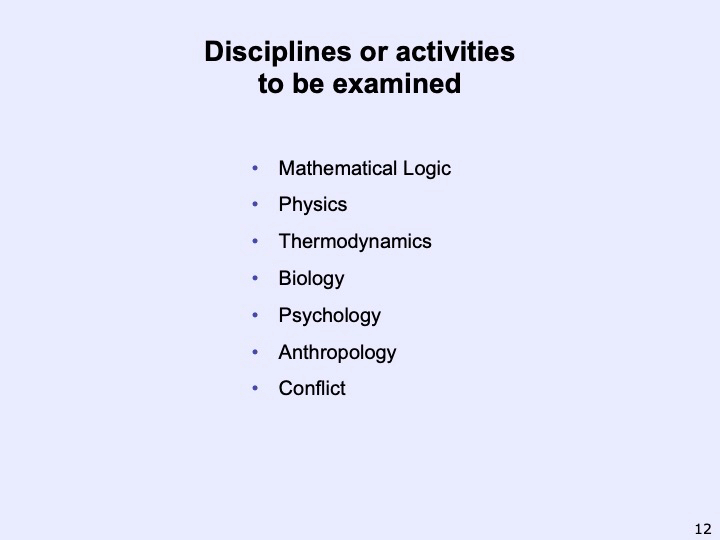
Most readers of this blog will be familiar with Boyd’s practice of exploring a variety of domains looking for what he called “invariants,” concepts that keep occurring in different fields. Here, for example, is his domain list from Strategic Game of ? and ?
From Strategic Game of ? and ?
The invariants he found in this collection explain the two question marks (All of Boyd’s works are available for free download from our Articles page).
What you may not be so familiar with is that the process goes both ways. That is, once he distilled out an invariant, it was often applicable to domains outside his original collection. In fact, this was virtually inevitable, as he observed near the end of his life in Conceptual Spiral (1992):
Taken together, the theorems associated with Gödel, Lowenheim & Skolem, Tarski, Church, Turing, Chaitin, and others reveal that not only do the statements representing a theoretical system for explaining some aspect of reality explain that reality inadequately or incompletely but, like it or not, these statements spill out beyond any one system and do so in unpredictable ways (14).
So the OODA loop, which started out as a concept from armed conflict — war — quickly spilled out into business, sports, politics, etc. One could argue that although these aren’t war, they are forms of conflict, thus the application of the OODA loop to them shouldn’t be surprising. But here is something perhaps less expected. This post introduces a paper from Lancaster University in England, “Rethinking reflective practice: John Boyd’s OODA loop as an alternative to Kolb.,” by Mike Ryder and Carolyn Downs (The International Journal of Management Education 20 (2022) 100703), https://www.sciencedirect.com/science/article/pii/S1472811722001057
Let me start by admitting that I have no idea who Kolb was or is and have never heard of “reflective practice.” But what is clear is that the OODA loop is making a major leap from any form of conflict into pedagogy — the art of teaching. Here is the paper’s abstract:
The world is changing and business schools are struggling to keep up. Theories of reflective practice developed by the likes of Schon (1983), Gibbs (1988), Driscoll (1994, 2007) and Kolb (1984, 2015) are outdated and unfit for current purposes. Problems include the chronology of events, the orientation of the observer, the impact of external inputs, and the fact that neither education nor the workplace follow a structured, linear path.
In response to these challenges, we propose a new ‘solution’: John Boyd’s OODA loop. We argue that OODA loops offer the chance to reshape reflective practice and work-based learning for a world in which individuals must cope with ‘an unfolding evolving reality that is uncertain, ever changing and unpredictable’ (Boyd, 1995, slide 1). By embracing the philosophy of John Boyd and his OODA loop theory, business schools can develop greater resilience and employability in graduates, preparing them to embrace change while also embedding the concept of life-long learning to make them better equipped to face the uncertainty that the modern world brings.
I am not going to get involved in debate over reflective practice, whatever that may be. However, having taught Boyd’s philosophy and OODA loop theory in graduate business school, I heartily concur with the last sentence of the abstract.
Before you read the paper, one caution. As you will soon discover, I am cited and quoted several times, granting me considerably more credit than I deserve. That being said, this is an excellent exegesis of some of Boyd’s ideas, particularly as they affect the “learning loop,” where we tweak our orientations to keep up with that “unfolding evolving reality” and develop the intuitive actions we need to respond to and influence that world. Boyd described this aspect of the “loop” in Conceptual Spiral, particularly slides 26 – 28, and drew his famous sketch of it in The Essence of Winning and Losing (1996):
The “learning loop” component of the OODA “loop” (emp. added)
Let me illustrate with a few quotes from the paper:
The real value of Boyd’s theory is in its approach to thinking and understanding one’s orientation with respect to the wider world…
A good example might be the student who memorises a long list of management theories and develops excellent speed of recall. While this may be a useful skill to pass an exam, what the student doesn’t gain is the intuitive ability to process factors and apply them to a given situation. This requires a far deeper level of understanding than a textbook or list of management theories can provide. Much rather, it requires knowledge and understanding beyond the formal realms of any given subject: it requires speed of contextual processing, rather than speed of recall.
This is why Boyd’s theory is so useful.
The application of the “loop,” the entire “loop,” to the process of teaching, itself, appears to me to be novel, and for this reason alone, I highly recommend this paper. I’m going to assume most of my audience aren’t professional educators (although we all end up teaching something to somebody at some point …). Whatever your occupation, however, it’s a great example of how ideas spread not by analogy but by first developing a deep understanding of their origins and meanings, and then applying this understanding to new domains.
Boyd first used this approach in “Destruction and Creation,” and, as he explains in the “Abstract” (available on the Articles page), continued to employ it the rest of his life:
Yet, the theme that weaves its way through this Discourse on Winning and Losing is not so much contained within each of the five sections, per se, that make up the Discourse; rather, it is the kind of thinking that both lies behind and makes up its very essence. For the interested, a careful examination will reveal that the increasingly abstract discussion surfaces a process of reaching across many perspectives; pulling each and every one apart (analysis), all the while intuitively looking for those parts of the disassembled perspectives which naturally interconnect with one another to form a higher-order, more general elaboration (synthesis) of what is taking place. As a result, the process not only creates the Discourse but it also represents the key to evolve the tactics, strategies, goals, unifying themes, etc., that permit us to actively shape and adapt to the unfolding world we are a part of, live in, and feed upon.





 Slightly East of New
You must be logged in to post a comment.