All about agility in 400 sec.

At a special event midway through the first day, five of the presenters at LeanKanban 2015 gave short presentations on various topics.  The trick was that you had to have an intro slide, an outro slide, and 20 content slides, each of which was timed to display for 20 seconds.  In the video below, you can see the timing ball moving inexorably across the bottoms of the screens.

Mine was modestly entitled “Agility: The Power and the Glory.”  The software development community has a concept of agility, and if you search on “SCRUM” you can get an idea of how it works.  Apparently it works well because lots of development teams use it.  The way the developers use the term is the same as Musashi’s chapters 2 and 3, where he discusses tactics and techniques. This is important stuff because poor technique can ruin an otherwise brilliant strategy.20x20.001

But like Sun Tzu, Musashi goes on to insist that the real purpose of agility is to drive the terms of the conflict, to ensure, for example, that what you develop succeeds in the marketplace. Nokia, for example, didn’t go out of the phone business because of poor technique in building feature phones.  Agility should govern strategy — what to develop — as well as tactics and technique — how to develop it.

As I explain in this 20-slide talk, one of the really cool things Boyd did was to extract the essence of agility from something like “super maneuverability,” that is, a hardware concept, and move it into the pilot’s mind.  My little talk shows that this proceeded in stages first by noting the ability to handle change, then in the idea of “operating inside the OODA loop,” and finally to the concept of orientation.  This progression is critical to the concept of agility because otherwise you have a big problem explaining why the Red Baron’s Fokker Triplane from WWI, which was among the most agile aircraft ever built, didn’t even stay a front-line fighter for the whole war.

As an added bonus, I deconstruct the OODA “loop,” the big one from The Essence of Winning and Losing, in 60 seconds.

All of the little talks are worth watching, and mine begins at about 35:40.  You’ll occasionally hear voices in the background. To reduce the times needed for changeovers, we were all miked and in the excitement, we sometimes forgot this simple fact.  The MC is Markus Andrezak of the German company Überproduct in Potsdam.

20 by 20 with Pawel Brodzinski, Chet Richards, Nadja Schnetzler, Karl Scotland and Dominica DeGrandis at LKCE15 from Lean Kanban Central Europe on Vimeo.

Gators, by the way, are extremely agile.  Don’t be fooled into thinking they are just sluggish, belly-dragging lizards: They do the cheng / chi maneuver (abrupt transition from expected to unexpected) better than any human I’ve run across.

Maneuver breaks out

Fokker Dr.1

Replica of a Fokker Dr.1 Triplane in the Deutsches Museum, Munich. A very agile airplane, but not very fast, so by the end of the war, no longer capable of operating inside opponents’ OODA loops.

If you look down through the sweep of history, you might see two broad trends in the concept we call “agility” or “maneuver.” In the military, including the martial arts, people have known that certain practices could disorient opponents, making the physical act of combat much easier to win.  Among these were deception, ambiguity (the “fog of war”), the ability to operate at a rapid tempo, and especially a rapid shift between what the opponent expects and what they experience. The oldest known documentation of these ideas comes from the Sun Tzu text, fragments of which date back to 300 BCE, and they flow like a stream through later Chinese commentators, the Japanese samurai, various schools of the martial arts, the campaigns of Genghis Khan, the German “blitzkrieg,” and on to our day via the works of John Boyd and the US Marine Corps doctrine of maneuver warfare.

Sometime after World War II, in Japan, they jumped the military track and into, of all things, automobile manufacturing.  Known today as “lean manufacturing,” the philosophy and set of practices that began as the Toyota Production System broke longstanding tradeoffs between cost, delivery time, and quality.  Before the TPS, and in US auto manufacturing up until the 1990s, higher quality meant higher costs. The TPS showed that it was possible to build better cars cheaper.

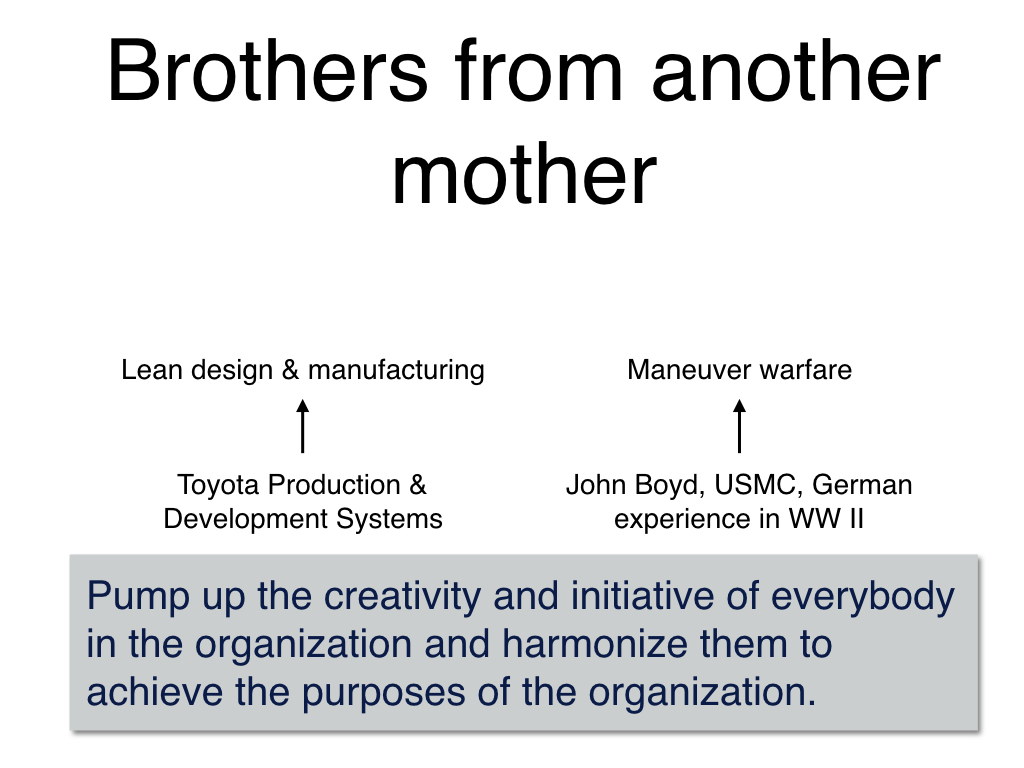
Why is the TPS another manifestation of the principles that underlie maneuver warfare?  For one thing, they both accord a central role to time. Sun Tzu wrote that quickness is the essence of war. Similarly, the TPS stresses the continuous reduction in the time between when a customer places an order and when they receive the vehicle. And as this chart from my keynote illustrates, they both rest on a philosophy that stresses human creativity and initiative:
Final Brothers illustrations.001

Both maneuver warfare and lean are mature concepts.  One could argue that all the elements that define maneuver warfare were identified and in place no later than the early 1940s and might even make a case for 1936, when the German Army issued its doctrine for command of troops, the Truppenführung. If you’re interested in the details, Martin van Creveld provides an extensive analysis of the Truppenführung in his book Fighting Power.  These concepts were refined by John Boyd, Bill Lind, and a group of young officers in the Marine Corps beginning in the early 1980s and reached what is essentially their current state with the publication of Marine Corps Doctrine Publication 1, Warfighting in 1989.

Similarly, Taiichi Ohno, one of the prime creators of the system at Toyota, maintained in his book Toyota Production System that the basics of the system were in place by 1973.  In 1979, in response to claims that the Japanese were dumping cars at below cost (nobody could sell a car that good for so little!), MIT began the International Motor Vehicle Program, which documented the system and compiled data that demonstrated its effectiveness. Their results were presented in a number of articles principally in the Harvard Business Review and Sloan Management Review and popularized in the 1990 book, The Machine that Changed the World.  Two of the authors of that work continued to develop the ideas into a more general theory of lean and published them in Lean Thinking (1996).  At about the same time, Allen Ward and his colleagues at the University of Michigan were researching the Toyota Vehicle Development System, which applies the same underlying principles but in quite novel ways. This may be evident from the subtitle of their 1995 paper, “How Delaying Decisions Can Make Better Cars Faster.”

It’s been 20 years since anything significant developed in the world of maneuver, agile, and lean.  My 2004 book, Certain to Win, looked more at the relationships between maneuver and lean. It was the first to point out the common foundation of maneuver and lean, particularly the “human” factors that underly both (by “pumping up creativity …”). It noted that in business, the military concept of grand strategy reduces to “ordinary” strategy. It offered an interpretation of the maneuver concept of cheng / chi that, by focusing on the customer, not the competitor, works for business, too.  Good foundational stuff, but it wasn’t written to divert the lean / maneuver pattern into a new field of application.

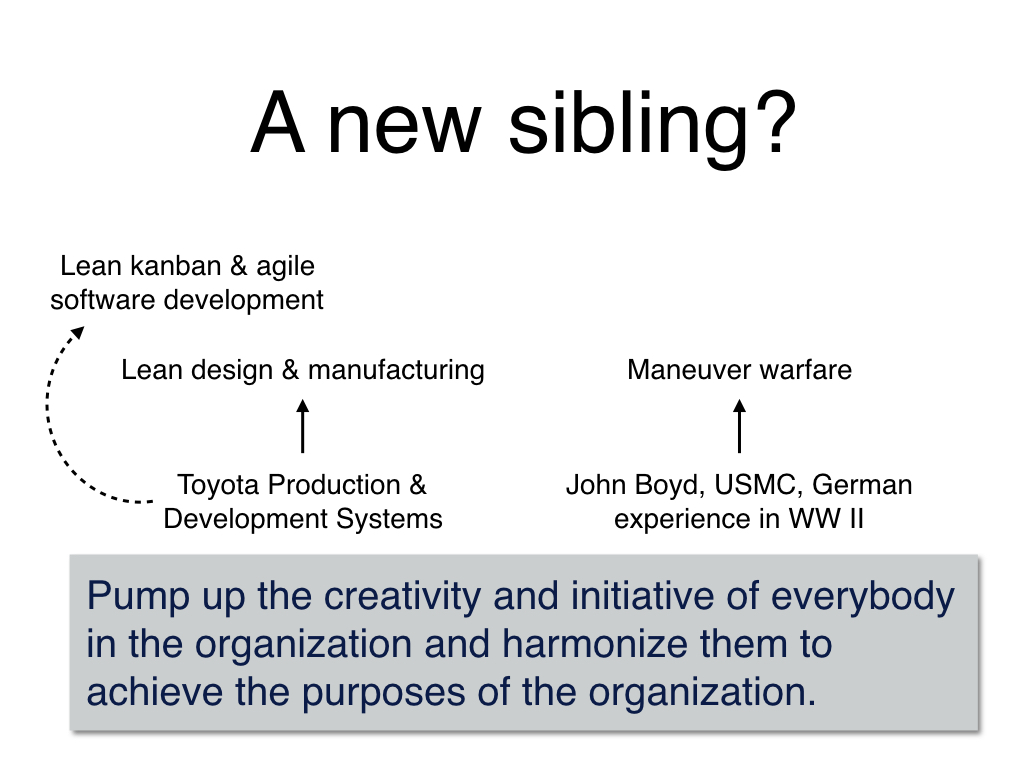
So it’s about time that the maneuver stream found a new channel, that it broke out of the worlds of manufacturing and war and over into what we might call “white collar” occupations.  From the quality and intensity of the discussions at LKCE15, building on what I first observed at Lean Software & Systems 2011 in Long Beach, we may be seeing the power of these ideas manifesting in an entirely new area:

Final Brothers illustrations.002


Lean kanban incorporates many of the practices associated with classical maneuver / lean theory: managing flow, limiting work-in-process inventory (which can hide problems and distort orientation), and employing an hypothesis-test methodology for learning.  According to the web site of one of its founders (and a keynote speaker at this conference), David Anderson, it also “encourages acts of leadership at all levels.” Depending on how they implement this idea, it could be in harmony with “Pump up the creativity and initiative of everybody …” Because this concept is the real foundation of classical lean and maneuver, I’d need to know more before pronouncing a final judgment.  Looks promising, though.

For more information, check out the conference’s sponsors — there are links down at the bottom of the conference’s home page.


“All by Ourselves” – Now a Major Motion Picture!

Or at least a video of my keynote at LeanKanban Central Europe 2015 in Munich on November 17:

All by Ourselves (Keynote) – Chet Richards at LKCE15 from Lean Kanban Central Europe on Vimeo.

Many thanks to the folks at it-agile for a superb conference! Ran like clock work, too many great presentations to catch them all, rocking late Oktoberfest, and somehow they arranged for record high temperatures in Munich.

All by ourselves

IMG_3652I’ve just uploaded a paper based (loosely) on the keynote that I gave at LeanKanban Central Europe 2015 in Munich last week.

The Tao te Ching suggests that the epitome of leadership is that once the mission is complete, the objective taken, or the product delivered, the team members congratulate themselves: “Amazing! We did it all by ourselves.” But this doesn’t often happen by accident, so in my talk, I explored how Boyd’s “EBFAS” climate can make it much more likely.

You can download the latest edition of “All by ourselves” from the Articles page.

Munich, at last

One of my favorite cities for more than 50 years, and it’s great to be back.  Beautiful weather for November made for a nice run along the Isar this morning.  Now making final preps for LKCE15 starting Monday.

There’s going to be a lot of fascinating talks.  I’m especially anticipating one called “Business is tough, but it’s even tougher when you’re stupid.” An area in which I have some expertise.

To help fight jet lag (no sleep on the plane, but they did have “The Big Lebowski”) I walked the mile into town this afternoon.

 
Almost ready for the Christmas Market in the Marienplatz. 

It’s been a busy fall

As readers of this blog know, I’m off to Munich later in the week to make several presentations at LeanKanban Central Europe 2015.  I understand there is still room at my tutorial on the 18th that will cover the fundamentals of Boyd’s strategy, including roughly 100 pages from Patterns of Conflict and his other briefings.

I have come under withering and totally underserved criticism from my legion of fans, well, from one of them, anyway, for not posting more regularly.  I will take up that task anew upon my return.

In the meantime, here’s something I discovered as I was digging through many a quaint and curious volume of forgotten lore preparing for my keynote on the 17th:

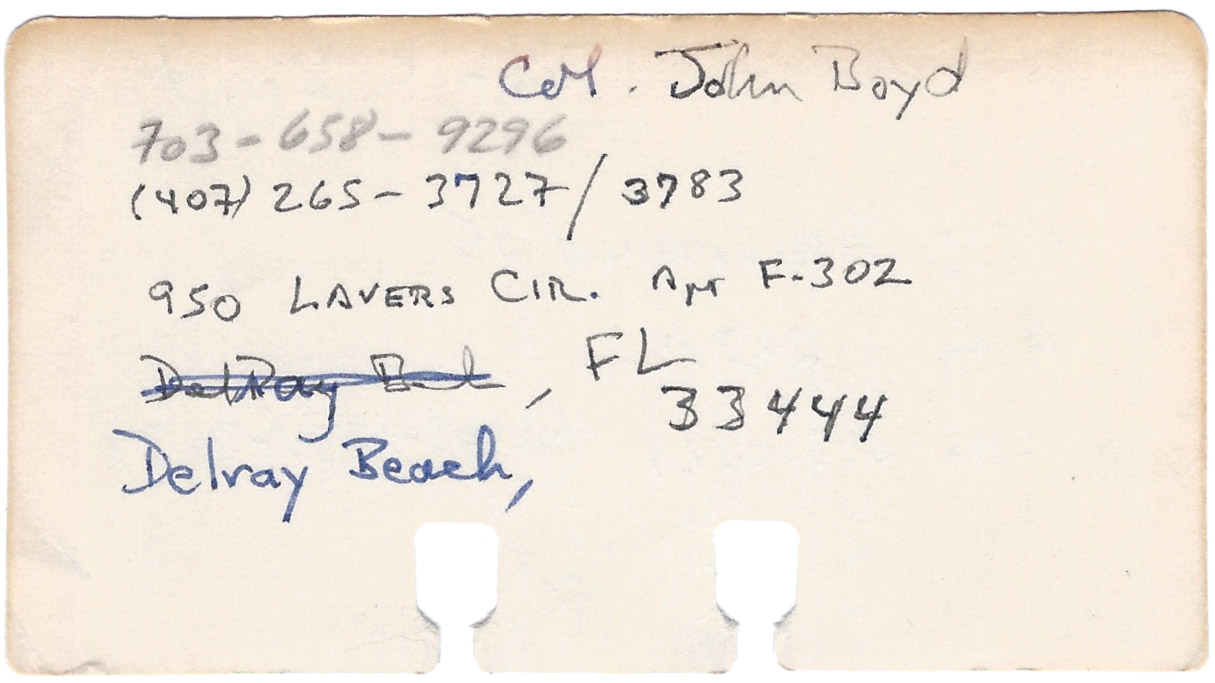
JRB Rolodex Card Obverse JRB Rolodex Card Reverse

Boyd left Beauregard ST late in 1988. As best I recall, this card (called a “Rolodex card” for those of you under about 50) dates from around 1981, although it might be from as early as 1976.  I believe that (202) 695-0529 was in the Tac Air shop, where Boyd worked as a consultant for Tom Christie after John’s retirement from the Air Force.  A voice keeps insisting that my phone number, when I worked in the same office, was (202) 697-0521.

Interview: What’s Boyd all about?

The organizers of LeanKanban Central Europe 2015 have posted an interview I did with Arne Roock, who, incidentally, will also be giving a presentation at the conference.

You can download the PDF from their site.

If you’ve never seen the Boyd material, I’m going to be presenting a fair amount of it, including about 100 pages of Patterns of Conflict and including slides from all the other briefings of the Discourse on Winning and Losing, during my tutorial.

Honor, Courage, Commitment

The values that new Marines swear to uphold.

Yesterday, September 11, 2015, I had the privilege of watching 622 new Marines put on an impressive graduation ceremony. They started training on June 23rd and officially became Marines when they completed the Crucible about a week ago. This ceremony was their last official duty at Parris Island before leaving for the School of Infantry at Camp Geiger, North Carolina.

They all look so young.

[Note: the video starts with the flag raising ceremony, “Morning Colors,” at 0800 and then moves to the graduation parade itself, which began at 0900. The flag was raised only to half staff in memory of 9/11. The band is the MCRD Parris Island Band, which makes appearances all around the country. The dog’s name is “Legend.”]

Why do we still buy Apple products?

The Guardian has a brief analysis centering on things like prestige (Apple products are expensive), ecosystem (Apple’s stuff works well together), and branding (you know what you’re going to get).

These are all true, but somehow, even taken together, they miss a key point: We’ve made Apple the world’s most valuable company because a whole lot of us really want to buy Apple products.  This may seem obvious, given the sales data, but think about it for a second. You have lots of choices for smartphones, for example, and a lot of them get great reviews in the tech press. But Apple continues to gain market share, even at their prices, while their sometimes technologically superior competitors lose.

Why?

I’m going to toss out a guess. Deep within Apple, Steve Jobs’ mantra is still alive and well: Insanely great! In other words, there are still enough people who influence product development and who understand the cheng / chi game. As you may recall, this ancient idea — the subject of Chapter 6 of the Sun Tzu text — involves using both the expected and the unexpected in combination to surprise and confuse an opponent and then exploit the situation before the opponent can figure it out. It’s the basis of Boyd’s concept of “operating inside the OODA loop.”

LKCE15-Badge-200x200-SpeakerIn business, though,  it should focus on the customer, not competitors, and becomes something like “it works great but it also delights users with …”  It works and it’s super cool! Yeah, I know that sometimes it doesn’t work that awfully great — I remember “MobileMe” and the first iteration of Apple Maps — but so far Apple has been a fast learner and fixes problems before they become fatal. Besides, as Boyd always insisted, you don’t have to be perfect, just better than your competition.

The result of expectation and delight working together is an emotional need, you just feel like buying their products is what you have to do. It’s just the right thing to do.

What’s really amazing is that Apple has kept corporate entropy at bay for so long. What usually happens is that slowly, over time, bean counters take over.  Risk taking subsides as profit taking dominates. Nokia could have had the first awesome smartphone, but they didn’t.  And putting arbitrary sales targets ahead of making the best products cost Toyota dearly earlier in the millennium.

We’re going to go into this a lot more at the Lean Kanban Conference in Munich in November, particularly in the workshop on the 18th.   Hope to see  you there.