Boyd, Jobs, and Creativity

Steve Jobs, that is. Unfortunately, if you take this path, you may not get a job with Bill Gates or other corporate overlord, and you probably won’t get promoted, but you just might do something wonderful.

Liberal Arts and Humanities Education: Who Is Right—Bill Gates, or the Late Steve Jobs? by Vivek Wadhwa, Fellow, Arthur & Toni Rembe Rock Center for Corporate Governance at Stanford University

When students asked me what subjects they should major in to become a tech entrepreneur, I would say engineering, mathematics, and science. I used to believe that education in these fields was a prerequisite for innovation, and that engineers made the best entrepreneurs.

That was several years ago. Read more

I’ve uploaded a chart I did for zenpundit several years ago showing some of the sources Boyd drew on for the Discourse.  Those of you who have been to the Boyd Collection at Quantico know that he didn’t just dabble in these areas, he devoured them, developing a deep understanding of subjects from military science to quantum mechanics to Taoism. Available on the Articles page.  I’m working on an update, maybe later this month.

At our little PR firm, J. Addams & Partners, we never hired anyone with a PR degree. As the founder, Jeannine Addams often said, if you’re bright and energetic, we can always teach you PR, but we can’t give you a 4-year degree in how to create, write, or think.

Delta CEO: Orientation is the Schwerpunkt

He didn’t actually say that (Boyd did, on Organic Design, 16), but Delta CEO Richard Anderson expressed the sentiment well in a recent interview with the Associated Press. For example:

AP: As you fly around, where do you sit?
ANDERSON: I was in row 28 coming up here. I wear my badge. And I fly in coach.

I really like this, especially because it’s exactly what I recommended that Delta execs should do back when I wrote Certain to Win:

If you’re a high roller with some airline, call your 1-800 telephone number to make a reservation. Try your web site. Stand in line to check in. Check a suitcase. Fly coach. Try to change a reservation. What do you think? Excited by your own stuff? Any sign of magical pizzazz there? Any reason anybody with a choice would do it again? And while you’re back there in coach, talk to people. (p. 157)

I don’t know if he does all of these things, and I also have no idea whether other high Delta execs follow suit (a little pun, sorry). But it’s a very good sign that Delta is getting a lot right.

I’ve also berated loyalty checks — where you only use your company’s products — remember how Detroit auto factories (when there were auto factories in Detroit) used to put signs in their parking lots telling people with imported cars to go park somewhere else?

So I was delighted to read this:

ANDERSON: I’ve done long-haul to Asia. You know what I like to try to do? I like to try to fly on the competition when I go long-haul. I take my little black book and just make notes and observe what’s going on and how the airports are operating, and how your competitors are operating.

Hell yes!  But again, my question would be whether such behavior is part of the Delta culture now; do all Delta personnel fly the competition on a regular basis, and do they report on what they found? Is there an institutional process to use these reports? Put another way, does this information become part of Delta’s common implicit orientation?

Anyway, kudos to Delta. As a Million Miler living in the South, I’ve flown them, and will be flying them, a lot.

Rededication of Boyd Hall

On June 13, 2013, Maj. Gen. John N. T. “Jack” Shanahan, USAF, gave the rededication speech of Boyd Hall at the Weapons Center, Nellis AFB, Nevada.

With the general’s kind permission, I have added a copy of his remarks to our Articles page.  General Shanahan gave a speech for the ages, and if it were possible to have embarrassed Boyd, such encomia might have done the trick.

General Shanahan is the commander of the Air Force Intelligence, Surveillance, and Reconnaissance Agency at Joint Base San Antonio, Lackland, TX. AFISR is the successor unit to my old organization.

Why airlines are like airlines

Great piece by aviation editor Scott McCartney in today’s Wall St. J., “If the World Were Run Like Airlines, Sandwich Prices Would Spike at Peak Hours and ‘Priority’ Elevators at the Hotel Would Cost Extra.” (paywall)

My first thought is, “Be patient, Scott. Give them time.”

In the meantime, here are some off-the-top-of-my-head ideas for why airlines, uniquely among modern industries, can get away with this type of pricing (comments apply to US airlines; I don’t know that much about the others):

  1. They can get away with it because there’s really not that much competition. They may look like they compete, and sometimes they do, but in fact, they’re an oligopoly. If the American-US Air merger is approved, we’ll be down to four major carriers: Delta, United, American, and Southwest.
  2. It is said that when you die and are on your way to Hell, you’ll change planes in Atlanta. Which means Delta in all probability, giving them pricing power at the country’s busiest airport. In Chicago or Houston, it would be United. American gets Dallas.
  3. The customers they want don’t care about the irritations McCartney mentions because business and first class passengers aren’t paying bag fees. Like all industries, airlines want to make a healthy profit at a manageable risk. Easiest way to do that is cater to the folks with lots of money. You can see an obvious sign of that in the new spending requirements for elite status. You can also see the oligopoly element at work.
  4. This suggests a strategy of divvying up those who can afford premium travel. Delta, for example, will get these passengers from Atlanta and most of the South.
  5. The hollowing out of the middle class — and wait until the boomers see how much their 401Ks and interest on CDs will leave them for niceties like air travel — means fewer coach passengers and less margin from those who are left. If you run an airline, lock in your share of the high profit premium passengers now! By any means necessary (to coin a phrase).
  6. Southwest may be a special case and could be where all the coach passengers, those who can afford more than a bus, end up. I don’t know how many that will be, even for Southwest (if they choose to go this route). Southwest started off competing against the bus, but recently they’ve been making eyes at business travelers, too. JetBlue started off in an all-coach configuration, too, but is now adding business class (with mini-suites, no less).
  7. Over time, this will lead to a shrinking down of at least the legacy industry to a luxury provider for those who can afford to pay the price, as I suggested in an earlier post. Because we don’t have much in the way of alternatives in this country for long distance travel, I can only speculate what this means for our continued prosperity.

Standing on our own two feet

Or not.  I’ve taken up yoga in my old age, both to complement tightness from running and to generally improve posture, breathing, awareness, and relaxation. Sure wish I’d started it about 20 years ago instead after I was 60. Still, 60 is better than 70. Yoga is one activity / philosophy that you can continue to practice as long as you can breathe, so I figure it’s time to get going on it.

SirsasanaThe headstand still needs some work, but it’s coming along. [Click for a larger view, if you promise not to laugh.]  Got a little cocky this morning, let my concentration slip for a millisecond or two, and fell out of it. Typically when that happens you just pull your legs down and do a backwards roll. Problem is that at my age, my inner ears don’t recover as quick as they used to, and I stay queasy for a few minutes. This is also the reason I had to give up roller coasters and probably wouldn’t be any too great as a fighter pilot, either. That and other things.

There are deep parallels between yoga and Boyd’s framework and not just the emphasis on flexibility. In fact, Boyd hardly ever mentions “flexibility” — once in Patterns, on chart 149, for example. Even “flexible” only shows up twice in Patterns, on charts 88 and 128. Somehow, though, you know that Boyd and flexibility are intimately related, but that’s not exactly the connection I have in mind.

More on this later. In the meantime, if you have any thoughts on the subject, please jump in. By the way, I don’t have any information that Boyd ever practiced yoga himself or read much about it. He did take up power walking after he moved to Delray Beach. He also claimed to have a pet alligator.

Namaste.

Happy Father’s Day 2013

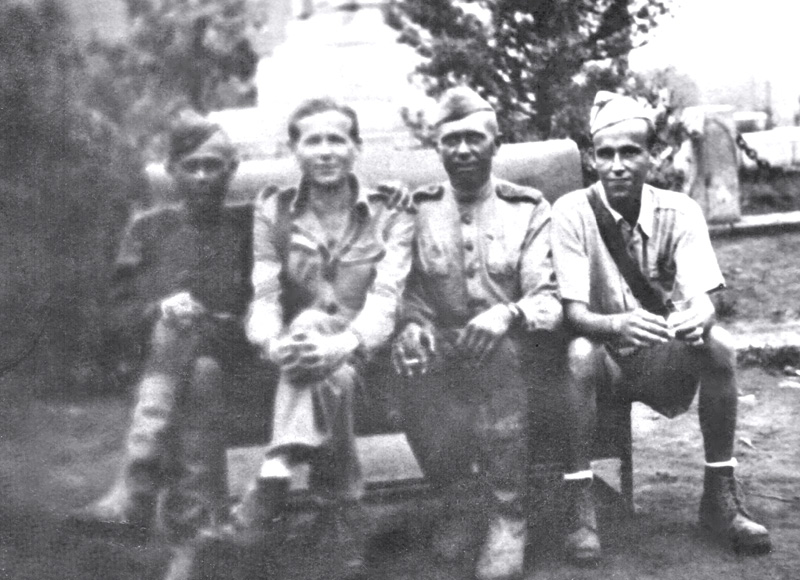
GC Richards MukdenHere’s a picture of my late father, Grover C. Richards (he dropped “Jr.” when his father died) taken in Mukden, Manchuria, September 1945. He’s on the far right, along with another POW and two of the Soviet soldiers who liberated their camp. Click for a larger view.

Dad was captured on Corregidor in May 1942, after the fall of Bataan. He was awarded the Silver Star for bravery for actions in the Bataan campaign. He retired from the Army in 1961, got his Ph.D., and retired again as Chair of the Psychology Department at Georgia Southern College, as it was then known, in 1981. He died in 1996.

Cheetahs — inside your OODA loops

Bad news if you’re an antelope, but in that case, probably something you already knew.

It isn’t just speed. Sure, the cheetah is the fastest mammal, but its 60 mph dash capability primarily gets it into position, into the envelope. If speed were all there was to it, there would be a lot of overshoots.

The key to the endgame is agility. As the New York Times explains it in “Cheetahs’ Secret Weapon: A Tight Turning Radius“:

But it turns out that speed is not the secret to their prodigious hunting skills: a novel study of how cheetahs chase prey in the wild shows that it is their agility — their skill at leaping sideways, changing directions abruptly and slowing down quickly — that gives those antelope such bad odds.

In Boyd’s framework, a tight turning radius per se would be “maneuverability,” not agility.  But terms like “abruptly” certainly add a flavor of agility, which more properly is the ability to transition from one maneuver to another more rapidly than an opponent.

But are cheetahs operating inside antelopes’ OODA loops? Are they changing the situation more rapidly than antelopes can comprehend, thereby achieving the intention of Patterns 132:

Generate uncertainty, confusion, disorder, panic, chaos … to shatter cohesion, produce paralysis and bring about collapse.

I don’t know. Guess we’ll have to wait for more research.


After the Storm

A sharp line of thunderstorms rolled across us about 7:30 last night leaving only minor tree damage in our area and some much needed rain. At around 8:30 I noticed a bright orange glow out our west-facing windows, ran outside into the last tailings of the storm, and took this picture. Ten minutes later, it was pitch black.

Fortunately my iPhone is in a water-resistant case.

After The Storm

My copy of Contempo has arrived!

Just got here today: my February 1, 1932 edition of Contempo. No, the Post Office wasn’t that slow; I bought it off eBay (and the USPS was right on time).

I ran across this footnote in the life of William Faulkner while attending my daughter’s graduation from UNC last month.  Minter’s 250-page bio, for example, doesn’t even mention that Faulkner visited Chapel Hill, much less that he contributed to this journal, and neither does his Wikipedia entry. The librarian at the university’s Southern Historical Collection, learning of my interest in Faulkner, retrieved their copy from the files, and I bought this one from John LaPine in Chicago (5 stars, by the way).

contempo_front_pageWhat is known is that the author visited Chapel Hill in October for at least three days (there is some controversy over the exact length of his visit), stayed drunk most of the time, and upon sobering up, learned that he had agreed to contribute to this journal, published by a couple of UNC students. It was a most unusual periodical, founded by a couple of young communists who also finagled pieces from such luminaries as George Bernard Shaw, T. S. Elliot, and Sinclair Lewis. The primary owner later moved to New York and became a highly successful stockbroker while never renouncing his left wing views. But that’s another story. (Click for a larger image)

The entire 2/1/1932 edition is credited to Faulkner, who gave the publication some poems and a short story that he hadn’t placed in more prestigious (and profitable) publications. Despite his binges, Faulkner was at the peak of his creative powers, having already published The Sound and the Fury and As I Lay Dying, having the manuscript for Light in August (my favorite) with him, and with his masterpiece Absalom! Absalom! only four years in the future. One of Contempo’s editors presciently wrote that Faulkner was “the most creative, most original and most potential writer that America has produced.” Such an opinion of Faulkner was not widely shared at that time, but 17 years later, he would win the Nobel Prize.

I had been living in Oxford about a year when the author died, so it’s possible that I saw him. I have no such memories, but I do have an original of the February 1, 1932 edition of Contempo and that will have to do.

[Note: the information on Faulkner in Chapel Hill and his association with Contempo is from “A week or 3 days in Chapel Hill: Faulkner, Contempo, and their contemporaries,” Jim Vickers, North Carolina Literary Review, Vol I, No 1, 1992. Available on-line from the NCLR site.]