Cheng and chi on the Web

A couple of weeks ago, I mentioned a piece by Hiroshi Mikitani on why customers buy. The simple answer: Because it’s fun. Another way to say this is that because it engages them emotionally, and a good way to do that is by exploiting the cheng / chi pattern.

Today, Shauna Mei tackles the same theme in a post on Quartz (an Atlantic magazine site):

How we sold out of an $840 reindeer leather apron this holiday season: Lessons for luxury retail in an e-commerce boom

Luxury retailers have made a science out of engaging customers’ emotions, particularly vanity, in their brick-and-mortars, but have been slow to capture the effect online. Mei notes:

Websites for luxury brands function mostly as digital catalogs, imparting very little context and even less of the emotion that is traditionally a major part of a luxury brand’s appeal. … The approach thus far has been misguided. The answer may actually lie in using the Internet as more than just another platform to display merchandise. In order to be successful, we must think of e-commerce as an outlet for strategic brand creativity, with the ultimate goal of engaging customers emotionally.

Not easy, certainly, but as Mei shows, possible. If you make achieving cheng / chi your Schwerpunkt, then you can initiate your observe-orient-hypothesis-test loops to create ways to do it.


 

Mikitani reveals the obvious!

Amazing why so few businesses understand it.

Check out his post on LinkedIn: Why Do People Buy?

He went through a classic deep understanding exercise — and again it’s astounding how few people, even those in sales and marketing have done this — and came up with:

I came to this conclusion: People buy for a variety of reasons – some reasons are unique to a single individual. But a common reason – an answer to the question “why” that stretches across global markets, across demographics, across product categories, is this: people buy things is because it is fun.

You can now explain Apple: Insanely great is fun. Showing off insanely great to your friends is fun. Hope they don’t forget that — by the way, it includes the shopping experience, not just the product.

As Boyd insisted, actions flow from orientation, so if your orientation isn’t a good model of unfolding reality (i.e., better than your competitions’ and for that matter, your customers’), don’t bother with the rest of your business strategy.

Or as Mikitani summarized it:

See things the way they really are.  Ask “why” over and over again.

Indy, part 2

Keynote at the AHIMTA conference in Indianapolis, 4 December 2012

Keynote at the AHIMTA conference in Indianapolis, 4 December 2012

Here I am giving the keynote yesterday morning at the All-Hazards Incident Management Teams Association conference in Indianapolis. These are the folks who, when a disaster strikes that overwhelms the capacity of an individual town or county, rush in to provide incident management services so that relief arrives as expeditiously and with as little friction as possible. Bet you didn’t even know they existed.

Downtown Indianapolis at sunrise, December 5, 2012

Downtown Indianapolis at sunrise, December 5, 2012

I was impressed with Indianapolis, what little I managed to see of it. Wonderful museum, the Eiteljorg, right across the street from the JW Marriott (which hosted the conference) specializing in art by Native Americans and of the American West, two of my favorite subjects. There’s also an extensive gallery on the history of the tribes in the Indianapolis area.

Indy

My first time here. Gave a class this afternoon and will do a keynote tomorrow morning at the AHIMTA (All-Hazards Incident Management Teams Association) 2012 Conference.

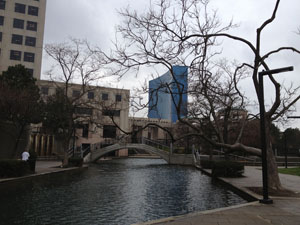
Canal district in Indianapolis, with the JW Marriott in background

Canal district in Indianapolis, with the JW Marriott in background.

I admit to being impressed. For one thing, the weather has been great — went running this morning in shorts and a T-shirt — and the canal district, where I ran, is really nice. That’s my hotel through the trees.

When you think about all that’s happened over the last year or so, including Hurricanes Sandy and Irene plus the tornadoes in Tuscaloosa and Joplin, it’s hard to think of a more important subject. I’m honored to have been invited.


Is the bloom off the rose?

Chris Matyszczyk has a nice piece over on Cnet:  What would Apple have to do to ruin your relationship?

One answer is: Be seen as violating what you consider as the moral bond between you & Apple, and Matyszczyk lists several possibilities:

  • Apple starts to knock off early by producing things that look like, well, knock-offs of other Apple products. Or worse, of things that are already out there.
  • So what if Apple keeps on suing to defend the patently indefensible? What if Apple sues BlackBerry with a claim that it has the patent on the, um, keyboard? Do we suddenly look at Cupertino and feel the love has died? Do we decide that we were in love with a bully and, well, nobody likes a bully? Continue reading

It’s not change

I am affiliated with the Executive MBA for Families in Business program at Kennesaw State University near Atlanta. We use Boyd’s framework as the strategy component of the course, and although the students become proficient in Boyd by program’s end, you sometimes wonder how they’re doing in applying it in their own businesses.

So it’s always good to hear a success story. Here’s an interview that one of our alums, Mikee Johnson, did recently with a business website here in South Carolina. He’s CEO of a lumber treatment company, Cox Enterprises, that weathered the housing downturn and is now back on its expansion track.

You’ll find Boyd woven throughout, but pay close attention around 8:10 where he notes that “it’s not change, it’s the speed of change” that drives business strategy nowadays.

You might recall from New Conception for Air-to-Air Combat (chart 24):

He who can handle the quickest rate of change survives.

If you’re interested in information on the EMBA program (and we may admit non-family students on a space-available basis), please contact the director, Kristi Stoudenmire, at kmcmilla@kennesaw.edu.


A Romney win

Whether you supported Obama, Romney, or whether the word “support” overstated your interest in the affair, the 2012 presidential election is a wonderful case study in how our orientation guides our observation.

Peggy Noonan has another of her perceptive columns in the November 8 Wall St. J. (subscription required). Early on, she gives a link to her column of three days earlier where she predicted “I think it’s Romney” and then laid out all the reasons why. Looking back, every one of them was an anecdote — a tired-looking Obama, the perceived enthusiasm of the Romney crowds, the number of yard signs in Florida. As she summarized it: “All the vibrations are right.” Continue reading

In order to think, I act.

That’s a quote from a recent LinkedIn piece, “The Two Types of Speed” by Hiroshi Mikitani, CEO of Rakuten, Inc.

You could say that Hiroshi has summarized Boyd’s Conceptual Spiral in one sentence (talk about a big squeeze!) Another quote from the blog should be familiar to anyone who’s dabbled in Lean: “Fast means you must eliminate waste.” In fact, he insists that you must have a continually functioning process for eliminating waste because waste always comes back (another formulation of the Second Law, by the way).

He’s also making the  point that an organization generally doesn’t act more quickly — reduce the time between order and delivery, for example, or between concept and first production — by doing what it’s doing now, just doing it faster. In fact, that would probably create even more waste.

Check out Hiroshi’s piece. What do you think about Hiroshi’s definition of “agility”?

[Rakuten is the largest e-commerce site in Japan and one of the largest in the world. It owns Buy.com and just invested $50 million in Pintrest.]

A3, Einheit, and the conceptual spiral

Boyd didn’t like to leave anything to chance. While he recognized that uncertainty is the atmosphere of conflict, it affects all sides, like the weather. Unlike the weather, however, you don’t have to take what nature gives you; you can pump up uncertainty in the other side. Boyd’s suggestion for doing this was to conduct experiments on your opponents, learn from these experiments more rapidly than they do, and then use your updated orientation to better shape and adapt to the situation. By doing this, you can throw more novelty at them than they can handle, while at the same time handling theirs with aplomb. Continue reading

New version of “Meaning of Life”

A few tweaks to “John Boyd, Conceptual Spiral, and the Meaning of Life,” now available from the Articles page.

Changes:

  • Page 2: A footnote supplying data to reinforce Boyd’s contention that one of the invariants he discovered, the one underlying both blitzkrieg/maneuver warfare and guerrilla warfare, has been “extraordinarily successful”
  • Page 15: Corrected the page citation for the Balck quote (with a hat tip to Feral Jundi)
  • Page 21: Added a cautionary note on using the military version of “operating inside the OODA loop” for conflicts other than war