All about agility in 400 sec.

At a special event midway through the first day, five of the presenters at LeanKanban 2015 gave short presentations on various topics.  The trick was that you had to have an intro slide, an outro slide, and 20 content slides, each of which was timed to display for 20 seconds.  In the video below, you can see the timing ball moving inexorably across the bottoms of the screens.

Mine was modestly entitled “Agility: The Power and the Glory.”  The software development community has a concept of agility, and if you search on “SCRUM” you can get an idea of how it works.  Apparently it works well because lots of development teams use it.  The way the developers use the term is the same as Musashi’s chapters 2 and 3, where he discusses tactics and techniques. This is important stuff because poor technique can ruin an otherwise brilliant strategy.20x20.001

But like Sun Tzu, Musashi goes on to insist that the real purpose of agility is to drive the terms of the conflict, to ensure, for example, that what you develop succeeds in the marketplace. Nokia, for example, didn’t go out of the phone business because of poor technique in building feature phones.  Agility should govern strategy — what to develop — as well as tactics and technique — how to develop it.

As I explain in this 20-slide talk, one of the really cool things Boyd did was to extract the essence of agility from something like “super maneuverability,” that is, a hardware concept, and move it into the pilot’s mind.  My little talk shows that this proceeded in stages first by noting the ability to handle change, then in the idea of “operating inside the OODA loop,” and finally to the concept of orientation.  This progression is critical to the concept of agility because otherwise you have a big problem explaining why the Red Baron’s Fokker Triplane from WWI, which was among the most agile aircraft ever built, didn’t even stay a front-line fighter for the whole war.

As an added bonus, I deconstruct the OODA “loop,” the big one from The Essence of Winning and Losing, in 60 seconds.

All of the little talks are worth watching, and mine begins at about 35:40.  You’ll occasionally hear voices in the background. To reduce the times needed for changeovers, we were all miked and in the excitement, we sometimes forgot this simple fact.  The MC is Markus Andrezak of the German company Überproduct in Potsdam.

20 by 20 with Pawel Brodzinski, Chet Richards, Nadja Schnetzler, Karl Scotland and Dominica DeGrandis at LKCE15 from Lean Kanban Central Europe on Vimeo.

Gators, by the way, are extremely agile.  Don’t be fooled into thinking they are just sluggish, belly-dragging lizards: They do the cheng / chi maneuver (abrupt transition from expected to unexpected) better than any human I’ve run across.

Maneuver breaks out

Fokker Dr.1

Replica of a Fokker Dr.1 Triplane in the Deutsches Museum, Munich. A very agile airplane, but not very fast, so by the end of the war, no longer capable of operating inside opponents’ OODA loops.

If you look down through the sweep of history, you might see two broad trends in the concept we call “agility” or “maneuver.” In the military, including the martial arts, people have known that certain practices could disorient opponents, making the physical act of combat much easier to win.  Among these were deception, ambiguity (the “fog of war”), the ability to operate at a rapid tempo, and especially a rapid shift between what the opponent expects and what they experience. The oldest known documentation of these ideas comes from the Sun Tzu text, fragments of which date back to 300 BCE, and they flow like a stream through later Chinese commentators, the Japanese samurai, various schools of the martial arts, the campaigns of Genghis Khan, the German “blitzkrieg,” and on to our day via the works of John Boyd and the US Marine Corps doctrine of maneuver warfare.

Sometime after World War II, in Japan, they jumped the military track and into, of all things, automobile manufacturing.  Known today as “lean manufacturing,” the philosophy and set of practices that began as the Toyota Production System broke longstanding tradeoffs between cost, delivery time, and quality.  Before the TPS, and in US auto manufacturing up until the 1990s, higher quality meant higher costs. The TPS showed that it was possible to build better cars cheaper.

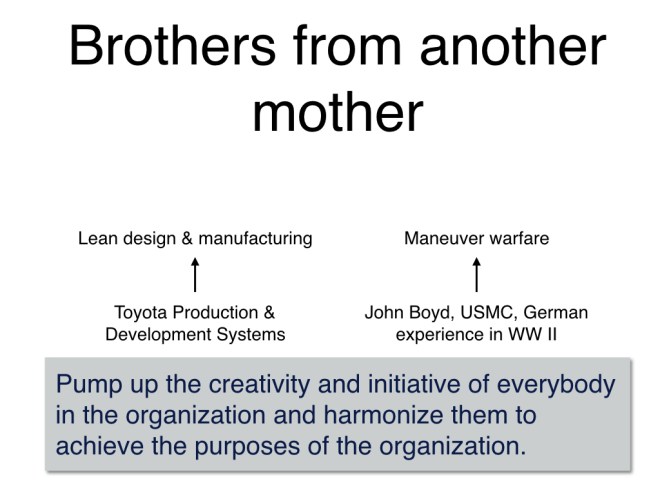
Why is the TPS another manifestation of the principles that underlie maneuver warfare?  For one thing, they both accord a central role to time. Sun Tzu wrote that quickness is the essence of war. Similarly, the TPS stresses the continuous reduction in the time between when a customer places an order and when they receive the vehicle. And as this chart from my keynote illustrates, they both rest on a philosophy that stresses human creativity and initiative:
Final Brothers illustrations.001

Both maneuver warfare and lean are mature concepts.  One could argue that all the elements that define maneuver warfare were identified and in place no later than the early 1940s and might even make a case for 1936, when the German Army issued its doctrine for command of troops, the Truppenführung. If you’re interested in the details, Martin van Creveld provides an extensive analysis of the Truppenführung in his book Fighting Power.  These concepts were refined by John Boyd, Bill Lind, and a group of young officers in the Marine Corps beginning in the early 1980s and reached what is essentially their current state with the publication of Marine Corps Doctrine Publication 1, Warfighting in 1989.

Similarly, Taiichi Ohno, one of the prime creators of the system at Toyota, maintained in his book Toyota Production System that the basics of the system were in place by 1973.  In 1979, in response to claims that the Japanese were dumping cars at below cost (nobody could sell a car that good for so little!), MIT began the International Motor Vehicle Program, which documented the system and compiled data that demonstrated its effectiveness. Their results were presented in a number of articles principally in the Harvard Business Review and Sloan Management Review and popularized in the 1990 book, The Machine that Changed the World.  Two of the authors of that work continued to develop the ideas into a more general theory of lean and published them in Lean Thinking (1996).  At about the same time, Allen Ward and his colleagues at the University of Michigan were researching the Toyota Vehicle Development System, which applies the same underlying principles but in quite novel ways. This may be evident from the subtitle of their 1995 paper, “How Delaying Decisions Can Make Better Cars Faster.”

It’s been 20 years since anything significant developed in the world of maneuver, agile, and lean.  My 2004 book, Certain to Win, looked more at the relationships between maneuver and lean. It was the first to point out the common foundation of maneuver and lean, particularly the “human” factors that underly both (by “pumping up creativity …”). It noted that in business, the military concept of grand strategy reduces to “ordinary” strategy. It offered an interpretation of the maneuver concept of cheng / chi that, by focusing on the customer, not the competitor, works for business, too.  Good foundational stuff, but it wasn’t written to divert the lean / maneuver pattern into a new field of application.

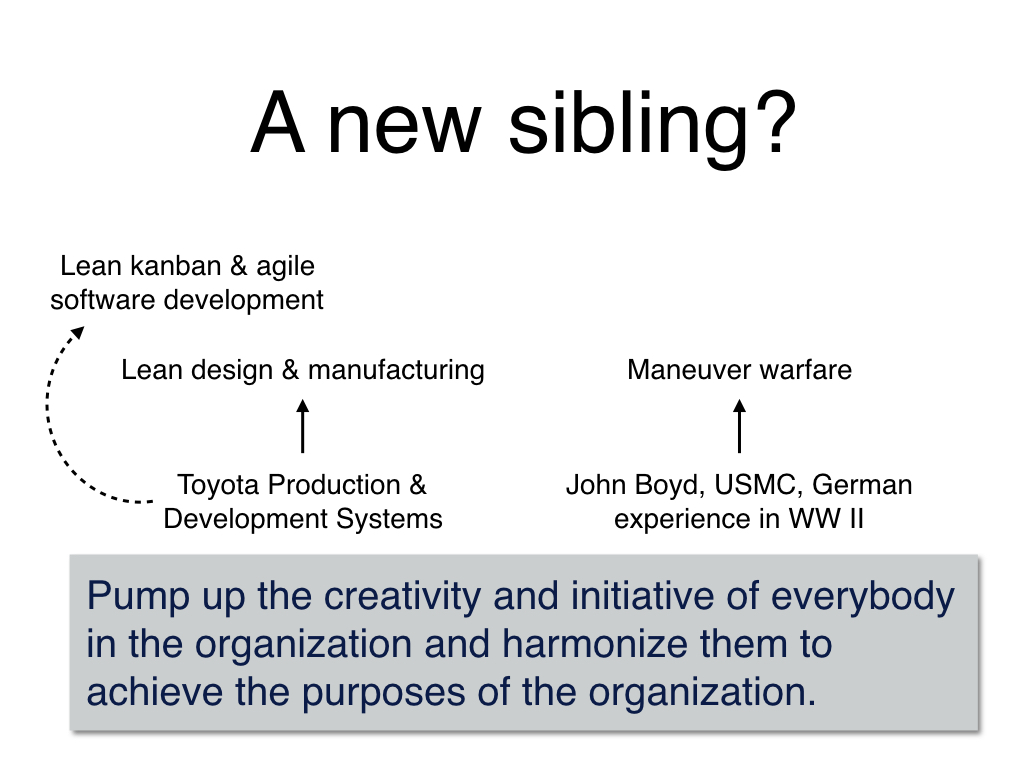
So it’s about time that the maneuver stream found a new channel, that it broke out of the worlds of manufacturing and war and over into what we might call “white collar” occupations.  From the quality and intensity of the discussions at LKCE15, building on what I first observed at Lean Software & Systems 2011 in Long Beach, we may be seeing the power of these ideas manifesting in an entirely new area:

Final Brothers illustrations.002


Lean kanban incorporates many of the practices associated with classical maneuver / lean theory: managing flow, limiting work-in-process inventory (which can hide problems and distort orientation), and employing an hypothesis-test methodology for learning.  According to the web site of one of its founders (and a keynote speaker at this conference), David Anderson, it also “encourages acts of leadership at all levels.” Depending on how they implement this idea, it could be in harmony with “Pump up the creativity and initiative of everybody …” Because this concept is the real foundation of classical lean and maneuver, I’d need to know more before pronouncing a final judgment.  Looks promising, though.

For more information, check out the conference’s sponsors — there are links down at the bottom of the conference’s home page.


“All by Ourselves” – Now a Major Motion Picture!

Or at least a video of my keynote at LeanKanban Central Europe 2015 in Munich on November 17:

All by Ourselves (Keynote) – Chet Richards at LKCE15 from Lean Kanban Central Europe on Vimeo.

Many thanks to the folks at it-agile for a superb conference! Ran like clock work, too many great presentations to catch them all, rocking late Oktoberfest, and somehow they arranged for record high temperatures in Munich.

Amazing what you can find on Google

Like an essay by an Israeli general that originally appeared in Hebrew in an Israeli defense journal in September 1949 (that would be coming up on 66 years ago).

Boyd extracted a paragraph from it as Chart 99 of Patterns of Conflict. Chuck Spinney, some 35 years after Boyd incorporated it, got worried about the source and after a few minutes, found the original.  We have now added a citation to that slide.

Chuck made the following observation:

If you think about it, this is Israel’s strategy — as well as its grand strategy — to this day: Divide up its opponents. This becomes clear in the use of settlements and Israeli-only roads to carve up and control the West Bank and in its failing effort to isolate Iran. Of course, strategy is destructive and these ideas work to destroy your adversary, but grand strategy should be constructive, it should end the conflict on favorable terms that do not also sow seeds for future conflict. Applying concepts from strategy, such as these from Gen. Yadin, to shape a grand strategy is a prescription for perpetual conflict and destruction (ultimately your own)!

Chuck, incidentally, is echoing Boyd’s observation that strategy is destructive while grand strategy should be constructive, which Boyd put on Chart 142 of Patterns. The notion that grand strategy should “end the conflict on favorable terms, while ensuring that conflict and peace terms do not provide seeds for (unfavorable) future conflict” is from Chart 139.

Chuck has a nice treatment of grand strategy on his Blaster blog, and all of Boyd’s briefings, including the newly revised Patterns of Conflict, can be downloaded from our Articles page.

Shaping and Adapting

While leading his company in Afghanistan, Marine Major Paul Tremblay was ordered to clear a much larger Taliban force that was defending an area of rugged terrain. Ordinarily, such terrain would favor the defense, not to mention the numbers problem.  Major Tremblay, however, fashioned a plan of attack based on the notion of “operating inside the OODA loop,” where relative numbers are much less relevant.

Chuck Spinney picks up the story:

Major Tremblay did not know Colonel Boyd but has been aware of his briefings since he was a 2nd Lieutenant at the Marine Corps Basic School. He is the only officer I know who has studied and applied Colonel Boyd’s ideas in a premeditated way in designing and leading a combat operation. His reinforced company level attack on the Taliban was a stunning success and based on radio intercepts, it became clear he penetrated his adversary’s OODA loops and collapsed the opposing units into confusion and disorder, exactly as Boyd predicted.  His thesis does not discuss this operation.

I’ve uploaded Major Tremblay’s recently completed master’s thesis (517 KB PDF). It’s a brilliant piece of work. Quoting Chuck, again:

P.J. Tremblay’s thesis aims to clarify what is perhaps the single most misunderstood aspect of Boyd’s theory of interacting OODA loops: the confusion of absolute speed with relative quickness, particularly as it applies to agility in Orientation and Re-Orientation. Tremblay’s aim is to improve the Marine Corps training curriculum by clarifying Boyd’s ideas and laying out a way to better incorporate them in progressively more comprehensive ways at each level in the Marine Corps’ educational system, from the lowest to the highest level.

PJ’s thesis is a case study in the kind of intellectual development and stimulation that John Boyd was trying to achieve by leaving the Marine Corps Research Center with the complete archive of his briefings and note. Boyd, an honorary Marine, would say, “Semper Fi, PJ.”

Chuck has posted the complete introduction to Maj. Tremblay’s thesis on his blog.

Just one word for the new graduate

Benjamin: Yes, sir.
Mr. McGuire: Are you listening?
Benjamin: Yes, I am.
Mr. McGuire: Neuroplasticity.
Benjamin: Exactly how do you mean?

This is another in a series of posts promoting, or at least complicating, our understanding of Orientation because Orientation is, after all, the Schwerpunkt.

In fact, if I had to boil Boyd’s philosophy down to one idea, it might be to ensure that your orientation makes more accurate forecasts than those of your opponents. If we’re talking business competition, substitute “customers” for “opponents.” Continue reading

Spinney: Why I wrote “Evolutionary Epistemology”

A reader asked about the reference to “Campbell” on slide 38, “Basic Assumptions of Different Orientations,” of Evolutionary Epistemology, whether this was Joseph Campbell, the late American author and scholar of myths. Chuck’s reply:

The Campbell I am referring to is Donald T Campbell. Curiously, I came up with the term “evolutionary epistemology” as a title by myself, when I was asked to brief Boyd’s D&C paper shortly after he died in 1997. This was to a strategy class at the Naval War College. Boyd never heard the term from my lips and I do not recall him ever using it. We often referred to his paper as his learning theory. I remember telling someone that this is really a paper about epistemology.

I added some things to the briefing that Boyd did not talk about in his lecture (especially, the evolution of cosmology) and while working on that part, it came to me that that Boyd’s paper was really about the evolution of epistemology. I am using the term “evolution” in a strict biological sense. So, I coined the the name of the briefing to distinguish it from John’s and to make clear that it was my interpretation of John’s work.

Later someone told me I was discussing things very similar to the work of Donald T. Campbell. And it turns out that Campbell, a social scientist, coined the term in the 1960s. I never heard of him, although he taught at my university (Lehigh), albeit after I had graduated!!!! I did a library search and came up with an article he wrote in 1974 with the same title, which you will find in Chapter II of a book of essays: Evolutionary Epistemology, Rationality, and the Sociology of Knowledge edited by Radnitzky and Barley (Open Court 1987). This book comes at the evolutionary nature from an entirely different perspective and there is no mention of Heisenberg, Gödel, or the 2nd Law. But many of the ideas overlap and are compatible with each other.

I do not think Boyd was familiar with Donald Campbell’s work, and I only came across it by accident after I prepared the briefing. So, since I evolved the title independently, I decided to keep it. But Campbell’s work (which I have not reviewed in many years) seemed consistent with Boyd’s.

By the way, lots of people were working on the ideas Boyd was exploring. My own favorite remains Jacob Bronowski — he was almost there — making two-way linkages between Heisenberg, Gödel, and the 2nd law, but he never synthesized all three. I think if Bronowski had seen Boyd’s paper, he would have slapped his forehead and said “ah hah!” By the way, Boyd showed the paper to the physicist Freeman Dyson (the three of us were in my office) and Boyd asked Dyson if he saw anything wrong in the argument. Dyson said he did not see any problems with the argument and from what I could tell, seemed to like the paper.

One final point: I do not recall Boyd saying anything about Joseph Campbell’s work or that it influenced his thinking — but that does not mean it did not.

Jacob Bronowski doesn’t appear in the sources for “Destruction and Creation.” There are two listings in the sources for Patterns, for The Identity of Man (1971) and A Sense of the Future (1977). I know that he was also a fan of The Ascent of Man (1973)Those three, plus two copies of The Origins of Knowledge and Imagination, are included in his collection at Quantico.  All heavily annotated. 

This Boyd Stuff Works!

Starting in around 2000, Dean Lenane, the CEO of a German-owned auto-systems supplier, CRH of North America, began applying Boyd’s concepts. The results were spectacular. As he told me once,

I asked my staff to read 4 books: Certain to Win, Boyd by Robert Coram, Maneuver Warfare Handbook by Bill Lind and Warfighting by the USMC. Although my people were sometimes puzzled by this curriculum, I was able to get most of what we were trying to get across stuffed into the assembled noggins.

Between 2000 and 2010, CRH North America went from no presence whatsoever to the largest supplier in its market sector in the NAFTA region. If anyone thinks this is easy, then I suggest they try it.

A couple of years ago, Dean began writing the story of how he did it. You can download the result, The Turnaround, from our Articles page. Last year, he put the essence of his experience in to a briefing slide show that I first saw out in San Diego in February and which he polished and gave at the 2014 Boyd and Beyond Conference back in October. With his kind permission, I’ve also uploaded the October edition to our Articles page.

New version of “Evolutionary Epistemology”

Chuck Spinney has posted a new version, 2.4, of Evolutionary Epistemology, his explanation in briefing slide format of Boyd’s “Destruction and Creation.”  The biggest change is a new page 4. You can download this version from our Articles page.

Robert Coram captured the problems most of us have when trying to understand what Boyd was driving at in D&C:

Because Boyd spent more than four years researching and writing and then distilling his work down to eleven pages, the result has a specific gravity approaching that of uranium.  It is thick and heavy and ponderous, filled with caveats and qualifiers and arcane references that span theories never before connected. To read “Destruction and Creation” is to fully appreciate the term “heavy sledding.” (Boyd, p. 323)

Yet, as Chuck illustrates, everything Boyd wrote in the remaining 20 years of his life — from Patterns of Conflict to The Essence of Winning and Losing — reinforce the main points of D&C. It is the only thing Boyd produced that he never revised.

Evolutionary Epistemology is more than an explanation, however. It stands as a complement to Boyd’s paper, and, by looking at his concepts from other angles, makes the original more approachable. It takes its place alongside Patterns, Strategic Game, Conceptual Spiral, and the rest of the Discourse as another illustration of message of “Destruction and Creation.”

[Note: the link to “Boyd’s Real OODA Loop” on page 43 has been broken. Please download the latest version from our Articles page.]

Coherent, Credible, and Wrong

The best strategist is not the one who knows he must deceive the enemy,
but the one who knows how to do it.

Polish SciFi master Stanislaw Lem (1921 – 2006)

We often think of Soviet doctrine as tanks lined up tread to tread, rolling forward until either they conquer or fall. Mass makes might. While there is a lot of truth to the Soviet, and so presumably Russian, respect for mass, it may surprise you to learn that the Soviets had, and so presumably the Russians have, a well thought-out doctrine of deception called maskirovka. The BBC ran a nice piece on the subject a few days back, “How Russia outfoxes its enemies,” by Lucy Ash.

Boyd had great respect for deception, “an impression of events as they are not,” as he wrote on Patterns chart 115, “Essence of Maneuver Conflict.” A person who is being deceived is not confused. He knows what the situation is. His orientation is coherent; his mental model of the world fits all the facts. It’s just wrong. Boyd’s primary vehicle for using deception was the cheng / chi maneuver, which he borrowed from Sun Tzu and reformulated in more modern terms as the Nebenpunkte / Schwerpunkt concept (see charts 78, 114, and many others). Basically, the deceiver shapes the orientation of the victim to expect (cheng) certain actions to take place. Think all of the stuff the allies did to shape Hitler into expecting the D-Day attack across the Pas de Calais. The deceiver then springs something entirely unexpected, the chi, and tries to exploit the resulting shock and confusion. Continue reading