Is outsourcing dead?

Of course not. There are still reasons to buy from overseas suppliers but as Boeing and now GE are learning, there are many reasons for bringing manufacturing back together with sales and R&D. This does not mean they they have to be co-located, by the way.

In case you haven’t read it, Charles Fishman lays out the argument, using GE as an example, in the December issue of The Atlantic. One caveat: To get maximum benefit, your company needs to be deep into lean.

Indeed, for many companies, it would make more sense to outsource the design function and keep manufacturing in-house (and in-country), sort of a reverse Apple. Speaking of which, is Apple’s domestic assembly of part of its Mac production a sign that they recognize the benefits of insourcing or a PR stunt?


 

Mikitani reveals the obvious!

Amazing why so few businesses understand it.

Check out his post on LinkedIn: Why Do People Buy?

He went through a classic deep understanding exercise — and again it’s astounding how few people, even those in sales and marketing have done this — and came up with:

I came to this conclusion: People buy for a variety of reasons – some reasons are unique to a single individual. But a common reason – an answer to the question “why” that stretches across global markets, across demographics, across product categories, is this: people buy things is because it is fun.

You can now explain Apple: Insanely great is fun. Showing off insanely great to your friends is fun. Hope they don’t forget that — by the way, it includes the shopping experience, not just the product.

As Boyd insisted, actions flow from orientation, so if your orientation isn’t a good model of unfolding reality (i.e., better than your competitions’ and for that matter, your customers’), don’t bother with the rest of your business strategy.

Or as Mikitani summarized it:

See things the way they really are.  Ask “why” over and over again.

Indy, part 2

Keynote at the AHIMTA conference in Indianapolis, 4 December 2012

Keynote at the AHIMTA conference in Indianapolis, 4 December 2012

Here I am giving the keynote yesterday morning at the All-Hazards Incident Management Teams Association conference in Indianapolis. These are the folks who, when a disaster strikes that overwhelms the capacity of an individual town or county, rush in to provide incident management services so that relief arrives as expeditiously and with as little friction as possible. Bet you didn’t even know they existed.

Downtown Indianapolis at sunrise, December 5, 2012

Downtown Indianapolis at sunrise, December 5, 2012

I was impressed with Indianapolis, what little I managed to see of it. Wonderful museum, the Eiteljorg, right across the street from the JW Marriott (which hosted the conference) specializing in art by Native Americans and of the American West, two of my favorite subjects. There’s also an extensive gallery on the history of the tribes in the Indianapolis area.

Indy

My first time here. Gave a class this afternoon and will do a keynote tomorrow morning at the AHIMTA (All-Hazards Incident Management Teams Association) 2012 Conference.

Canal district in Indianapolis, with the JW Marriott in background

Canal district in Indianapolis, with the JW Marriott in background.

I admit to being impressed. For one thing, the weather has been great — went running this morning in shorts and a T-shirt — and the canal district, where I ran, is really nice. That’s my hotel through the trees.

When you think about all that’s happened over the last year or so, including Hurricanes Sandy and Irene plus the tornadoes in Tuscaloosa and Joplin, it’s hard to think of a more important subject. I’m honored to have been invited.


Is the bloom off the rose?

Chris Matyszczyk has a nice piece over on Cnet:  What would Apple have to do to ruin your relationship?

One answer is: Be seen as violating what you consider as the moral bond between you & Apple, and Matyszczyk lists several possibilities:

  • Apple starts to knock off early by producing things that look like, well, knock-offs of other Apple products. Or worse, of things that are already out there.
  • So what if Apple keeps on suing to defend the patently indefensible? What if Apple sues BlackBerry with a claim that it has the patent on the, um, keyboard? Do we suddenly look at Cupertino and feel the love has died? Do we decide that we were in love with a bully and, well, nobody likes a bully? Continue reading

It’s not change

I am affiliated with the Executive MBA for Families in Business program at Kennesaw State University near Atlanta. We use Boyd’s framework as the strategy component of the course, and although the students become proficient in Boyd by program’s end, you sometimes wonder how they’re doing in applying it in their own businesses.

So it’s always good to hear a success story. Here’s an interview that one of our alums, Mikee Johnson, did recently with a business website here in South Carolina. He’s CEO of a lumber treatment company, Cox Enterprises, that weathered the housing downturn and is now back on its expansion track.

You’ll find Boyd woven throughout, but pay close attention around 8:10 where he notes that “it’s not change, it’s the speed of change” that drives business strategy nowadays.

You might recall from New Conception for Air-to-Air Combat (chart 24):

He who can handle the quickest rate of change survives.

If you’re interested in information on the EMBA program (and we may admit non-family students on a space-available basis), please contact the director, Kristi Stoudenmire, at kmcmilla@kennesaw.edu.


Veterans Day 2012

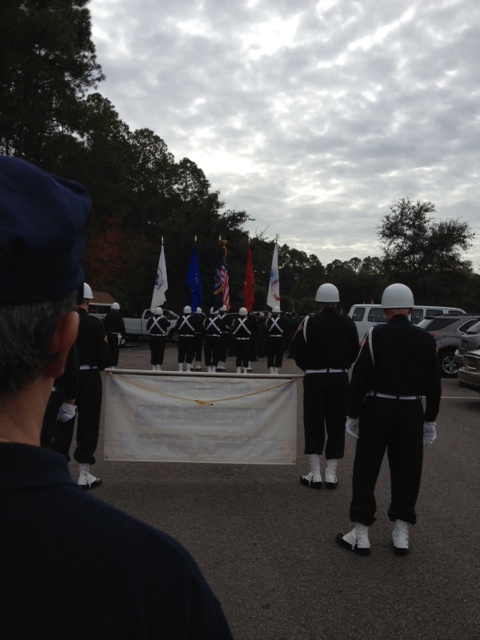
Where I live in South Carolina, we have a Veterans Association, and a couple of times a year, a few of us form up and march in a mini-parade. We have vets from WWII on (you have to be 55 or older to live here), and although most of us are not combat veterans, we feel it’s important to honor those who did go into the line of fire.

My late father definitely falls into the latter category: veteran of Bataan, where he won the Silver Star, and survivor of 3 1/2 years in Japanese prison camps. Later, he commanded the 1st Recon Squadron of the famed 2nd Armored Cavalry Regiment. I wear his 2A/C unit crest on my hat, next to my Air Force pin.

There is a lot of controversy over our occupations of Iraq and Afghanistan, but we need to keep those discussions separate from our acknowledgement of those who served honorably there and in our country’s other battles.

Here’s to you, Dad. Toujuors Pret.

A Romney win

Whether you supported Obama, Romney, or whether the word “support” overstated your interest in the affair, the 2012 presidential election is a wonderful case study in how our orientation guides our observation.

Peggy Noonan has another of her perceptive columns in the November 8 Wall St. J. (subscription required). Early on, she gives a link to her column of three days earlier where she predicted “I think it’s Romney” and then laid out all the reasons why. Looking back, every one of them was an anecdote — a tired-looking Obama, the perceived enthusiasm of the Romney crowds, the number of yard signs in Florida. As she summarized it: “All the vibrations are right.” Continue reading

In his year

Many years ago, I asked a Saudi friend of mine if he didn’t long for the day democracy would come to the Kingdom (Scotch is not that hard to find over there if you know the right people, and he was the right people). He smiled and answered to the effect “Look, I have a business to run. It’s not my job to pick the government. That’s what we have a royal family for, and honestly, I think they do a better job than your system of letting anybody vote, whether they graduated sixth grade or not.” Continue reading

Tom Barnett endorses Romney

Unexpected, to say the least, because Tom usually describes himself as a Democrat. His reasoning is interesting:

The sad truth about a second Obama presidency

Tom is quite familiar with Boyd’s work, and I admit to being a big fan of what he’s trying to achieve. Where we differ is on method: He still supports large armies, talks about power projection, solves the problem of terrorism by “killing bad guys,” and thinks that economics is driven by how many sub-minimum wage workers you have.

On the other hand, he considers our level of strategic thinking as “pathetic.” Here’s a briefing that he gave last year.  Pay close attention to his strategy for dealing with Afghanistan and South Asia. You may not agree with it, but it is refreshingly out of the box.

All in all, we have much more in common than any points of disagreement, and I consider him as one of our best geopolitical strategists. I think that after watching this, you’ll understand why he isn’t a senior figure in the administration, the more the loss for the rest of us.