Confused about the OODA “loop”? Let AI explain

For those of you who still harbor questions, misunderstandings, even doubts about John Boyd’s OODA Loop model, help is finally here.

My colleague, LtCol Johan Ivari of the Swedish Defense University in Stockholm, fed my paper, “Boyd’s OODA Loop,” into Google’s NotebookLM. You can listen to the resulting podcast at https://play.fhs.se/media/Boyd’s%20OODA%20Loop%20by%20Chet%20Richards%20(2020)/0_9wflxxm1

Personally, I find this fascinating if not a little scary. For one thing, it wasn’t clear who was doing the talking, until my brother (who also uses NotebookLM) pointed out that the two interlocutors, one with a male voice and the other female, were generated by the system. OK.

They did a very good job. This podcast could serve as a useful introduction to the OODA Loop concept. However, as Colonel Ivari points out, best to use it as an accompaniment to the actual paper (which you can download from our Articles page, along with all of Boyd’s briefings* and lot of other stuff).

Colonel Ivari has posted an entire panoply of AI-generated podcasts, https://play.fhs.se/playlist/details/0_09pafeoh

They’re all fascinating, but if you’ve never read Chuck Spinney’s Evolutionary Epistemology, his podcast would be a good place to start.

I’m not sure why the female discussant sounds like a Valley Girl (“Totally!”), but somehow, I don’t think Boyd would mind.


*I haven’t updated the covers, yet, so please don’t try to go to dnipogo.org or d-n-i.net. These domain names are no longer maintained by either the Project on Government Oversight or myself and may contain malicious content.

Influence strategies

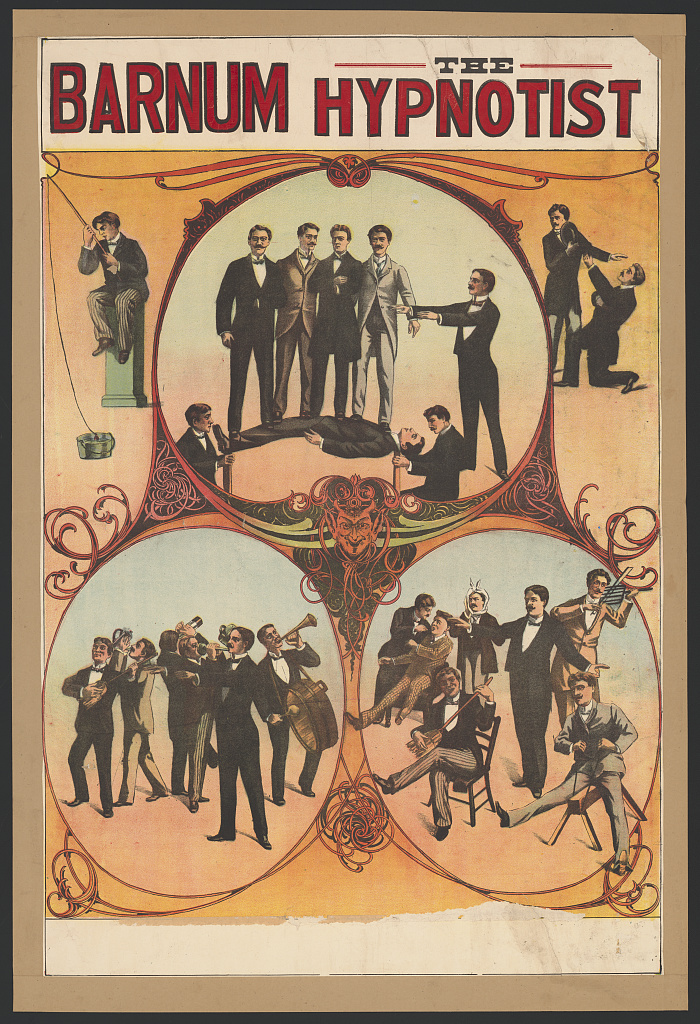
c. 1900. Library of Congress Digital Collection.

Once again, social science can help us understand behavior and why, or why not, certain influence strategies may be effective. Jeffrey Pfeffer, Thomas D. Dee II Professor of Organizational Behavior, Stanford University.


What he’s talking about is leadership. Here’s my definition:

Fire up the creativity and initiative of everybody in the organization; harmonize and focus this energy to accomplish the purposes of the organization.

And here’s Boyd’s:

Implies the art of inspiring people to enthusiastically take action toward the achievement of uncommon goals. Organic Design for Command and Control, slide 37 (available from our Articles page)

If you could magically reach in and influence everybody’s mind, leadership under either of these definitions would be much easier. A couple of years ago, I gave a presentation on leadership, The Lost Arts of Leadership, (31.4 MB PDF) to the Kanban Global Summit in San Diego. My thesis was that what Boyd, Pfeffer and I are all talking about is mind control, in particular, over groups of people.

Now before you laugh too hard, note that there are performers who make a good living doing just this, as in the picture above. For a contemporary example, go to Derren Brown’s YouTube channel. If you haven’t watched any of his videos, try one. It doesn’t take much of a stretch to imagine how these techniques could serve the purpose of leadership. And, as I tried to show in my presentation, they have been employed by effective leaders down through history (for better or for worse).

The principles that support leadership also enhance strategy, which can be thought of as leadership but over the opponent rather than within your own organization. The idea of influence strategies — controlling the enemy’s mind, rather than just reacting to his moves — goes way back. Here’s Miyamoto Musashi from 1645:

Using your knowledge of military tactics, think of all the enemies as your own soldiers. Think that you know how to make the enemy move as you wish and try to move the enemy around freely. You are the general. The enemy are soldiers under your command. The Book of Five Rings, Bradford Brown, et al. (1982), p. 78.

I’ve revised the presentation to feature a longer quote by Professor Pfeffer and added a reference in the accompanying notes (152 KB PDF) that provides data on the deleterious effects of picking some arbitrary percentage of employees judged to be poor performers and summarily firing them.

Speaking of the notes, which I highly recommend since they provide commentary and sources that I found interesting but would have made the presentation itself too long, I’ve gone through and (I think) reconciled the notes to the slide numbers.

Tom Barnett’s OODA Loop

Dr. Thomas P.M. Barnett, who is probably best known for his 2004 best-seller, The Pentagon’s New Map, gave a presentation last November featuring an OODA Loop. Because it is not the traditional circle, or John Boyd’s own sketch from my last post, I thought you might be interested in it. As an extra added attraction, he uses it to build a snowmobile a la Boyd*.

Question for my audience: Does what Barnett has constructed satisfy the purposes of an OODA loop (or “loop”) in Boyd’s sense? The link goes to my presentation “The Essence of Winning and Losing — Deconstructed,” and the roles Boyd prescribes for OODA loops (any OODA loops) are on slide 9.

Very Important Note: This is not a blog on geopolitics, so I am not going to comment on the specifics of Barnett’s conclusions. I know some of you have strong feelings on these issues, but this is not the place.

On a personal note, I have known Tom for many years and can attest he is quite familiar with Boyd’s work. His second book, Blueprint for Action, mentions me on p. 10. I have great respect for his curiosity and intellect, although we have had, over those years, spirited discussions on some of his recommendations. His latest book is America’s New Map, and he maintains a website and posts daily on substack.


*For those unfamiliar with Boyd’s snowmobile analogy, please download his briefing Strategic Game of ? and ? from our Articles page. He introduces his snowmobile starting on slide 6.

Deconstructing The Essence of Winning and Losing

If all men by nature desire to know, then they desire most of all the greatest knowledge of science. Duns Scotus

Download my new presentation, The Essence of Winning and Losing — Deconstructed. Or, where did the OODA loop come from, and what is it supposed to do? 505KB PDF

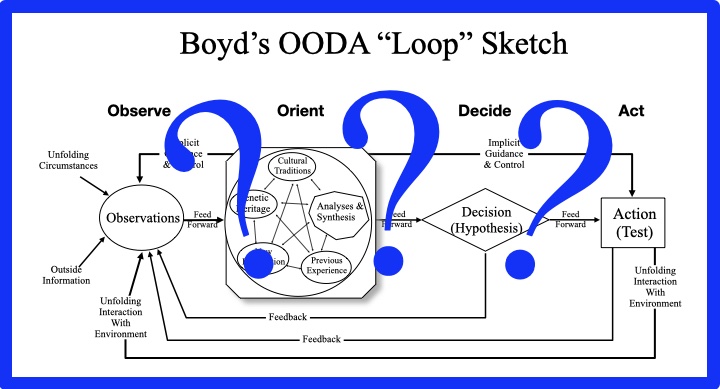
A pencil draft of the OODA loop arrived in the mail one day in early 1995 with a note from John Boyd asking me to turn it into a computer graphic. We went back and forth several times — I’d mail him updates, and he’d call up and want to talk. As I recall, the big bone of contention was the shapes of the arrows within the Orient block: which should be solid and which dashed, and in which directions the arrows should point.

He was particularly worried about the arrows from new information and previous experiences into genetic heritage. In the end, though, he decided not make any distinctions and just connect each of the bubbles to each of the others with solid arrows. Over the next several months, he added three more slides explaining what he wanted the OODA “loop” to do. Again, lots of back-and-forth.

By January 1996, Boyd had finished his revisions to The Essence of Winning and Losing. It was his last work, significant because in it he defines for the first time on paper what he meant by an OODA loop. Although he had been using the term since his first major presentation, Patterns of Conflict (created 1977 – 1986), It was virtually always combined with the preposition “inside,” in phrases like “operating inside their OODA loops.”

In fact, in the 319 slides that he created before TEoWL, he used the phrase “OODA loop” by itself, whether abbreviated or spelled out, on only 5 pages. On none of these did he actually define it

Portrait of the philosopher Duns Scotus (c. 1265-1308), artist unknown, c. 1650. Bodleian Libraries, University of Oxford

If it meant “Observe, then orient, then decide, then act,” there would be no need for further explanation, other than defining the terms. The fact that we’re talking about TEoWL suggests Boyd had something else in mind.

To guide us through Boyd’s process of constructing the loop, TEoWL begins with the concept of an “implicit repertoire.” These are the practices we need to “make intuitive within ourselves” as Boyd put it, in order to deal with those urgent and unpredictable requirements that the situation, including opponents in a conflict, throws at us. TEoWL asks where this set of practices comes from and how we add to it as circumstances change.

Put another way: From the infinite set of possible practices that we might create and train for, and given that there are only 24 hours in a day, how do we select? That is the question at the heart of TEoWL, and the answer he came up with is an OODA “loop.”

A few points to keep in mind:

  • The purpose of the “OODA loop ‘sketch’” on page 3 is to “clarify” a set of statements he makes on the first page of the presentation and the interactions among them. These statements all address how we manage our implicit repertoire.
  • He called it a “sketch.” To use his snowmobile analogy from Strategic Game (1987), you might think of it as Model 1.
  • However, we know from research into his files at the Library of Marine Corps University, he created many prototypes before he settled on this particular one. My personal guess is that if he had lived (he died on March 9, 1997), there would have been additional releases.

What I have done is to break down the elements of TEoWL into what I hope are digestible portions in a largely graphical format. My primary audience is the collection of people who are adapting Boyd’s sketch to serve their various purposes. I thought it might be useful for them to briefly review Boyd’s derivation of the “loop.” In other words, it is for those philosophical engineers who are developing Models 2, 3, etc., which is, I am sure, what Boyd would be doing if he were alive today.

This presentation, along with all of Boyd’s presentations and lots of other stuff, are all available from our Articles page.

If OODA was a (revised) Venn diagram

Codde, Pieter Jacobsz (b.1599-12-11 – d.1678-10-12), Intérieur de corps de garde (Titre principal), 1626. Huile sur bois. Petit Palais, Musée des Beaux-Arts de la Ville de Paris.

Clinton D. Pope
Chief Quality Officer
Indian Health Service, Phoenix, AZ

[Editor’s note #2: Mr. Pope has revised his Venn diagram at the bottom of this post. Kaizen for Boyd’s snowmobile.]

[Editor’s note: When people start playing around with Boyd’s OODA “loop” sketch from The Essence of Winning and Losing — available from our Articles page — what usually emerges is something even more complicated than what Boyd produced. Although many of these reveal interesting insights, my personal feeling is that we need someone to come along, absorb all these various efforts, and experience an “Aha!” moment that produces a new OODA “loop” sketch as elegant as, but no more complicated than, Boyd’s. To help that process along, it might be useful to revisit Boyd’s purpose for that sketch: a framework to help us “to comprehend, shape, adapt to and in turn be shaped by an unfolding evolving reality that is uncertain, everchanging, and unpredictable.” Perhaps meditate upon and internalize this objective before we start drawing more arrows? With that in mind, here’s an OODA “loop” without any arrows.]

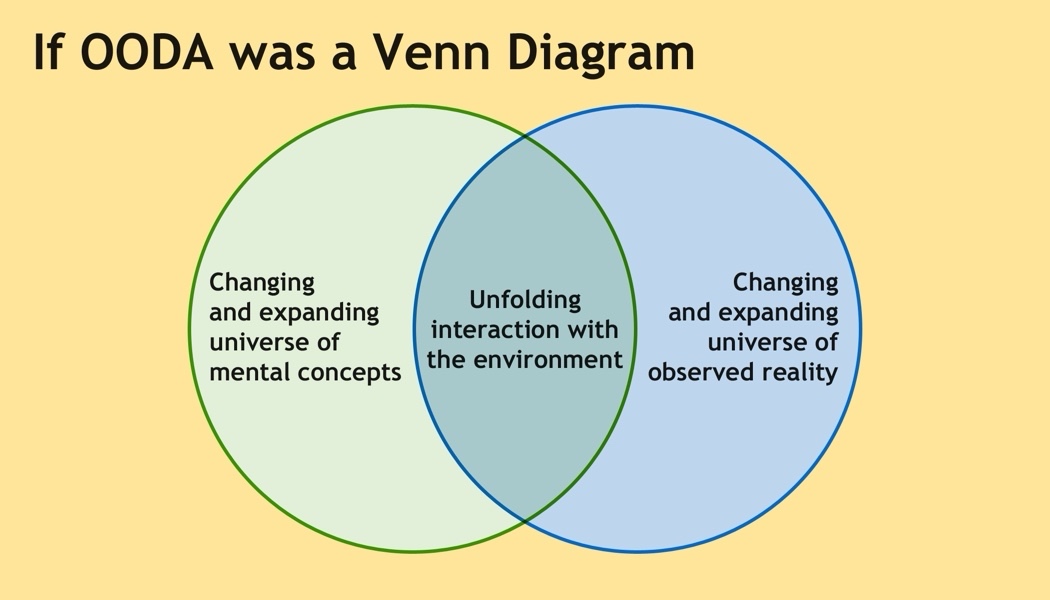
This will likely be lost on some as the Venn diagram doesn’t mention observations, orientation, decision, or action.

However, OODA is a model of how we interact with the environment, both shaping and being shaped by the environment.

Mental concepts and observed reality are both ever changing and expanding.

To “survive” (e.g. obtain more favorable interactions with the environment), we need better means to observe what’s really going on as accurately as possible and from multiple perspectives; we need to analyze and synthesize new and existing information to orient current state in relation to desired state with a sense of how to position for a more favorable state; we need to facilitate decision making that is timely (not the fastest, but well timed) and based on available indicators; and we need to confidently act with the intention to learn (this is to test the hypothesis or prediction of the decision).

The OODA Loop is cyclical, but not linear in nature. For instance, orientation and observation are always happening. They don’t stop so that you can make decisions and act. Likewise, in every action or inaction, in every decision or indecision, you are always interacting with the environment. You don’t exist except in the environment. The “dialectic engine” is always humming.

The difference between those who survive and those who are eliminated is the ability to effectively orient and adapt to the changing environment.

If OODA was a Venn diagram

Codde, Pieter Jacobsz (b.1599-12-11 – d.1678-10-12), Intérieur de corps de garde (Titre principal), 1626. Huile sur bois. Petit Palais, Musée des Beaux-Arts de la Ville de Paris.

Clinton D. Pope
Chief Quality Officer
Indian Health Service, Phoenix, AZ

[Editor’s note: When people start playing around with Boyd’s OODA “loop” sketch from The Essence of Winning and Losing — available from our Articles page — what usually emerges is something even more complicated than what Boyd produced. Although many of these reveal interesting insights, my personal feeling is that we need someone to come along, absorb all these various efforts, and experience an “Aha!” moment that produces a new OODA “loop” sketch as elegant as, but no more complicated than, Boyd’s. To help that process along, it might be useful to revisit Boyd’s purpose for that sketch: a framework to help us “to comprehend, shape, adapt to and in turn be shaped by an unfolding evolving reality that is uncertain, everchanging, and unpredictable.” Perhaps meditate upon and internalize this objective before we start drawing more arrows? With that in mind, here’s an OODA “loop” without any arrows.]

This will likely be lost on some as the Venn diagram doesn’t mention observations, orientation, decision, or action.

However, OODA is a model of how we interact with the environment, both shaping and being shaped by the environment.

Mental concepts and observed reality are both ever changing and expanding.

To “survive” (e.g. obtain more favorable interactions with the environment), we need better means to observe what’s really going on as accurately as possible and from multiple perspectives; we need to analyze and synthesize new and existing information to orient current state in relation to desired state with a sense of how to position for a more favorable state; we need to facilitate decision making that is timely (not the fastest, but well timed) and based on available indicators; and we need to confidently act with the intention to learn (this is to test the hypothesis or prediction of the decision).

The OODA Loop is cyclical, but not linear in nature. For instance, orientation and observation are always happening. They don’t stop so that you can make decisions and act. Likewise, in every action or inaction, in every decision or indecision, you are always interacting with the environment. You don’t exist except in the environment. The “dialectic engine” is always humming.

The difference between those who survive and those who are eliminated is the ability to effectively orient and adapt to the changing environment.

Cooking the books

Dr Ray Leopold*

Of course, defense spending numbers are being manipulated: It’s in the DNA of those most intimately involved. That type of manipulation is well beyond the natural human concept which says that if you measure something, you change it. It is far more insidious.

I daresay that most of those in-the-know never expected anything other than manipulated numbers.  They’re not really jaded, they’re just behaving as Europeans, and a few others, have dealt with one another for centuries!

In a more colloquial context, I consider myself a veteran of three wars:  The Pentagon Wars, The Spectrum Wars, and The Telecommunications Wars, and I think you may find what I’m about to write is a bit different than you’ve seen before.  Jim Burton — who used the title The Pentagon Wars — along with many of you, too, have done a great job of covering The Pentagon Wars, but IMHO they were kids’ play compared to the Spectrum Wars and the Telecommunications Wars, and these other two will probably survive the walls of the Pentagon.  (Spectrum, of course, relates to ‘wireless’ while Telecom relates to all commercial communications.) 

For better context, maybe some of you are not aware that I was in the middle of ‘making the right things happen’ at WARC-92 in Spain, which allocated spectrum for HDTV, next-generation cellular phones, and Non-Geostationary Satellite Services (NGSS), and I was also in the midst of our FCC’s 1993 Negotiated Rulemaking for that NGSS spectrum, which much of the world had then also adopted.   FYI, WARC = World Administrative Radio Conference, held by the The International Telecommunications Union (ITU), which is an arm of the UN.

Strategy, Tactics and Documented Warfare precede Sun Tzu, but when you get to putting numbers on resources and then get involved in planning, no-planning (in the Boyd context), counting, accounting and reporting on those things, I think we’re in the nth iteration, where n = the number of generations of humanity.

When it comes to Europe, I will tell you that these kinds of things go back at least 450 or 500 years to revenue sharing associated with the money from postage stamps among those same countries.  When the telegraph was created, some people may think that it was aligned with railroads, but I think you will find that, even though telegraph lines oftentimes went along railroad lines, the revenue side of telegraphy was assigned to the post offices.  

In Europe, they created their PTs — their national and international postal & telegraph offices.  Then, of course, those PTs evolved as PTT s when the telephone came along, and those rules they created for those postal activities, then postal and telegraph activities, and finally postal, telegraph and telephone activities are still embedded in all that is done at the ITU in Geneva, Switzerland.

So, when NATO and the UN came along shortly after WWII, those bureaucrats who began to staff their offices were already well-schooled in dealing internationally with numbers and revenue streams, with all of the skullduggery of centuries of their versions of rules, regulations, protocols, and procedures for officially cooking the books to their individual likings.  They were also well aware that their different nations didn’t necessarily calculate things or interpret them in a common way, but they always got along until they didn’t!!  

(Little wonder that they had so many wars and how many searched for a New World!  What surprises me more is how many folks here in America become so enamored with that Old World.)

On a personal note, there is also little wonder how John Boyd quickly concluded that we had to focus on the budget when we launched our development planning work on The Air Staff in June of 1973.  I do still have a paper copy of that planning and budget set of charts that he and I had used together when we had first briefed our work across the Air Staff from Nov 5, 1973 to May 31, 1974, and I’m especially glad that Chuck Spinney got excited about it, too; otherwise I may have never gotten back to engineering and those other two wars 

When he and I had done those briefings together, John Boyd (who was spending most of his own time on the lightweight fighter) used to point out how I was the only full-time AF-wide development planner on the Air Staff (until Chuck came along to become the second), then I left amidst a rather interesting battle among a couple of four stars. and caught my breath again teaching engineering at the AF Academy, and Chuck became the only one; but Boyd got me back to the OSD (Office of the Secretary of Defense) Staff (where Chuck was, too) for the early ’80s.  I had learned much from John which then made me unusually effective in those other wars, too. 

There may now be quite enough books written about all of that, and I’m especially pleased with the books the two of you (Winslow Wheeler & Chet) have written!**


*Robert Coram included Dr. Ray Leopold among Boyd’s acolytes in Boyd, The Fighter Pilot Who Changed the Art of War, and provided a brief description of his career after the Air Force (p. 441). Among his many accomplishments, Ray is perhaps best known in these times for being one of the primary creators of the Iridium system, which is still going strong to this very day. You may also be interested Ray’s thoughts on Boyd, Robin Olds, and Operation Bolo included in an earlier post.

**Here are a couple of the better known: The Wastrels of Defense and If We Can Keep It, respectively. You can download a PDF of IWCKI from our Articles page.

Conceptual Spiral in Boyd’s Own Words

In 1992, John Boyd released his last major presentation, Conceptual Spiral. Coming in at 38 slides and just shy of 3,000 words, it is roughly 10 times the size of his next and final presentation, The Essence of Winning and Losing (TEoWL).

While his presentations through 1987 concern armed conflict, Conceptual Spiral displays 18 “outstanding contributions” to science, from Sir Isaac Newton to Chaitin and Bennett (1985), and similarly 39 from engineering.

In trying to understand Conceptual Spiral, it is important to keep in mind that although the slides can be read as a stand-alone document, Boyd generally did not give out hard copies to people who hadn’t sat through the presentation. Many of the slides are complex and present challenges to figuring out what Boyd intended.  Fortunately there is a complete recording of Boyd giving Conceptual Spiral to an audience at Air University as part of an Air Force project, SPACECAST 2020 .  The folks at AGLX have captured this presentation and transcribed it into written form, with Boyd’s slides embedded, which you can download as a PDF from their site. We also did a podcast on Conceptual Spiral.

I was heavily involved in Conceptual Spiral. Boyd would call and go over alternative phrasings for the various slides, asking what made the most sense, which alternatives read better, and so on.  Even with this, I got a lot out of the transcript.

For example, you will notice that Boyd is still describing the OODA “loop” as a real, sequential loop. If, however, you read the transcript carefully, you can detect that his concept of the “loop” is showing the first glimmers of change.  He is beginning to realize that the OODA loop he talks about here (he doesn’t use the term “OODA loop” in the text of Conceptual Spiral itself) is incomplete. As he concluded as far back as “Destruction and Creation” (1976), all theories for describing reality must be incomplete, so this fact came as no surprise to him. He takes a step in remedying this in his next briefing, The Essence of Winning and Losing.

This realization, though, does not invalidate the conclusions of Conceptual Spiral. The loops of Conceptual Spiral are the engines that power the OODA “loop” sketch of TEoWL because, as Boyd explains in Conceptual Spiral, they not only “change reality through novelty,” they are also what changes our orientations to correspond with that dynamic reality. As he makes explicit on the first slide of TEOWL, their operation also allows us to create and employ the implicit guidance and control feeds of the “loop.” 

If your organization does not continuously generate new product ideas and new strategies, as well as improving the processes for introducing them to the external world, every passing day leaves you more open to competitors who will.

Even if you have read the text of Conceptual Spiral and even if you have heard Boyd give the presentation, studying the transcript will repay your investment in time.  

[Be sure and check out the Q&A section at the end. Although the recording did not capture the questions themselves, you’ll be able to infer their gist, and Boyd’s answers are clear.]

All Warfare is Based Upon …

Utagawa Kuniyoshi, The Famous Samurai: Miyamoto Musashi (c. 1850)

The best strategist is not the one who knows he must deceive the enemy but the one who knows how to do it. Polish author Stanislaw Lem (1921 – 2006)

All war, Sun Tzu once observed, is based upon deception. And in keeping with Lem’s pronouncement, he knew how to do it:

The task of a military operation is to accord deceptively with the intentions of the enemy. The Art of War, Chapter 11 (Cleary trans)

Like so much of Eastern philosophy, this bears deep thought,  For one thing, what do we mean by “deception”?  Is it primarily camouflage, disguising ourselves so that the opponent does not recognize us? Feinting in one direction while we attack in another? Publicly making misleading statements about our intentions?  All of these are deceptive, of course, but they all focus on what we’re doing, what our intentions are.  Sun Tzu, however, talks about the intentions of the enemy.  John Boyd’s definition captures this distinction:

An impression of events as they are not. Patterns, 115

Deception: Merely a Prerequisite for Surprise?

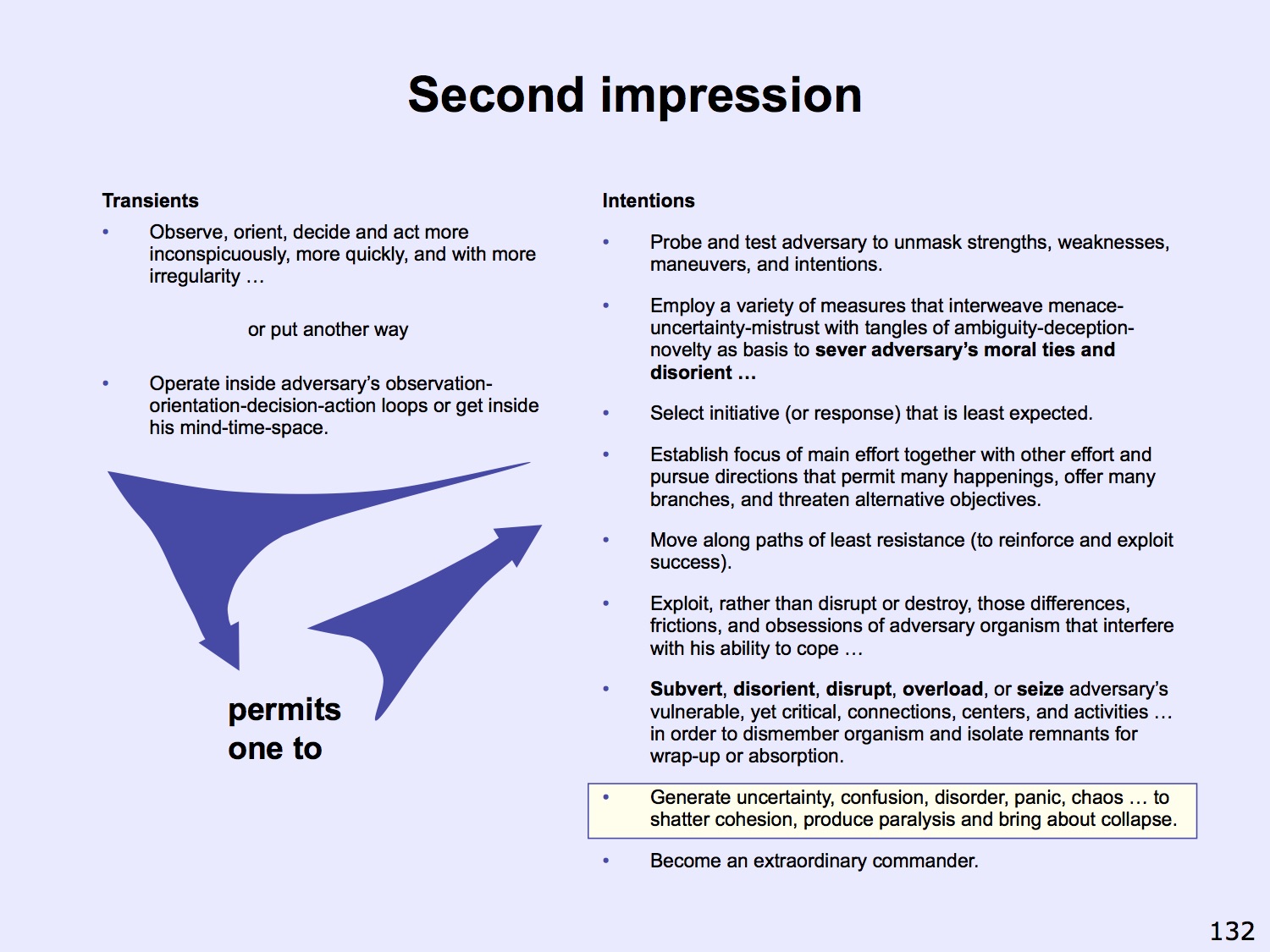
As Boyd explained it, to deceive an opponent, you must create a view of the world in his mind — his orientation — that is logical, compelling, and validated by observation, but which is wrong.  The enemy will intend to act on this impression, allowing you to, for example, trap or ambush him or attack in an unexpected, direction.  The key is knowing what his impressions, and thus his intentions, are.

How do we know “the intentions of the enemy”? One way is through your knowledge of the opponent, your fingerspitzengefuhl of how they act in various situations.  

If I was him, what would I most want me to do? Easy, I thought. So I did it.  K. J. Parker, Savages, Kindle Ed, Loc 619.

A new approach

But there is another, more powerful and more reliable way of knowing opponents’ intentions: You be the one who put them there.

His primary target is the mind of the opposing commander … Sun Tzu realized that an indispensable preliminary to battle was to attack the mind of the enemy.  Samuel B. Griffith, in his introduction to The Art of War.

In other words, the blokes and boffins on His Majesty’s Service had tailored their program of deception to the peculiar tastes of their famous adversary.  Bruce Ivar Gudmundsson on (successful) British attempts to shape Rommel’s impressions in 1941.

The idea is more powerful than just setting up the opponent for surprise. You can use deception to control the intentions, and thus the actions, of your opponents:

You are the general. The enemy are soldiers under your command.  Miyamoto Musashi, Book of 5 Rings (1645) trans Brown, et al., 1982.

Think Stork taking over the band in Animal House. Once you achieve this degree of mastery over the opponent, there is hardly any limit to the bad mental and moral conditions you can inflict, including ambiguity, hesitation, and destruction of the opponent’s cohesion. 

Bottom Line

Most of my readers will be familiar with these effects on the mental capabilities of the opposing side. So, here’s my main point. When we talk about creating impressions in other peoples’ minds, we’re talking mind control, or as it is often called, mentalism. There are people who do this for a living.

It seems reasonable to see if we can borrow some concepts from them.

Watch the this short YouTube video:  

https://www.youtube.com/watch?v=Lo5BRAKvJoA

Now, watch it again, and this time pay close attention to their explanation of why it works:  “We’re going to give the audience a story they can tell themselves …”  where part of that story is the intention: “You’re telling yourself that at no time will you allow your attention …”  Once they get to this point,

Penn and Teller accord deceptively with that intention. It’s important to note that Penn and Teller make a distinction between the deceptive actions we carry out and true deception, which is in the mind of the target, “That doesn’t fool anyone …”

I’ve put a few more observations on their act in the Notes to my presentation The Lost Arts of Leadership, and you can download both from our Articles page.  Please do.

Here’s a more complex example involving not only the target but creating a team to exploit the target’s intention. It is one of the amazing and informative videos on the YouTube channel of the modern British mentalist, Derren Brown. Pay close attention to the first half, “The Gallery.”  It’s about an hour long, but in addition to being extremely entertaining, it illustrates the idea of what Penn and Teller call a “curating of attention,” that is, nurturing a story, an intention, in your subject’s mind, and then exploiting it.

https://www.youtube.com/watch?v=NWiKVAQRT4g

If strategy is deception, and deception is mind control, then strategy is mind control.

According to the Wikipedia page on the principles of war, none of them include deception.  It’s sometimes mentioned as an enabler for surprise, but as I’ve tried to show, it can be far more than that. When I establish my War College, developing fingerspitzengefuehl for deception would be the schwerpunkt. It would be taught by people who actually know how to do it.

The Autobiography of John Boyd

As far as we know, Boyd never wrote his life story or left any autobiographical notes. However, in 1977, about 18 months after he retired, he sat down for a long interview for the Air Force’s Corona Ace program.

Robert Coram included a lot of this material in his book, Boyd, the Fighter Pilot Who Changed the Art of War, for which this interview is one of the sources. I think you’ll find it interesting, though, to read what Boyd said about his life in his own words, and you’ll pick up details that Coram didn’t have space to include in his book.

Although the document doesn’t provide any information about the interviewer, Lt Col John N. Dick, Jr., it’s clear from early on that Colonel Dick is also a fighter pilot, so the back-and-forth between these two guys is fascinating, and illuminating, in its own right.

Download The USAF Oral History Interview of Colonel John R. Boyd (5.8 MB PDF)