Reality or simulation? Is there a difference?

The Endorian Sorceress Causes the Shade of Samuel by Dmitry Nikiforovich Martyanov, 1857. Shutterstock image.

About a month ago, German physicist Sabine Hossenfelder ran a YouTube video “Physicists Prove That Universe is not a Simulation.” As I understand the argument, they showed that if the universe were a simulation, it would have to obey the conclusions of Gödel’s Theorem, but that the real, observable universe doesn’t.

Dr. Hossenfelder wasn’t entirely convinced, and I’m certainly not qualified to judge, but check it out for yourself.

Then, just a few days ago, Mark McGrath and Ponch Rivera posted a No Way Out podcast, “Beyond the Linear OODA Loop: Jon Becker on Authentic Boyd Strategies,” where their guest maintains that we are living in a simulation. So what gives?

The difference is that Becker is not addressing the entire physical universe but is echoing John Boyd’s observation that:

To make these timely decisions implies that we must be able to form mental concepts of observed reality, as we perceive it, and be able to change these concepts as reality itself appears to change. The concepts can then be used as decision models for improving our capacity for independent action. “Destruction and Creation,” p. 2.

In other words, what we are living in is a simulated world generated by our mental models, and so our (simulated) world is indeed governed by Gödel’s Theorem. Becker, then, draws some interesting conclusions about how to live and operate in this environment.

Recognizing that we are living in a simulation, there are things we can do. We can not only mitigate the effects on ourselves by following Becker’s suggestions — e.g., recognize the effects of our egos, incorporate a range of perspectives (including those from the external environment), and always remember that orientation is a process and not a picture — but also exploit the fact that our impression of the unfolding situation is a simulation. We can do this in at least a couple of ways: internally to our organization as leadership and externally to it, as strategy. With John Boyd, everything is about mitigating and exploiting, with the latter providing the schwerpunkt.

Back in 2022, I did a presentation on the internal implications — that is, on leadership — of living in a simulation. After watching Jon’s podcast, I made a few updates to the notes accompanying that presentation. The fundamental conclusions, though, haven’t changed. For millennia, there have been people who recognized that what we regard as reality is actually a mental construct. Over the centuries, some of these folks evolved tools for manipulating this fact. So it stands to reason that leaders and strategists today could benefit from exploiting these tools. We refer to many of these as “magic.”

Think of them as the chi to the cheng you find in most management, leadership, and strategy tomes. Serious leadership gurus and strategists have dismissed them as tricks or “slight-of-hand.” Entertainment but good for little else. But the deeper question is, “Why do they work?” And why do they work even though you know the performer on stage is trying to fool you? It’s just like in a conflict: Your opponent knows you’re trying to deceive them. But you have to do it, anyway. If you look carefully, you’ll find that many of the most successful leaders down through history have found these techniques and made good use of them.

You can download the presentation here, and the notes, which I strongly recommend because I don’t think the presentation by itself will make a lot of sense, here. The Witch of Endor, by the way, makes her appearance on slide 53.

[The links in the paragraph above go to the versions that were current when this column was published in December 2025. Any more recent versions are posted on our Articles page.]

Deep Dive into the OODA Loop

Mark McGrath of AGLX has just done a really deep — 1 hr 40 min — dive into the heart of John Boyd’s OODA Loop:

Mark brings a unique set of qualifications:

  • He’s a former US Marine
  • He has spent years working with the OODA loop in his own businesses
  • He also researched Boyd’s original notes at the Boyd Collection in the Marine Corps University Library in Quantico, VA.

This last part is important because the “loop” didn’t spring fully formed from Boyd’s brow like some modern day avatar of Athena. Boyd first used the term as part of the expression “operating inside the OODA loop” at least as early as the mid-1970s. But he never wrote down what it actually was. As recently as 1989, he was still describing it as a linear observe-then-orient-then-decide-then-act process, which would make further elaboration superfluous.

But in the early 1990s, when he was working on his last briefing, The Essence of Winning and Losing, he needed a sketch of the OODA loop. As he started fitting the pieces of that presentation together, he realized that the simple circle wasn’t going to do the job. After many, many, MANY iterations (I was involved with a few of them), he settled on the version that appears in that presentation. It is this collection of iterations, and many other hand-written sketches riddled with arrows and acronyms (some of which have yet to be deciphered), that Mark studied.

It’s a long podcast, so I’d recommend you take it a little at a time.

Boyd in his own words

Boyd gave Patterns of Conflict several hundred times, and many of these were recorded on video. Unfortunately, I can’t find any of them on, for example, YouTube. If you know of one, please put a link in the comments. A complete version of Patterns would be around 8 hours.*

However, we do have a complete audio recording of Boyd presenting not only Patterns but also Organic Design for Command and Control and Strategic Game of ? and ? Boyd gave these at the Marine Corps University in Quantico, Virginia (just south of Washington DC) on three evenings from April 25 – May 3, 1989.

Ian Brown and Frans Osinga have just published a transcript of these briefings, along with their own analyses, in their new book, Snowmobiles and Grand Ideals. Everyone with even a passing interest in Boyd, including those who are thoroughly sick of him (perhaps especially those), must read this book. Even better when you can get it for free.

As fascinating as Boyd’s own words are, you should pay careful attention to Brown’s and Osinga’s own sections. Each has published major works on Boyd, and they provide deep insights into Boyd’s presentations and the mighty shoulders Boyd stood on.

Brown and Osinga have done a masterful job, and their book deserves a substantive review, which I will try to do at some point. For now, though, here’s a couple of short quotes from Dr. Osinga’s introduction to tide you over:

Thus, he introduced into strategic theory the concept of open complex adaptive systems struggling to survive in a contested, dynamic, nonlinear world pregnant with uncertainty, constantly attempting to improve and update its schemata and repertoire of actions and its position in the ecology of the organization. (32)

[I]t is basically only necessary to create an initial advantage and prevent the opponent from compensating for it. (34) [Editor’s note: As good a definition of “operating inside the OODA loop” as I’ve seen.]


*The three briefings together run around 281 slides. There is a complete video of Boyd giving Conceptual Spiral, 38 slides, at Air University in 1993. The book also includes a transcript of this presentation.

The Manchurian Blitzkrieg: A Japanese Perspective

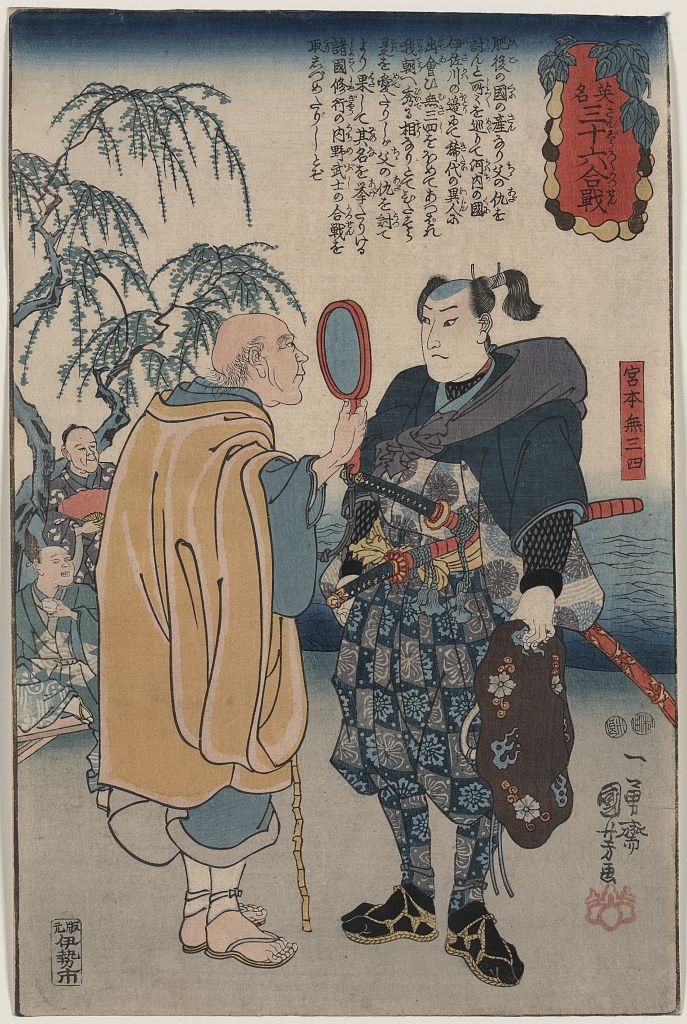
“The Famous Samurai: Miyamoto Musashi” print by Utagawa Kuniyoshi (1798-1861)

This post publishes a comment by LtCol Hiro Katsura, Japanese Ground Self-Defense Force. Colonel Katsura is completing a Ph.D. dissertation that focuses on the internalization of mission command in the U.S. Marine Corps, particularly examining how competence is cultivated among NCOs who are expected to operate with delegated authority.

[Editor’s note: This is a follow-up to my post on the Soviet invasion of Manchuria in August 1945.]


As you mentioned, this campaign is an extremely important case study in strategic history.

The surprise attack at midnight on 9 August caught the Kwantung Army completely off guard. This was the result of several overlapping factors: the inability to anticipate the Soviet redeployment of mechanized forces across more than 9,000 km from Europe in only three months; Japan’s continued hope that the USSR might mediate a conditional peace settlement; and the simultaneous three-front offensive, which created defensive chaos—further compounded by inadequate communications.

At the time, the Kwantung Army still had over 700,000 men on paper, but most of its elite units and equipment had already been siphoned off to the Pacific. What remained was qualitatively weakened: undertrained troops, shortages of ammunition and fuel, and outdated armor—mainly Type 95 light tanks with 37mm guns, plus a handful of Type 98s. These conditions greatly amplified the effect of the Soviet surprise. Even so, the discipline of the Japanese Army is striking—reports say that even after the commander announced Japan’s defeat and the order to disarm, many officers and staff still argued for continued resistance.

Taken together, this explains why Boyd described the Soviets as moving inside Japan’s OODA loop. It was not only a matter of operational tempo, but also a fatal mismatch between Japanese perceptions and reality, which paralyzed decision-making.

I am reminded of a lecture I once attended in Tokyo by David Glantz.* He also described the Manchurian operation as a classic Soviet blitzkrieg. One anecdote he shared was particularly memorable: the name “August Storm” came from an offhand comment by his eight-year-old daughter at the dinner table. Years later, one of his former students—by then a SAMS graduate and a planner for the Gulf War—remembered that story and suggested the name Desert Storm. Glantz laughed that the true origin traced back to a little girl’s imagination—a curious thread in the tapestry of military history.

On a personal note, one of my mentors had been in Manchuria at that time. After the surrender he was captured and spent eight years in Siberian detention. Knowing his story gives this campaign a very human weight for me. And of course, your own father’s presence there makes this history resonate all the more strongly.


*Colonel, US Army, ret., historian who has published extensively on Soviet military history and doctrine, including:

He is probably best known for When Titans Clashed: How the Red Army Stopped Hitler (1995, revised 2015), which he co-wrote with Jonathan M. House.

A few thoughts on “Speed versus Quickness”

Credit: Oxford, Bodleian Library, LP 186

Larry Kummer*
August 25, 2025

Perhaps Chuck is over-conceptualizing the D-Day operations. The whole D-day deception – Operation Fortitude – is the stuff of legend. But there is little evidence that it affected German deployments in a meaningful way. A bigger advantage of the Allies was Hitler’s bizarre command structure for the defense.

As for D-Day, the accounts differ in their key details. Hitler was by then a meth-head, possibly sedated around 3 am by his personal physician, Dr. Theodor Morrell. When the call came at roughly 6 am about activity at Normandy, it is uncertain if he could have been awakened. Perhaps his aids didn’t try. He got the news at roughly noon, along with his generals’ request for permission to move the tanks. Sometime that afternoon Hitler ordered the tanks unleashed.

How long did Fortitude’s deception ops delay Hitler’s response? If the tanks had been released at noon – a few hours earlier, in full daylight, fully exposed to Allies’ air power – how would it have affected the outcome? We can only guess.

I said that perhaps Chuck “over-conceptualized” those events. He described them as a very high-level abstraction – and, like all such, of value to the extent it is useful. Here, I’ll offer another perspective that is simpler and, in my opinion, equally useful. As Boyd said, you have to slice the problem from many different directions.

Another example of conflating OODA loops with a simple action is Operation Mincemeat, intended to confuse the Germans about the invasion of Sicily. Like Fortitude, it was wildly complicated. But with a different twist in the ending, the story of which doesn’t require OODA loops.

Mincemeat had excellent results. A key part was “The Man Who Never Was,” a fake British officer whose corpse washed up on the Spanish coast with secret documents in his pocket. But the two key Germans in Spain who forwarded this hot info to Berlin saw through the trick. Desperate to justify their cushy jobs, however, they reported their actions as a valuable opportunity. If they had been more honest and loyal, this might have alerted the Germans to Sicily as our next target.

History is contingent: The German’s D-Day alert did not reach the Normandy zone; two corrupt Germans did not blow the whistle on Mincemeat. These are factors that move history.

In the present day, discussions of 4GW (and 5GW and 6GW) that center on OODA loops show the decay of the military arts in America: bizarrely abstract and very complex. Suitable for a nation that tied in Korea and lost every significant war in the following 70 years.

Oddly, the winners in those wars did so without such awesome PhD-level theories.

Part of our problem stems from a focus on the wrong aspects of Boyd’s theories, like Paleolithic hunters given a telescope – who then use it as a microscope. I recommend we broaden our approach to Boyd. For example, we should take to heart his description of grand strategy in Patterns of Conflict, slide 139:

  • Increase our solidarity, our internal cohesion.
  • Weaken our opponents’ resolve and internal cohesion.
  • Strengthen our allies’ relationships to us.
  • Attract uncommitted states to our cause. End conflicts on favorable terms, without sowing the seeds for future conflicts.

It’s worth pointing out that this section culminates in his “Theme for Vitality and Growth,” slide 144, whose purpose is nothing less than to “Improve fitness as an organic whole to shape and expand influence or power over the course of events in the world.” The acronym “OODA” doesn’t appear anywhere on that slide.

In fact, my candidate for Boyd’s greatest insight applies at all levels, from building a strong society, to grand strategy, to building a military, to tactics:

“People, Ideas, and Hardware. ‘In that order!’ the late Col John R. Boyd, USAF, would thunder at his audiences.”

Ideas spread best when in their simplest (or core) form. Christianity had its fastest rate of growth of converts before the Gospels were written, telling people little more than ‘Christ died for our sins and rose again.’ Another way to say this: The passages I quote are Boyd 101. Only when those are mastered should his disciples attempt to teach Boyd 201. That time might be many years in the future.


*Larry Kummer is the editor of the Fabius Maximus website, writing about these matters since 2003 (often presciently). [Editor’s note: His description. I am not prone to disagree, although one must contend with the blind hog syndrome.]

Here are some listings of posts on his site:

On OODA Loops (warning, Chuck and I are both featured, more prominently than we deserve):

https://www.google.com/search?q=%22ooda+loop%22+site%3Afabiusmaximus.com

On 4GW:

Speed versus Quickness

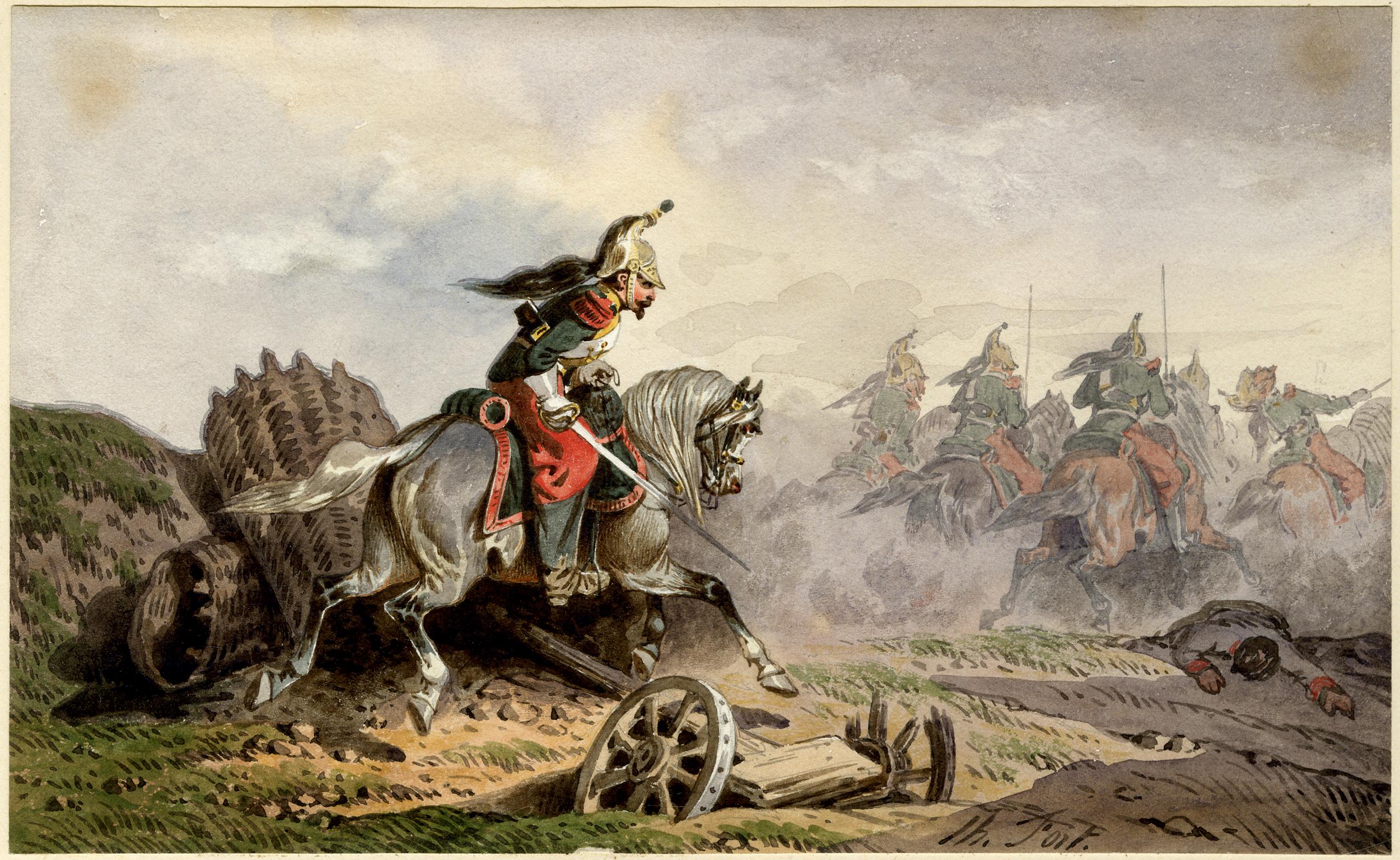
Drawing by French artist Théodore Fort c. 1845. © The Trustees of the British Museum. Shared under a Creative Commons Attribution-NonCommercial-ShareAlike 4.0 International (CC BY-NC-SA 4.0) licence.

Editor’s note: One often hears that Boyd insisted that the side with the faster OODA loop wins. Here’s what one of Boyd’s closest associates, Chuck Spinney, says about that.


Aide Memoire

It seems to me that it is important to appreciate that the difference between speed, quickness, and initiative is crucial. When it came to the OODA loop, Boyd, after considerable thought, came to view “quickness” as the crucial factor related to what many people confuse with raw speed. That is because he is describing the interaction of multiple opposing OODA loops in conflict and cooperation, and a focus on absolute speed can lead one astray. 

Perhaps a simple (and over-simplified) example can help to illustrate the point. You can not generalize from this, because it is very extreme example to illustrate the point (a more general version of working on an adversary’s orientation is given by Boyd in his “Counter Blitz a la Sun Tzu”). [Editor’s note: Slides 146 – 155 of Patterns of Conflict.]

Imagine two adversaries in conflict, call them A and B. A has an insight into B’s Orientation and decides to set up a trick based on a deception. A plans to strike at point 1 but wants to convince B the attack will be at point 2, before the battle or operation is joined. A prepares this trap over a long period of time, e.g., by setting lures and deceptions, to reinforce the pattern in B’s mind. All this takes place over months.

Moreover, A can monitor the degree to which B is buying into the deception and can reinforce the false impression by feeding carefully tailored information (which is based on the monitoring). Finally, assume B does not appreciate the extent to which his Orientation is being shaped and monitored by A. Now assume further that B has a higher speed OODA loop than A in normal circumstances.

A strikes object #1 but B’s orientation is that the real objective is #2, so B moves faster (in the wrong direction) than A can possibly move (remember B has a speedier OODA loop). Result B, is blindsided when it dawns on him that his Orientation was wrong, and coupled with the presence of menace, the sudden eruption of surprise events cause the speedier OODA loop of B to over- and under-react and degenerate into confusion and disorder, which by the presence of lethal menace is magnified into panic, chaos, and maybe even collapse.

So, who really has the quicker OODA loop? A laid out an elaborate deception, methodically over a long period of time, but A could also monitor B’s orientation and therefore reinforce B’s mistaken impression of unfolding events. B acted speedily but in wrong direction and played into A’s hands, and the unfolding, menacing events suddenly loomed out of nowhere to threaten B, causing anxiety, confusion, which if exploited properly could be magnified into chaos, panic and collapse. Boyd would argue that A had a quicker OODA loop than B because A controlled the pace and shape of action. In other words, A had the initiative, even though B’s OODA loops were inherently faster.*

Now perhaps B’s speedier OODA loop could enable B to recover the initiative, if A did not or could not press its Orientation advantage in such a way as to prevent B’s OODA loop from operating effectively at its natural tempo and rhythm.  

Basically, Orientation is by far the most important part of the OODA loop because it not only shapes Decision and Action but it also shapes (or misshapes) Observations — in this artificial example A had a better Orientation (by definition because it could monitor B’s Orientation whereas B could not monitor A’s Orientation). In the example I just described, A had a better appreciation of what it was Observing whereas A’s deception operation, coupled with A’s monitoring capability, caused B’s Orientation to misshape its Observations, and indeed amplify B’s disconnect from reality, assisted by A’s reinforcing action on B’s Orientation. 

Bear in mind, this is an artificial example, but the reader might have recognized that its essential attributes loosely paralleled those surrounding the Allies advantages over the Germans leading up to the D-Day invasion and its immediate aftermath. 

At the strategic level of conflict, the Allies contrived an elaborate deception plan aimed at convincing the Germans they would invade France at Pas the Calais instead of Normandy. They even created a phony army under Patton, who the Germans considered our best operational commander, complete with a phony signals net. 

The Allies also had Bletchley Park’s Ultra Secret and an effective spy network. They had duplicated the German Enigma machine and could read the most secret German codes, while the Germans had no idea their codes were broken. So the Allies could monitor the extent to which which Hitler and OKW were buying into the Allied deception plan and their judicious use of spies could feed in formation that reinforced the pre-conceived beliefs and observations that contributed to the mis-orientation of the Germans. 

The Allies used a variety of ruses thereby creating false Observations — creating a kind of confirmation bias — that reinforced the German’s Orientation that the invasion would take place at Pas de Calais. This all took place over a period of months, and even though the Germans knew an invasion was imminent in June 1944, the allies could verify that the German Orientation was causing them to focus on the wrong place.  

In the event, Hitler and OKW withheld the Panzer reinforcements from counter attacking at Normandy long enough for the Allies to establish a secure beachhead.  Allied control of the air compounded the German Orientation problem by slowing the Action part of the German OODA loop. But the operational level OODA loops of the German ground forces enabled them recover somewhat and eventually extract a large number of troops before we closed the Falaise Gap (even though, the allies captured a large number Germans as well). 

The Allies were able to maintain the initiative at the strategic and operational levels of the conflict, even though their tactical level OODA loops were slower and more methodical that those of the Germans, because they were inside the German loops at the operational and strategic levels of the Normandy operation. 

Conversely, the Allies, who had come to depend on their Orientation advantage, were taken by complete surprise six months after the successful Normandy landing in the Battle of Bulge because the Germans used secure land lines to organize their offensive. 

OODA loops in guerrilla war are also display a similar speed/quickness dichotomy in this regard … guerrillas maintain links to local populations gives them a similar Orientation advantage.  In fact the North Vietnamese had a telling saying with respect to the issue speed versus quickness — the Americans may control the clocks, but we control the time.

By the way, we coined a term for a situation where Orientation drives and misshapes Observations at all levels of conflict — “incestuous amplification” — it is the sine qua non of getting inside your opponent’s OODA loops. Incestuous amplification can also be a self inflicted wound, as is certainly evident in our OODA loops shaping the “kill chain” targeting decisions in drone warfare. 

Please excuse this long example, but the distinction of speed vs quickness and initiative are crucial to understanding Boyd’s ideas in the context he thought about them. 

The appendix in Coram’s book contains his short paper, “Destruction and Creation” — this is epistemological foundation of the OODA loop, although it predates his conception of OODA loop. I have a briefing explaining why this is so, if you are interested, you can download it that this link: Evolutionary Epistemology. [Editor’s note: All of Boyd’s works, including D&C, are available from our Articles page.]

Note also, at bottom, the theory of the OODA loop is about a living, non-linear phenomenon, which makes it biological in the sense that it is goal seeking, exhibits growth and decay, is evolutionary in nature (i.e., it is shaped by an unpredictable interplay of chance and necessity mediated by some kind of selection process), and is governed by a homeostatic control system embodying positive as well as negative control loops — that makes it an open, far-from-equilibrium open system prone to chaos.
 
Chuck Spinney
15 April 2015


*Editor’s note: Boyd would also describe this situation as A was inside B’s OODA Loops. See, for example, Patterns, slide 132.


Last Blitzkrieg of WWII

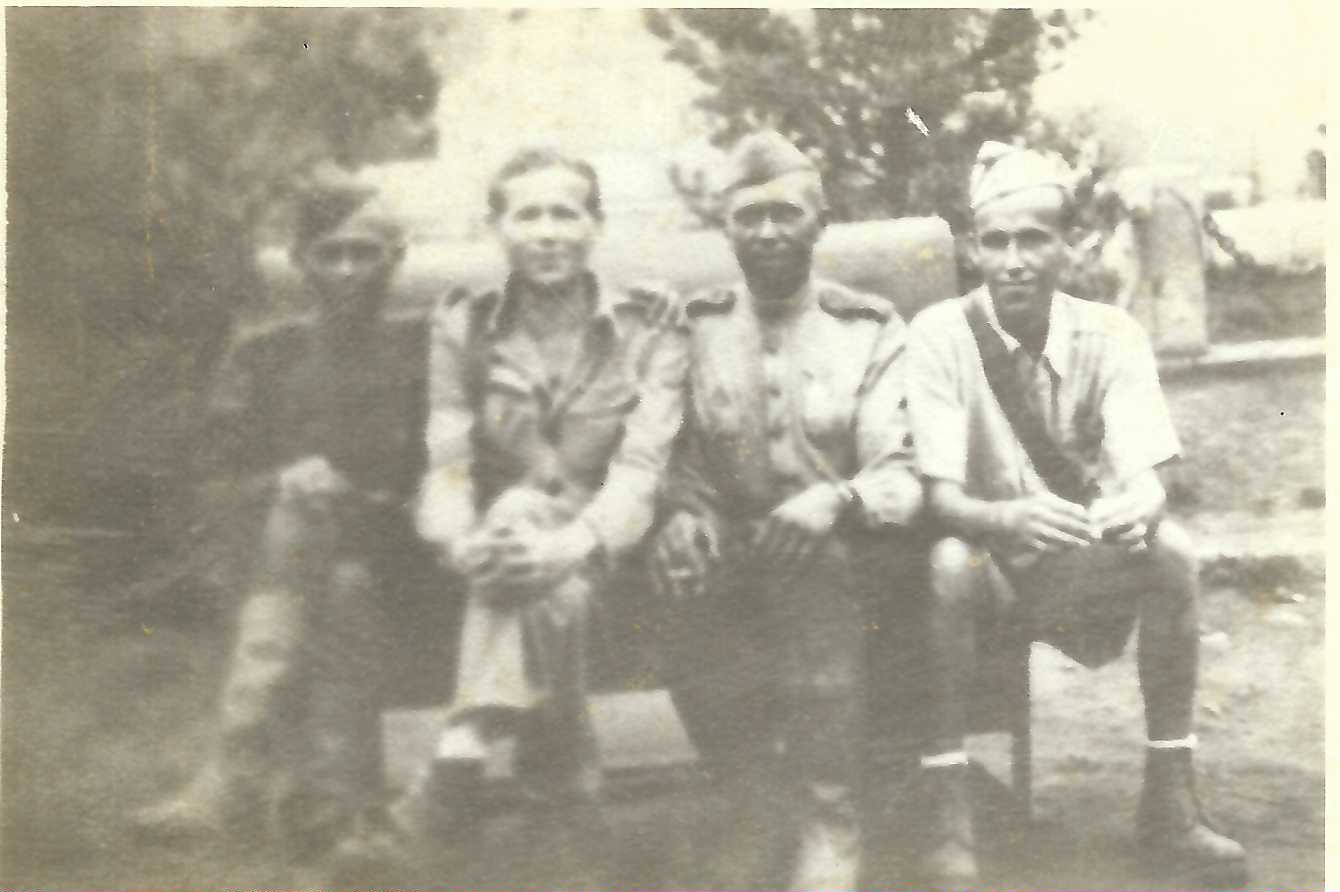
The person on the far right is my late father, then-Captain Grover C. Richards, Jr. He and a fellow POW posed for this photo with two Red Army soldiers who had just liberated Camp Hoten in Mukden, Manchuria, (now Shenyang, Liaoning province) in mid-August 1945.

The Soviets invaded Manchuria on August 9, 1945, exactly 80 years ago as I write this. Boyd considered that operation as one of the two examples of a blitzkrieg that was superbly executed, highly successful, and overlooked outside a small group of students of military history and strategy. The other was the Battle of the Kerch Peninsula (December 1941 – May 1942).*

It was an enormous operation, involving over 2 million troops from both sides. The Red Army alone employed over 5,000 tanks, many of them them modern T-34s, nearly 30,000 artillery tubes and Katyusha rocket launchers — the famous “Stalin’s Organs” — and nearly 4,000 aircraft. Although the action took place in an arena of war the size of western Europe, the battle was over in 11 days.

If you are familiar with Boyd’s terminology, we can describe the Soviet strategy simply as: They operated inside the Japanese OODA loops. Although outmanned, outgunned, and often surrounded, many Japanese units fought tenaciously to the last. But if your opponent is inside your OODA loops, it is ultimately to no avail.**

One of the factors that made this campaign so interesting was that the bulk of the Soviet forces had to move from western Europe, where they had participated in the defeat of Nazi Germany, to far eastern Siberia, a distance of roughly 6,000 miles. This was accomplished in the space of three months. As described by Wikipedia:

They (the Japanese) had estimated that an attack was not likely before the spring of 1946, but the Stavka (Soviet high command) had in fact been planning for a mid-August offensive, successfully concealing the buildup of a force of 90 divisions. Many Soviet units had crossed Siberia in their vehicles to avoid straining the rail link.

The Japanese were caught completely by surprise upon receiving the Soviet declaration of war an hour before midnight on 8 August, now facing a simultaneous invasion on three fronts that began just after midnight on 9 August.

Here is a YouTube video that gives an overview of the campaign (only the first half is on Manchuria). Although the quality is uneven, you should be able to pick out many of the elements of blitzkrieg strategy: Deception and surprise; high tempo of operations; bypassing and isolation of strong points; and advance via multiple thrusts to probe and test the opponent and generate ambiguity:


* On Boyd’s chart of “Blitzkrieg Results,” Patterns 89, under “Successful,” Kerch is “Summer 1942.” The Manchurian operation is also listed.

**As described in glorious detail on slide 132 of Patterns of Conflict.

My father retired from the Army as a LTC on June 30, 1961, became a college professor, and retired the second time as Chair of Psychology of what is now Georgia Southern University in 1981. He died in Jacksonville, FL, on September 29, 1996, and is buried in Arlington. His military awards included the Silver Star for actions on Bataan.

What are the chances of that?

Wellington had considered the relative probability of a French attack at various points; he concluded that the sector from Torres Vedras to the Atlantic was the least likely and could be left mainly in the hands of his static force. Jac Weller, Wellington in the Peninsula, 145.

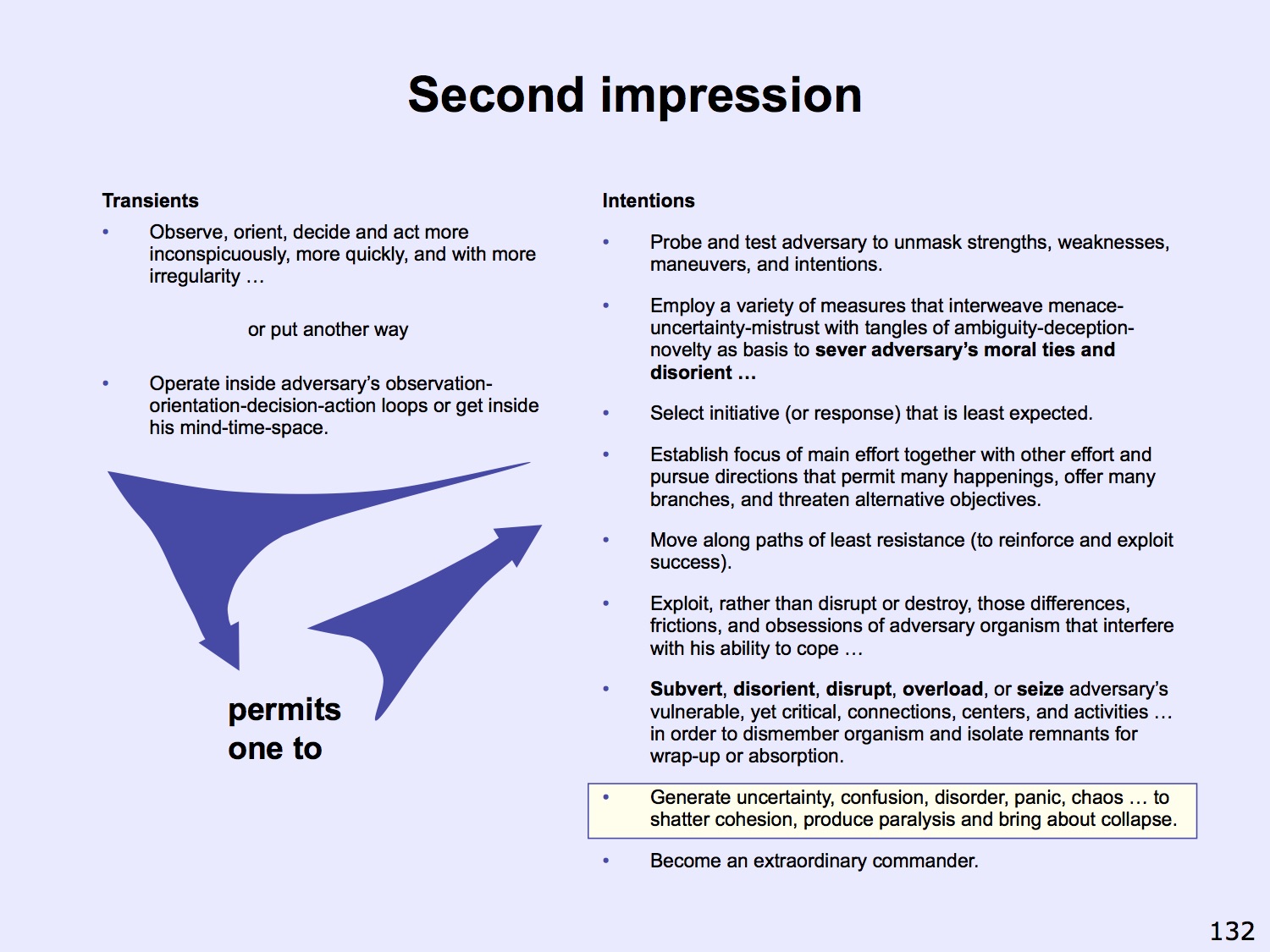
Deep into Patterns of Conflict, John Boyd finally got around to defining (more or less) the phrase “operating inside the OODA loop”:

Second Impression

To me, though, the most intriguing thing about this slide is what’s not on it: No mention of probabilities or likelihoods. In fact, the words “probability” and “likelihood” don’t occur in Patterns of Conflict, and you’ll find “likely” just twice, both times as paragraph headings, (“Likely result”).

Why is this? Why wouldn’t you put most of your preparation into what the opponent is most likely to do? Why would you waste time, men, and machinery preparing against something the opponent is highly unlikely to do?

I was reminded of this question again while reading Laurie R. King’s latest, Knave of Diamonds. Sherlock Holmes is passing time practicing his card handling skills dealing three card monte. In that game, the dealer shows the other player three cards, one of which is special — the Ace of Spades, for example — and the other two can be anything, say a couple of minor hearts.

The dealer shuffles the three cards and places them face down. The player, then, wins by picking out the ace. Win and you get back twice your bet.

What is the probability the player wins?

If you said “one third,” you are wrong. The correct answer is zero, which is why in the trade, the other player is called the “mark.”

And which is why my book is called Certain to Win (quoting Sun Tzu), not, More Likely to Do Better.


Wellington, incidentally, virtually always operated inside his opponents’ OODA loops. This explains why, even when outnumbered, he was able to defeat all of the marshals that Napoleon sent against him, and finally defeat Napoleon himself. In the process, he indeed became an extraordinary commander.

We really don’t know what Wellington was thinking in October 1810 when he was disposing his forces at the Lines of Torres Vedras. What I’ve quoted are Jac Weller’s reconstructions a century and a half later for a non-specialist audience. My guess is that instead of rolling the dice, Wellington was thinking something like: If they want to come that way, more power to them. I can hold them with my less capable units while I shift my better forces to deal with them. Wellington was a master of mobile defense, a tactic he often used against the French.

Confused about the OODA “loop”? Let AI explain

For those of you who still harbor questions, misunderstandings, even doubts about John Boyd’s OODA Loop model, help is finally here.

My colleague, LtCol Johan Ivari of the Swedish Defense University in Stockholm, fed my paper, “Boyd’s OODA Loop,” into Google’s NotebookLM. You can listen to the resulting podcast at https://play.fhs.se/media/Boyd’s%20OODA%20Loop%20by%20Chet%20Richards%20(2020)/0_9wflxxm1

Personally, I find this fascinating if not a little scary. For one thing, it wasn’t clear who was doing the talking, until my brother (who also uses NotebookLM) pointed out that the two interlocutors, one with a male voice and the other female, were generated by the system. OK.

They did a very good job. This podcast could serve as a useful introduction to the OODA Loop concept. However, as Colonel Ivari points out, best to use it as an accompaniment to the actual paper (which you can download from our Articles page, along with all of Boyd’s briefings* and lot of other stuff).

Colonel Ivari has posted an entire panoply of AI-generated podcasts, https://play.fhs.se/playlist/details/0_09pafeoh

They’re all fascinating, but if you’ve never read Chuck Spinney’s Evolutionary Epistemology, his podcast would be a good place to start.

I’m not sure why the female discussant sounds like a Valley Girl (“Totally!”), but somehow, I don’t think Boyd would mind.


*I haven’t updated the covers, yet, so please don’t try to go to dnipogo.org or d-n-i.net. These domain names are no longer maintained by either the Project on Government Oversight or myself and may contain malicious content.

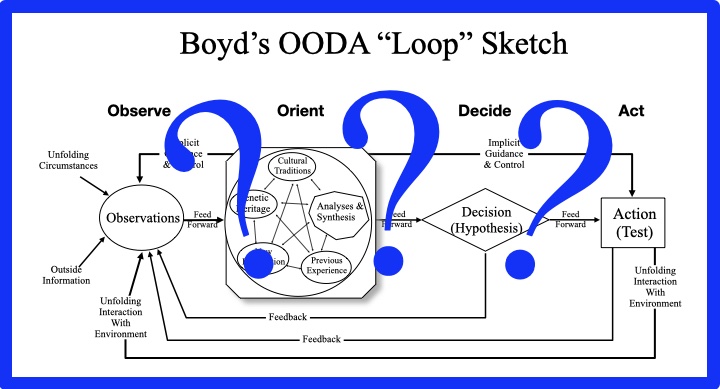
Tom Barnett’s OODA Loop

Dr. Thomas P.M. Barnett, who is probably best known for his 2004 best-seller, The Pentagon’s New Map, gave a presentation last November featuring an OODA Loop. Because it is not the traditional circle, or John Boyd’s own sketch from my last post, I thought you might be interested in it. As an extra added attraction, he uses it to build a snowmobile a la Boyd*.

Question for my audience: Does what Barnett has constructed satisfy the purposes of an OODA loop (or “loop”) in Boyd’s sense? The link goes to my presentation “The Essence of Winning and Losing — Deconstructed,” and the roles Boyd prescribes for OODA loops (any OODA loops) are on slide 9.

Very Important Note: This is not a blog on geopolitics, so I am not going to comment on the specifics of Barnett’s conclusions. I know some of you have strong feelings on these issues, but this is not the place.

On a personal note, I have known Tom for many years and can attest he is quite familiar with Boyd’s work. His second book, Blueprint for Action, mentions me on p. 10. I have great respect for his curiosity and intellect, although we have had, over those years, spirited discussions on some of his recommendations. His latest book is America’s New Map, and he maintains a website and posts daily on substack.


*For those unfamiliar with Boyd’s snowmobile analogy, please download his briefing Strategic Game of ? and ? from our Articles page. He introduces his snowmobile starting on slide 6.