
Editor’s note: One often hears that Boyd insisted that the side with the faster OODA loop wins. Here’s what one of Boyd’s closest associates, Chuck Spinney, says about that.
Aide Memoire
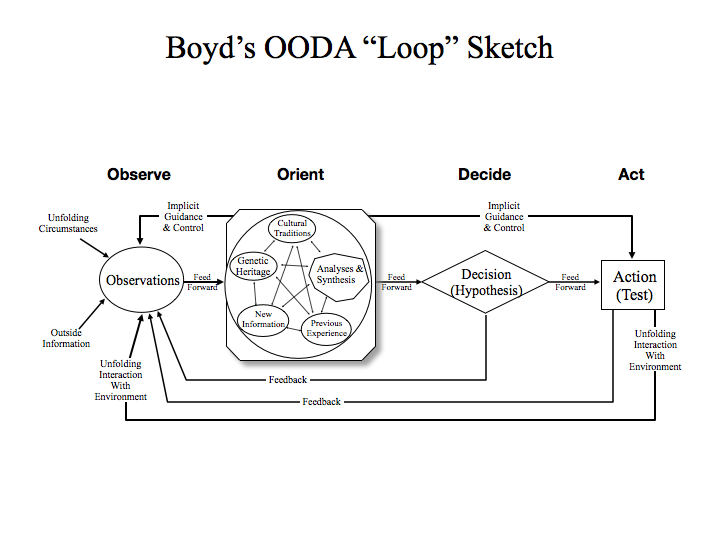
It seems to me that it is important to appreciate that the difference between speed, quickness, and initiative is crucial. When it came to the OODA loop, Boyd, after considerable thought, came to view “quickness” as the crucial factor related to what many people confuse with raw speed. That is because he is describing the interaction of multiple opposing OODA loops in conflict and cooperation, and a focus on absolute speed can lead one astray.
Perhaps a simple (and over-simplified) example can help to illustrate the point. You can not generalize from this, because it is very extreme example to illustrate the point (a more general version of working on an adversary’s orientation is given by Boyd in his “Counter Blitz a la Sun Tzu”). [Editor’s note: Slides 146 – 155 of Patterns of Conflict.]
Imagine two adversaries in conflict, call them A and B. A has an insight into B’s Orientation and decides to set up a trick based on a deception. A plans to strike at point 1 but wants to convince B the attack will be at point 2, before the battle or operation is joined. A prepares this trap over a long period of time, e.g., by setting lures and deceptions, to reinforce the pattern in B’s mind. All this takes place over months.
Moreover, A can monitor the degree to which B is buying into the deception and can reinforce the false impression by feeding carefully tailored information (which is based on the monitoring). Finally, assume B does not appreciate the extent to which his Orientation is being shaped and monitored by A. Now assume further that B has a higher speed OODA loop than A in normal circumstances.
A strikes object #1 but B’s orientation is that the real objective is #2, so B moves faster (in the wrong direction) than A can possibly move (remember B has a speedier OODA loop). Result B, is blindsided when it dawns on him that his Orientation was wrong, and coupled with the presence of menace, the sudden eruption of surprise events cause the speedier OODA loop of B to over- and under-react and degenerate into confusion and disorder, which by the presence of lethal menace is magnified into panic, chaos, and maybe even collapse.
So, who really has the quicker OODA loop? A laid out an elaborate deception, methodically over a long period of time, but A could also monitor B’s orientation and therefore reinforce B’s mistaken impression of unfolding events. B acted speedily but in wrong direction and played into A’s hands, and the unfolding, menacing events suddenly loomed out of nowhere to threaten B, causing anxiety, confusion, which if exploited properly could be magnified into chaos, panic and collapse. Boyd would argue that A had a quicker OODA loop than B because A controlled the pace and shape of action. In other words, A had the initiative, even though B’s OODA loops were inherently faster.*
Now perhaps B’s speedier OODA loop could enable B to recover the initiative, if A did not or could not press its Orientation advantage in such a way as to prevent B’s OODA loop from operating effectively at its natural tempo and rhythm.
Basically, Orientation is by far the most important part of the OODA loop because it not only shapes Decision and Action but it also shapes (or misshapes) Observations — in this artificial example A had a better Orientation (by definition because it could monitor B’s Orientation whereas B could not monitor A’s Orientation). In the example I just described, A had a better appreciation of what it was Observing whereas A’s deception operation, coupled with A’s monitoring capability, caused B’s Orientation to misshape its Observations, and indeed amplify B’s disconnect from reality, assisted by A’s reinforcing action on B’s Orientation.
Bear in mind, this is an artificial example, but the reader might have recognized that its essential attributes loosely paralleled those surrounding the Allies advantages over the Germans leading up to the D-Day invasion and its immediate aftermath.
At the strategic level of conflict, the Allies contrived an elaborate deception plan aimed at convincing the Germans they would invade France at Pas the Calais instead of Normandy. They even created a phony army under Patton, who the Germans considered our best operational commander, complete with a phony signals net.
The Allies also had Bletchley Park’s Ultra Secret and an effective spy network. They had duplicated the German Enigma machine and could read the most secret German codes, while the Germans had no idea their codes were broken. So the Allies could monitor the extent to which which Hitler and OKW were buying into the Allied deception plan and their judicious use of spies could feed in formation that reinforced the pre-conceived beliefs and observations that contributed to the mis-orientation of the Germans.
The Allies used a variety of ruses thereby creating false Observations — creating a kind of confirmation bias — that reinforced the German’s Orientation that the invasion would take place at Pas de Calais. This all took place over a period of months, and even though the Germans knew an invasion was imminent in June 1944, the allies could verify that the German Orientation was causing them to focus on the wrong place.
In the event, Hitler and OKW withheld the Panzer reinforcements from counter attacking at Normandy long enough for the Allies to establish a secure beachhead. Allied control of the air compounded the German Orientation problem by slowing the Action part of the German OODA loop. But the operational level OODA loops of the German ground forces enabled them recover somewhat and eventually extract a large number of troops before we closed the Falaise Gap (even though, the allies captured a large number Germans as well).
The Allies were able to maintain the initiative at the strategic and operational levels of the conflict, even though their tactical level OODA loops were slower and more methodical that those of the Germans, because they were inside the German loops at the operational and strategic levels of the Normandy operation.
Conversely, the Allies, who had come to depend on their Orientation advantage, were taken by complete surprise six months after the successful Normandy landing in the Battle of Bulge because the Germans used secure land lines to organize their offensive.
OODA loops in guerrilla war are also display a similar speed/quickness dichotomy in this regard … guerrillas maintain links to local populations gives them a similar Orientation advantage. In fact the North Vietnamese had a telling saying with respect to the issue speed versus quickness — the Americans may control the clocks, but we control the time.
By the way, we coined a term for a situation where Orientation drives and misshapes Observations at all levels of conflict — “incestuous amplification” — it is the sine qua non of getting inside your opponent’s OODA loops. Incestuous amplification can also be a self inflicted wound, as is certainly evident in our OODA loops shaping the “kill chain” targeting decisions in drone warfare.
Please excuse this long example, but the distinction of speed vs quickness and initiative are crucial to understanding Boyd’s ideas in the context he thought about them.
The appendix in Coram’s book contains his short paper, “Destruction and Creation” — this is epistemological foundation of the OODA loop, although it predates his conception of OODA loop. I have a briefing explaining why this is so, if you are interested, you can download it that this link: Evolutionary Epistemology. [Editor’s note: All of Boyd’s works, including D&C, are available from our Articles page.]
Note also, at bottom, the theory of the OODA loop is about a living, non-linear phenomenon, which makes it biological in the sense that it is goal seeking, exhibits growth and decay, is evolutionary in nature (i.e., it is shaped by an unpredictable interplay of chance and necessity mediated by some kind of selection process), and is governed by a homeostatic control system embodying positive as well as negative control loops — that makes it an open, far-from-equilibrium open system prone to chaos.
Chuck Spinney
15 April 2015
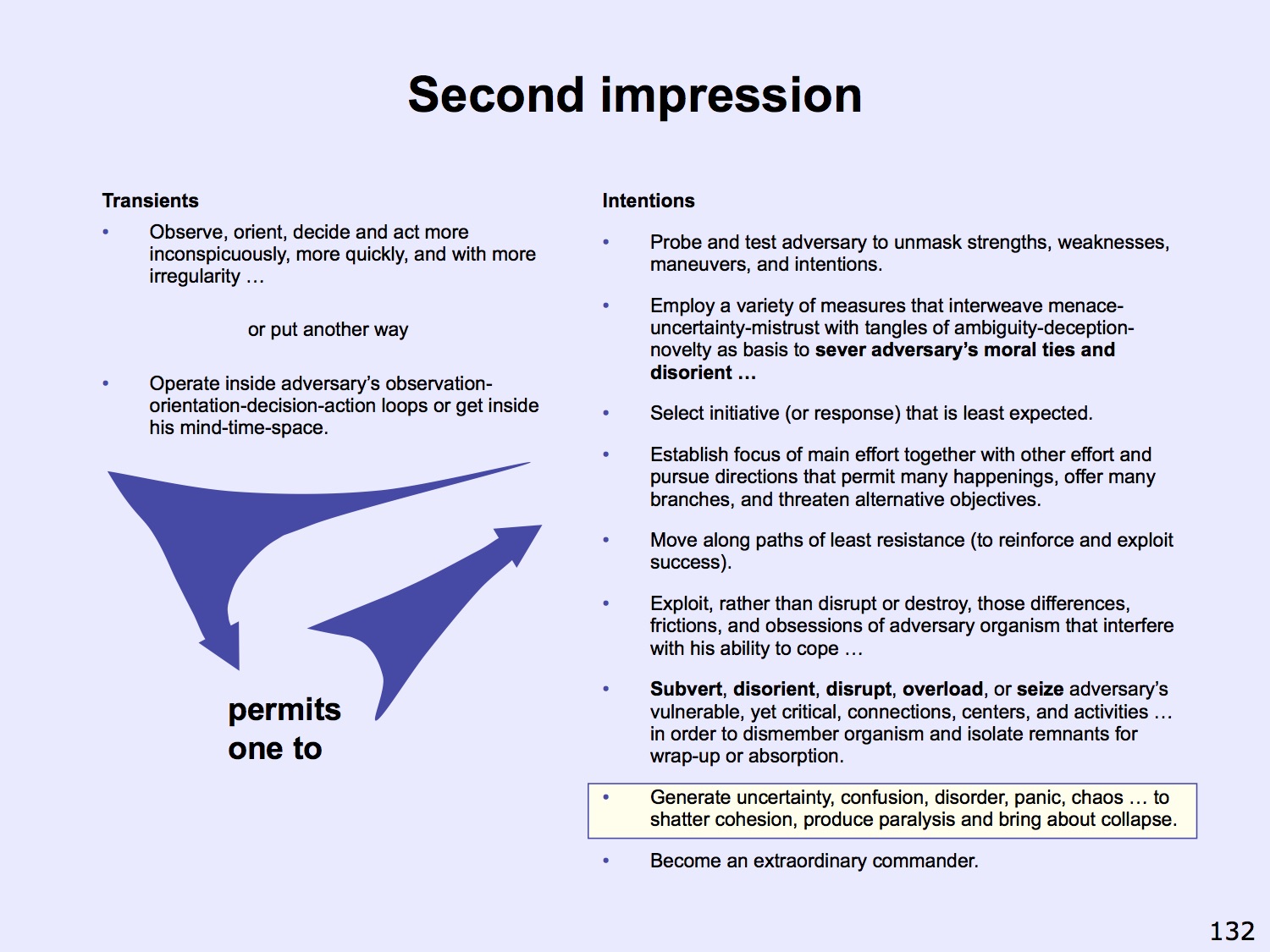
*Editor’s note: Boyd would also describe this situation as A was inside B’s OODA Loops. See, for example, Patterns, slide 132.



 Slightly East of New
You must be logged in to post a comment.