
Mission Command: The Who, What, Where, When and Why, An Anthology
by Donald Vandergriff (Author, Editor), Stephen Webber (Editor
August 2017
I like good anthologies, and this is a very good one. Good anthologies can do several things, among them:
- Provide discrete bins of thought that you can mine for nuggets — parts for your snowmobiles.
- Let you look at a concept, in this case, “mission command,” from alternative viewpoints. Sometimes this can lead to an “Aha!” moment.
- Expand your orientation — are you really doing all you could to engage the hippocampus? Be honest, now.
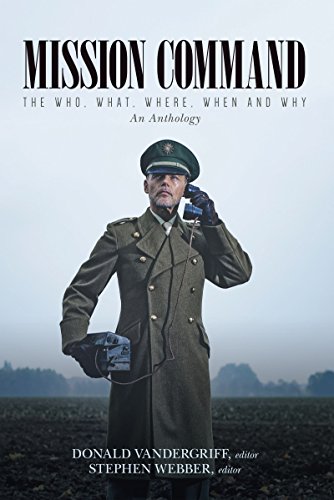 Don and Steve have done a great job of collecting essays that take you far beyond “What is Mission Command?” In fact, when you get through, you may find that you know less about the concept than you thought. For example, people sometimes equate mission command with the German term Auftragstaktik. But Auftrag doesn’t mean “mission.” It’s more like the English “contract.” When Boyd’s talking about “the German concept of ‘mission,'” he notes on Patterns of Conflict, slide 76:
The German concept of mission can be thought of as a contract, hence an agreement, between superior and subordinate. The subordinate agrees to make his actions serve his superior’s intent in terms of what is to be accomplished, while the superior agrees to give his subordinate wide freedom to exercise his imagination and initiative in terms of how intent is to be realized.
As part of this concept, the subordinate is given the right to challenge or question the feasibility of mission if he feels his superior’s ideas on what can be achieved are not in accord with the existing situation or if he feels his superior has not given him adequate resources to carry it out. Likewise, the superior has every right to expect his subordinate to carry out the mission contract when agreement is reached on what can be achieved consistent with the existing situation and resources provided.
So there’s obviously a lot more to the concept than simply “Tell people what to do and let them decide how.” Don’s and Steve’s anthology will help you broaden your understanding and, perhaps, improve your use of the underlying philosophy in your own organization.
All the chapters are good, but I’d like to draw your attention to a couple that you might find especially broadening.
Quo vadis, mission command?
First, Grant Martin’s chapter on “Type II” mission command for situations where “the commander’s intent is ambiguous or weakly connected to the political purpose of the operation. … What should be added is how to conduct mission command when the purpose of the operation is unclear, where the scope is unbounded, and where cause and effect are not linear.” Most business applications, in other words. He proposes a new definition
In non-linear causality situations, however, leaders must both assist and be assisted by their subordinates to best appreciate the context of the situation and during execution must learn and constantly adjust the appreciation of the context based on that learning. Of note: The learning must go both ways.
Boyd, didn’t like the term “command & control,” suggesting instead “leadership & appreciation.” Where does this leave mission “command”? If Martin’s idea intrigues you, you might explore other possibilities for expanding the concept. Boyd used the term “organic,” which has some of the bottom-up flavor suggested by Martin (there’s an example in chapter 5 of Certain to Win). Another idea is not to issue orders, even mission orders, at all, a possibility explored by David Marquet in Turn the Ship Around!**
The requisite physical energy***
Daniel Markert and Scott Sonnon introduce subjects that you don’t often find in leadership texts in their chapter, “Operationally fit for mission command.” For those of you not up on your neurophysiology, this one may be a little challenging. Just accept that the hippocampus, amygdala, hypothalamus, and their kin are regions within the brain (or you could Google them and find out where). Markert and Sonnon address a major but often overlooked issue in leadership, that leaders inhabit human bodies:
The rapid onset of the fatigue reflex elevates stress arousal and degrades cognitive function with negative effects on shared understanding, risk awareness, creativity, and decisiveness.
They explain why this is true and what you can do about it. Recall that Boyd suggested that “Without a common outlook, superiors cannot give subordinates freedom of action and maintain coherency of ongoing action” (Patterns 74), so this is important stuff, and Markert’s and Sonnon’s chapter may start you down a productive path.
Explore, enjoy, learn, question.
Preview / buy Mission Command at Amazon
*This idea is implicit in Boyd’s EBFAS climate. Stephen Bungay develops it in detail in The Art of Action, where he, essentially, equates Auftragstaktik with Boyd’s entire EBFAS climate. Mini review in an earlier post.
**Also covered in my presentation, All by Ourselves, available on the Articles page and in the mini review mentioned above.
***Observation by Gen Hermann Balck, Patterns, p. 118.
 When I first read the title “Fit for Purpose,” it seemed a little passive. Something like “meets specs,” which is necessary but suggests that somebody else is driving the market. I don’t know Alexei personally, but David is the founder and chairman of

 In my last post, I suggested a few things to read once you’ve become satiated with Boyd himself (don’t worry, it happens). A reader kindly recommended Steven Pressfield’s study of the Six Day War, told from the viewpoints of Israeli participants ranging from 19-year-old troopers to Minister of Defense Moshe Dayan. I highly recommend it as a source book for illustrating the major points of Boyd’s work.
 So Sunday morning I take iPhone in hand and say, “Hey Siri, what time does Kay Hills open?” She comes right back with “Cahill’s Market on May River Road opens at 9 am,” provides a map, and offers to give directions.
  Slightly East of New
You must be logged in to post a comment.