Is now live on amazon.com:
https://www.amazon.com/review/R3TCZXXUYUIAUA/ref=pe_1098610_137716200_cm_rv_eml_rv0_rv
Hint: ✰ ✰ ✰ ✰ ✰
Is now live on amazon.com:
https://www.amazon.com/review/R3TCZXXUYUIAUA/ref=pe_1098610_137716200_cm_rv_eml_rv0_rv
Hint: ✰ ✰ ✰ ✰ ✰
More stuff to read after you’ve OD’d on Boyd’s Discourse.
Please add your suggestions in the Comments.
If you’d like more on how the IDF operates, here are two by Martin van Creveld:

The important thing is not to take any of these as gospel (same applies to Boyd’s briefings, too) but as sources of ideas. For example a previous post mentioned four elements of the IDF culture:
On page 196 of Command, van Creveld cites:
Are these different translations of the same concepts? Complementary? Contradictory? Would any apply to you? How would you build them in your organization? How could you demonstrate that your program is working, i.e., that you’re having a positive effect on organizational performance?
Those of you who have taken on “Destruction and Creation” (available, along with all of Boyd’s works, from the Articles tab) have probably puzzled over how, and why, Boyd dragged in three concepts not ordinarily associated with strategy:
Most people just shrug them off as analogies: We see something in domain B, strategy for example, that seems like something in domain A, say, particle physics. I worked with Boyd on “Destruction and Creation,” and I’m reasonably sure that this is not how he’s using these concepts.
I’ve added a short paper to the Articles page that gives my explanation. While you’re there, you might also check out Chuck Spinney’s take on “Destruction and Creation,” Evolutionary Epistemology, particularly charts 33-35, where he discusses Boyd’s use of the three concepts.
The Lion’s Gate: On the Front Lines of the Six Day War
Steven Pressfield
New York: Penguin 2014
398 pages
In my last post, I suggested a few things to read once you’ve become satiated with Boyd himself (don’t worry, it happens). A reader kindly recommended Steven Pressfield’s study of the Six Day War, told from the viewpoints of Israeli participants ranging from 19-year-old troopers to Minister of Defense Moshe Dayan. I highly recommend it as a source book for illustrating the major points of Boyd’s work.
I will admit to being a huge fan of Pressfield, beginning with The Gates of Fire. I suspect that regardless of your position on the various players in the Levant, past or present, you’ll find The Lion’s Gate to be a page-turner.
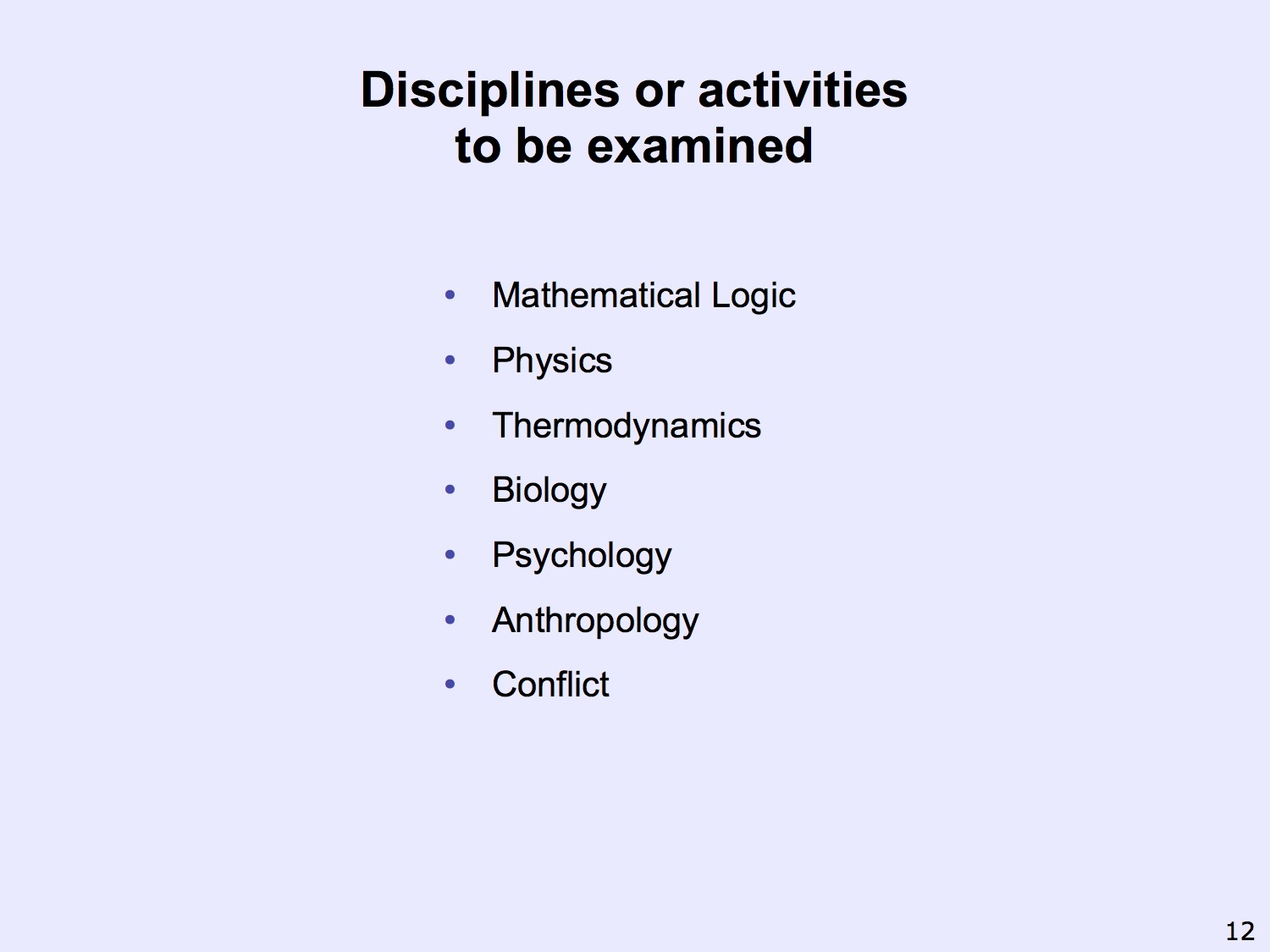
I get asked from time to time what to read after finishing Boyd’s Discourse (All of Boyd’s briefings are available from the Articles tab at the top of this page). If you look at the Sources section of Patterns of Conflict, or the “Disciplines or activities to be examined” page from Strategic Game:

the answer would appear to be “most anything.”
Let me toss out a few suggestions from the last few years; please add your favorites in the comments. Continue reading
Some of you have taken me to task for my comments about Siri. Note that I wasn’t criticizing Siri’s current performance. Instead, I was pointing out how hard it can be to regain the magic once you’ve disappointed your customer. Product developers often get focused on the chi, the “Pursuit of Wow!” as Tom Peters once called it, but if the thing doesn’t work, i.e., no cheng, you don’t need to worry yourself about the chi. If the bathroom’s not clean, who cares what brand of chocolate is on the pillow?
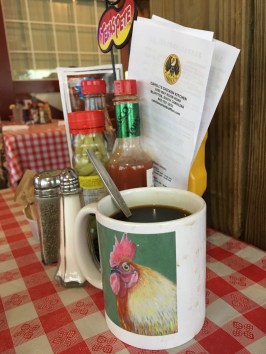
So Sunday morning I take iPhone in hand and say, “Hey Siri, what time does Kay Hills open?” She comes right back with “Cahill’s Market on May River Road opens at 9 am,” provides a map, and offers to give directions. Cahills is a favorite breakfast / lunch, and sometimes dinner spot here in the Hilton Head area. If you go, be sure and ask for coffee in the rooster or pig cups, designed by my wife, Ginger.
Did I mention that these things are starting to get scary? Not the cups, they’re pretty cool.
No, I’m not going to discuss the president’s plans for Afghanistan, but the Amazon Echo and more specifically its AI system, Alexa.
I’ve used Apple’s Siri for years but usually found it more trouble than it’s worth. The problem is that if you’re talking with a fellow native speaker, there’s a virtual infinity of questions you could ask. If you’re talking to an AI system, there’s only a small subset that it will understand (“Pardon?”) What’s that subset? I got tired of guessing. It’s good at finding local restaurants when we’re traveling.
Once Siri lowered the bar, it made it easier for Amazon to meet expectations (cheng) and then to exceed them (chi.) The net effect, as I explained in Certain to Win, is that you become hooked. With Alexa, for example, Amazon has gone to great lengths to ease you into the process. Inside the shipping box there’s a short list of things you can try. These are pretty much what you expect, and I’m sure all the other AI systems can do these, too (although, as I noted, Siri’s initial performance was so disappointing that I never thought to try). Then the web site has a few more, and the support pages even more, and pretty soon you’re trying them out, and Wow! All of the requests I made worked, even while the system was playing music and I was on the other side of the room. Simple example: It will play anything on Amazon Prime (and on Unlimited if you subscribe to that). It will even tell you the artist. Just by asking. Which is chi at least to me.
This time in the wild battlefields of strawberry development:
Bjorn, the company’s president, says, “Consumers have to be more satisfied, or what we call more delighted, all the time.” Produce companies tend to be driven by supply: what they grow, they try to sell. Driscoll’s, conversely, sees itself as a consumer-products company. According to Bjorn, “We create the demand …”
The company is Driscoll’s “a fourth-generation family business, says that it controls roughly a third of the six-billion-dollar U.S. berry market, including sixty per cent of organic strawberries, forty-six per cent of blackberries, fourteen per cent of blueberries, and just about every raspberry you don’t pick yourself.”
Produce is war, and it is won by having something beautiful-looking to sell at Costco when the competition has only cat-faced uglies.
In other words, they meet customer expectations for flavor and appearance (that would be cheng) but then figure out how to add something special and unexpected — something that delights (the chi). This could be a new variety as a result of their high powered R&D effort, or perhaps a tinkering of a currently seasonal variety to make it available year round, in 49 countries. The result, as the man said, and as it usually is: “We create the demand.” The Steve Jobs of Strawberries?
Boyd, paraphrasing Sun Tzu, put it this way on Patterns chart 13: “Employ cheng and ch’i maneuvers to quickly and unexpectedly hurl strength against weaknesses.” Driscoll’s use of this concept, inadvertent as it might, perhaps, be isn’t an analogy. It’s the exact same concept applied to a different sphere of competition.
Read the complete article, “How Driscoll’s Reinvented the Strawberry” by Dana Goodyear in August 21, 2017 edition of The New Yorker.
“Lean,” which is based on the same fundamental principles that underly maneuver warfare, has long been applied to production. In fact, much, if not most, of what we now call “lean” came from study of the Toyota Production System. Beginning with a stream of papers from the International Motor Vehicle Project at MIT in the late 1980s, the academic community has documented that the system works to the extent that if you have a competitor who adopts it, and you don’t, you’ve signed your own corporate death
warrant.
Less well known is that the same basic underlying principles also apply to R&D. As far as I know, the first paper to document this was “The Second Toyota Paradox: How delaying decisions can make better cars faster,” by Allen Ward, Jeffrey K. Liker, John J. Cristiano and Durward K. Sobek II, and published by the Sloan Management Review in April 1995 (register on their site and you can read it). Note that the sub-title gives lie to the notion that simply doing what you’re doing now, but doing it faster, is the key to success. A most important paper!!
As it turns out, there is a major conference abrewing out in San Jose on this subject in September. Led by Terry Barnhart, who has done brilliant work in applying Boyd’s concepts to R&D, it looks to be one of the major events in Lean for product development this year.
Here, courtesy of the conference organizers, are particulars:
September 18-21
San Jose Marriott and San Jose Convention Center
San Jose, California
For more information and to register, please visit their web site.
In Hell? In Chile? (which, I understand, is actually rather nice):
I was watching this parade, when all of a sudden, they break into a goose step and begin playing the Badenweiler March. Note the uniforms, with Fritz helmets, and the UN designation on the vehicles. WTF? Time warp? I’ve read the comments, but can anybody can shed more light on this?
There’s some controversy over whether the Badenweiler March was actually Hitler’s favorite, but as the Wikipedia article notes, there was an order in Nazi Germany that it be played only when Hitler was present.
You must be logged in to post a comment.