Dispatches from the front

In this case, automotive engineering.

Dean Lenane gave a major presentation at the recent European Manufacturing Strategies Summit in Berlin and has kindly agreed to post it on our Articles page (link above).  Look for “Organizing for Success with lessons from The master – John Boyd, OR, People, ideas, technology…IN THAT ORDER.”

In addition to being a keen student of Boyd’s ideas, Dean has had the wherewithal to put them into practice. As CEO of CRH North America, he grew the company from $20 M annual revenue to more than $350 M in a span of seven years. He documented some of this experience in The Turnaround, also on the Articles page. Now, as Managing Director, Europe, for Fisher Dynamics, he is continuing to experiment. I think you’ll find  his presentation innovative, exciting (if you’re into this sort of thing), and useful.

One thing I might point out is Dean’s concept of “providing coherent strategy” beginning on slide 69. You may recall that the objectives Boyd set on p. 2 of Patterns of Conflict were:

Mission

Focus and direction

• To make manifest the nature of moral-mental-physical conflict
• To discern a pattern for successful operations
• To help generalize tactics and strategy
• To find a basis for grand strategy

[“Focus and direction” was Boyd’s translation of Schwerpunkt.]

In order to  do this, he needed to harmonize grand strategy, strategy, and tactics so that success at one level wasn’t undone by failure at another — the “win the battles but lose the war” phenomenon.  It took him a while to get there, but Boyd finally gave an answer on slide 141.

Dean’s concept of “coherent strategy” serves the same function for manufacturing, and I would suggest for all commercial enterprises. To give one example, he insists:

This requires that a solid understanding of how things work at a tactical level be possessed by those making the strategic decisions.

By implication, a large staff structure of persons without actual front line experience and management by a mandarin class of professional managers without actual detailed knowledge of the specific business and products is anathema to a fast maneuver approach as these will slow down the decision loop. Slide 76.

Compare to Boyd’s slide 176:

– In accepting this idea we must admit that increased unit complexity (with magnified mental and physical task loadings) does not enhance the spontaneous synthetic/creative operation. Rather, it constrains the opportunity for these timely actions/counteractions.

Or put another way

– Complexity (technical, organizational, operational, etc.) causes commanders and subordinates alike to be captured by their own internal dynamics or interactions—hence they cannot adapt to rapidly changing external (or even internal) circumstances.

I think you’ll find what Dean has developed over the last 15 or so years to be an important addition to the expansion of Boyd’s ideas beyond their original domain of war and another instance of the Conceptual Spiral in action.

Good luck.

Fit for success

Fit for Purpose: How modern businesses find, satisfy, and keep customers
David J Anderson and Alexei Zheglov
To be released by Amazon on November 29, 2017

Fit for PurposeWhen I first read the title “Fit for Purpose,” it seemed a little passive. Something like “meets specs,” which is necessary but suggests that somebody else is driving the market. I don’t know Alexei personally, but David is the founder and chairman of Lean Kanban, Inc., which provides training and consulting in “Lean Kanban” and related management tools based on a philosophy similar to Boyd’s. I’ve spoken at several of their events and keynoted Lean Kanban Central Europe 2015. (The charts and a related paper are available from the Articles page, link above).

But when I got deeper into Anderson & Zheglov’s book, it became clear that although their methods would certainly help developers meet specs, “purpose” could be something much more active and powerful.

Developers, whether of software, cars, or airplanes, occasionally forget that the real purpose of their efforts is to produce something that will delight their customers so much that they come back for more, and tell their friends, family, and colleagues. So David and Alexei subtitled their book not “Better ways to develop widgets,” or some such, but “How modern businesses find, satisfy, and keep customers.” As they insist, the only “purpose” that counts is the customer’s:

Before you can evaluate whether your products or services are fit-for-purpose, you need to be able to identify your customer’s purpose.

Continue reading →

New edition of “Boyd’s Big Ideas”

Now playing on our Articles page.

This one is based on a version that I presented last year to the Weapons & Field Training cadre at the Marine Recruit Depot, Parris Island.

Cover of Big Ideas 11-2017

Don’t let the title fool you.

Between 1976 and 1996, Boyd produced nearly 350 slides comprising six briefings. Most of these went through many, many revisions. And then there’s the roughly 3,900 word paper, “Destruction and Creation.” All of these, incidentally, are available on the Articles page.

What I’ve tried to do here is sort some of this into a few categories that reflect distinctions that Boyd actually used. The idea is to make Boyd’s body of work accessible to people who didn’t have the opportunity to hear Boyd himself deliver it.  The fact is that Boyd never intended for his briefings to stand alone and for years he wouldn’t give out copies to people who hadn’t heard them.

The danger is that people will glom onto the categories I’ve selected, and this will limit their own thinking and use of Boyd’s Discourse. Try to avoid this, and, as I almost entitled this presentation, be your own guru.

Good luck!

More After Boyd

More stuff to read after you’ve OD’d on Boyd’s Discourse.

  • One reader suggested Nicholas Taleb, particularly Fooled by Randomness, The Black Swan, and Antifragile
  • Another recommended Reality is not what it seems, by Carlo Rovelli and The Soul’s Code: In Search of Character and Calling, by James Hillman

Please add your suggestions in the Comments.

If you’d like more on how the IDF operates, here are two by Martin van Creveld:

Command in War

  • Command in War (also one of Boyd’s favorites; the quote on Organic Design chart 29 starts on p. 199).
  • The Olive and the Sword, a Critical History of the Israeli Defense Force

The important thing is not to take any of these as gospel (same applies to Boyd’s briefings, too) but as sources of ideas. For example a previous post mentioned four elements of the IDF culture:

  • Complete the mission
  • Perform every action to perfection
  • Follow through at any cost
  • Be “ruthlessly candid” in debriefings

On page 196 of Command, van Creveld cites:

  • Individual daring
  • Maintenance of aim
  • Improvisation
  • Resourcefulness

Are these different translations of the same concepts? Complementary? Contradictory? Would any apply to you? How would you build them in your organization? How could you demonstrate that your program is working, i.e., that you’re having a positive effect on organizational performance?

How Boyd used Gödel, Heisenberg, and the Second Law

Those of you who have taken on “Destruction and Creation” (available, along with all of Boyd’s works, from the Articles tab) have probably puzzled over how, and why, Boyd dragged in three concepts not ordinarily associated with strategy:

  • Gödel’s Theorem
  • The Heisenberg Uncertainty Principle
  • The Second Law of Thermodynamics

Most people just shrug them off as analogies: We see something in domain B, strategy for example, that seems like something in domain A, say, particle physics.  I worked with Boyd on “Destruction and Creation,” and I’m reasonably sure that this is not how he’s using these concepts.

I’ve added a short paper to the Articles page that gives my explanation.  While you’re there, you might also check out Chuck Spinney’s take on “Destruction and Creation,” Evolutionary Epistemology, particularly charts 33-35, where he discusses Boyd’s use of the three concepts.

A side of tachboulah, please

The Lion’s Gate: On the Front Lines of the Six Day War
Steven Pressfield
New York: Penguin 2014
398 pages

CoverLionsGateIn my last post, I suggested a few things to read once you’ve become satiated with Boyd himself (don’t worry, it happens). A reader kindly recommended Steven Pressfield’s study of the Six Day War, told from the viewpoints of Israeli participants ranging from 19-year-old troopers to Minister of Defense Moshe Dayan. I highly recommend it as a source book for illustrating the major points of Boyd’s work.

I will admit to being a huge fan of Pressfield, beginning with The Gates of Fire. I suspect that regardless of your position on the various players in the Levant, past or present, you’ll find The Lion’s Gate to be a page-turner.

Continue reading →

After Boyd

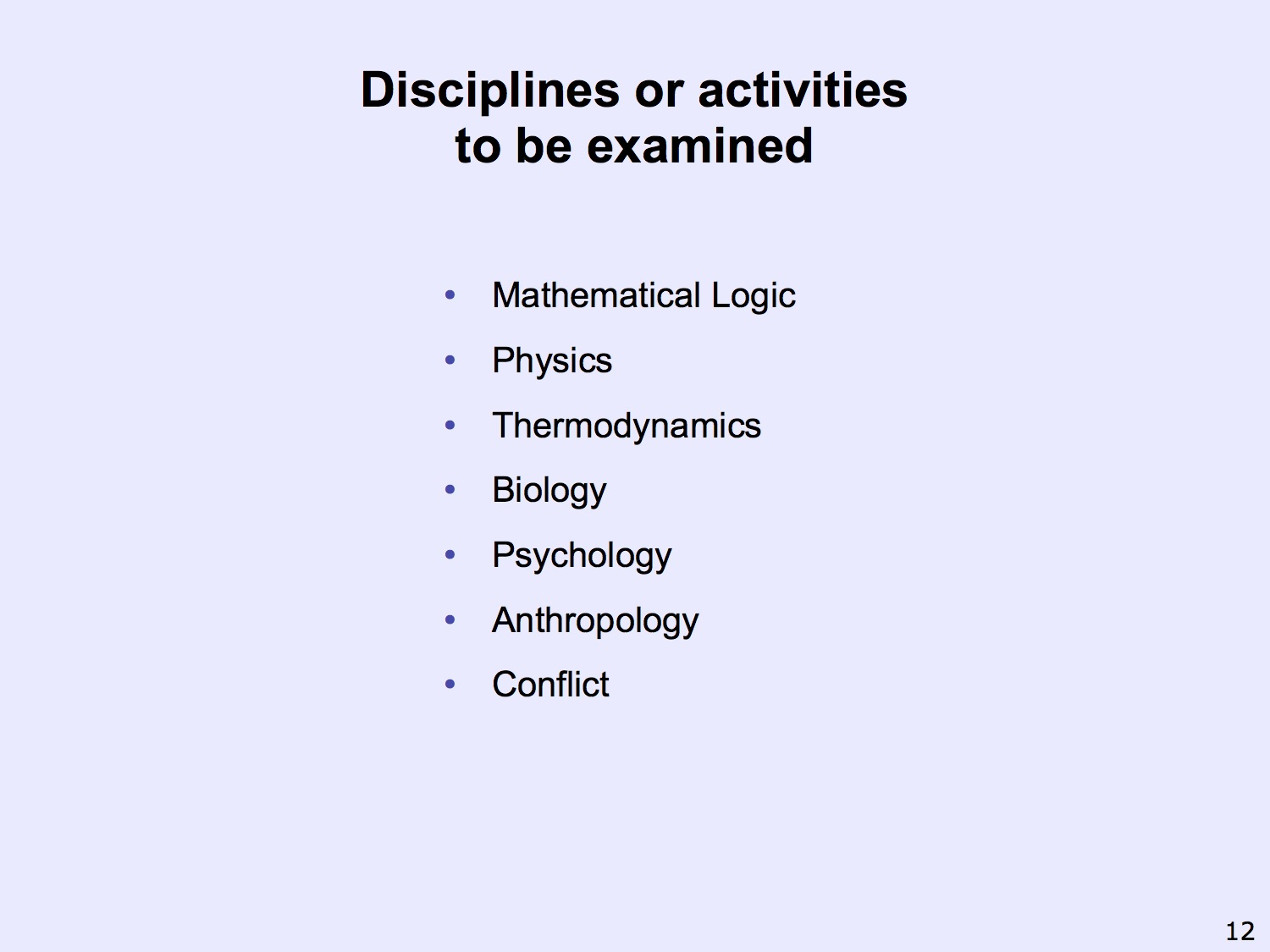
I get asked from time to time what to read after finishing Boyd’s Discourse (All of Boyd’s briefings are available from the Articles tab at the top of this page).  If you look at the Sources section of Patterns of Conflict, or the “Disciplines or activities to be examined” page from Strategic Game:

Strategic_Game12

the answer would appear to be “most anything.”

Let me toss out a few suggestions from the last few years; please add your favorites in the comments. Continue reading →

AI update: Siri

Some of you have taken me to task for my comments about Siri.  Note that I wasn’t criticizing Siri’s current performance. Instead, I was pointing out how hard it can be to regain the magic once you’ve disappointed your customer. Product developers often get focused on the chi, the “Pursuit of Wow!” as Tom Peters once called it, but if the thing doesn’t work, i.e., no cheng, you don’t need to worry yourself about the chi. If the bathroom’s not clean, who cares what brand of chocolate is on the pillow?

IMG_2888So Sunday morning I take iPhone in hand and say, “Hey Siri, what time does Kay Hills open?”  She comes right back with “Cahill’s Market on May River Road opens at 9 am,” provides a map, and offers to give directions. Cahills is a favorite breakfast / lunch, and sometimes dinner spot here in the Hilton Head area.  If you go, be sure and ask for coffee in the rooster or pig cups, designed by my wife, Ginger.

Did I mention that these things are starting to get scary? Not the cups, they’re pretty cool.


These things are scary

No, I’m not going to discuss the president’s plans for Afghanistan, but the Amazon Echo and more specifically its AI system, Alexa.

I’ve used Apple’s Siri for years but usually found it more trouble than it’s worth. The problem is that if you’re talking with a fellow native speaker, there’s a virtual infinity of questions you could ask. If you’re talking to an AI system, there’s only a small subset that it will understand (“Pardon?”)  What’s that subset? I got tired of guessing. It’s good at finding local restaurants when we’re traveling.

Once Siri lowered the bar, it made it easier for Amazon to meet expectations (cheng) and then to exceed them (chi.) The net effect, as I explained in Certain to Win, is that you become hooked. With Alexa, for example, Amazon has gone to great lengths to ease you into the process. Inside the shipping box there’s a short list of things you can try.  These are pretty much what you expect, and I’m sure all the other AI systems can do these, too (although, as I noted, Siri’s initial performance was so disappointing that I never thought to try). Then the web site has a few more, and the support pages even more, and pretty soon you’re trying them out, and Wow! All of the requests I made worked, even while the system was playing music and I was on the other side of the room. Simple example: It will play anything on Amazon Prime (and on Unlimited if you subscribe to that). It will even tell you the artist. Just by asking. Which is chi at least to me.

Continue reading →